



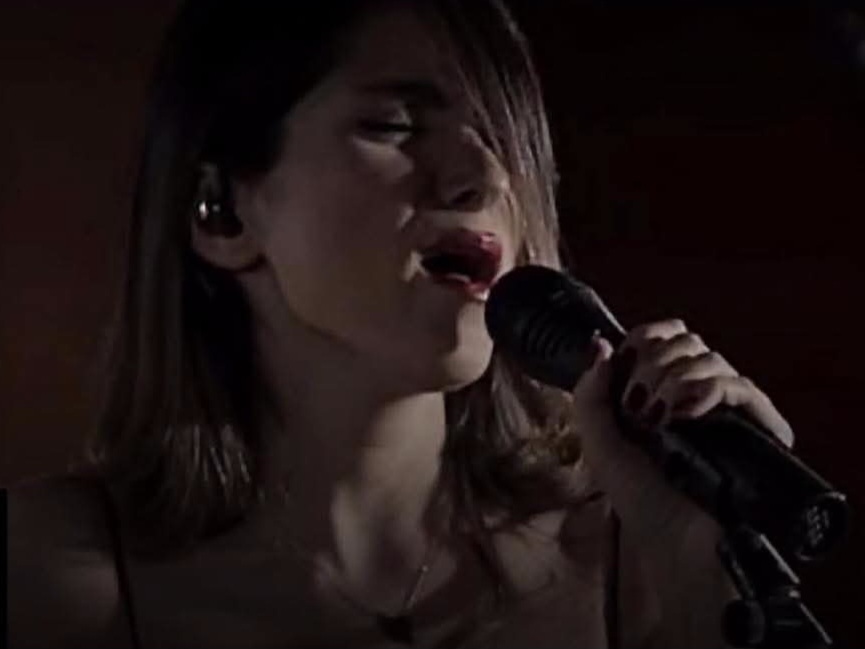
TEHRAN — An Iranian criminal court in Qom province has sentenced 29-year-old singer and composer Parastoo Ahmadi to 74 lashes, a two-year travel ban, and a two-year prohibition on all artistic activities. The severe penalties follow a viral online performance where she sang solo without a mandatory hijab.
The sweeping judicial crackdown also targeted her production crew, handing down identical sentences of 74 lashes and two-year bans to eight other team members, including her accompanying musicians.
The harsh sentences, which have sent shockwaves through Iran’s artistic community, stem from a 27-minute digital broadcast dubbed the “Caravanserai Concert.” Streamed live on YouTube from the historic Dayr-e Gachin Caravanserai in Qom, the performance featured Ahmadi wearing a sleeveless black dress, her hair completely uncovered. Accompanied by her male bandmates, she performed a poignant rendition of the celebrated patriotic anthem Az Khoon-e Javanan-e Vatan (“From the Blood of the Youth of the Homeland”)—a track long associated with Iranian political dissent.

Because Iranian authorities strictly prohibit women from performing solo before mixed-gender audiences and enforce rigid hijab rules in public spaces, Ahmadi styled the performance as an “imaginary concert.” Stripped of a physical audience or official venue licensing, the broadcast bypasses physical restrictions to beam directly into the digital world. Despite state blocking of YouTube, millions of Iranians accessed the stream using Virtual Private Networks (VPNs).
The judiciary quickly intervened, arresting Ahmadi in Mazandaran province shortly after the broadcast. Security forces also searched her home and confiscated her personal belongings. While she and her team were later released on bail, state prosecutors pursued formal charges, accusing the group of “offending public decency” and distributing “vulgar and immoral content.”
Legal advocates have condemned the ruling as entirely arbitrary. Moein Khazaeli, a human rights attorney with the legal aid organization Dadban, pointed out that the verdict lacks a legitimate basis under domestic law.
”Singing, performing music, and producing or disseminating musical works by women are not criminalized under Iranian criminal law,” Khazaeli said. “Consequently, such activities cannot reasonably be construed as the production or publication of obscene content.”
Khazaeli also emphasized that international human rights bodies categorize judicial flogging not as a lawful penalty, but as a form of state-sanctioned torture that violates international treaties safeguarding human dignity.
The ruling underscores a broader, systematic tightening of cultural censorship and dress codes inside Iran. The Islamic Republic has dramatically increased its crackdowns on digital dissent, specifically targeting female artists who have used online platforms to align themselves with the “Woman, Life, Freedom” movement that ignited in late 2022.
Despite the looming threat of physical violence and professional ruin, Ahmadi’s public defiance has turned her into a potent symbol of modern Iranian resistance. Activists and fellow artists have flooded social platforms with messages of solidarity, viewing her performance as an uncompromising reclamation of a woman’s right to be heard.
Do you want to advertise with us?
Do you need publicity for a product, service, or event?
Contact us on WhatsApp +2348033617468, +234 816 612 1513, +234 703 010 7174
or Email: validviewnetwork@gmail.com
CLICK TO JOIN OUR WHATSAPP GROUP