


TIJUANA, Mexico — A severe diplomatic and logistical crisis has engulfed the 2026 FIFA World Cup just days before kickoff, as the Iranian national football team arrived at their emergency base camp in Mexico amid a fierce dispute with the United States government over entry visas.
”Team Melli” landed in the Mexican border city of Tijuana early Sunday morning, June 7, completing a hasty relocation from their original training camp in Antalya, Turkey. The squad was forced to abandon long-held plans to base themselves in Tucson, Arizona, due to prolonged delays and ultimate rejections of travel documentation by Washington officials.
While the U.S. State Department confirmed over the weekend that the 26 players and essential technical staff have finally been granted visas, it aggressively defended its decision to block several high-ranking executives and administrative support staff.
Allegations of Extraneous Pretenses
The administrative visa blocks have targeted the very top tier of the Football Federation Islamic Republic of Iran (FFIRI). Among those barred from entering the United States is federation president Mehdi Taj, a former commander in the Islamic Revolutionary Guard Corps (IRGC). Taj had previously been blocked by U.S. authorities from attending the tournament’s group draw in Washington, D.C.
According to reports from Iran’s semi-official Tasnim news agency, other crucial figures denied visas include:
- Mehdi Kharati (Executive Director)
- Hedayat Mombini (Secretary General)
- Mohsen Motamedkia (Media Director)
A U.S. State Department official, speaking to media outlets on Saturday, June 6, was blunt about the administration’s restrictions.
”The visas necessary for Iran to compete in the World Cup, including for athletes and necessary support staff, have been issued,” the official stated. “We will not allow the Iranian team to abuse this system to sneak terrorists into the United States under false pretenses.”
The background of the dispute is deeply tied to broader geopolitical conflict. In late February, direct military engagements involving U.S. forces and Israel against Iranian targets brought the nations to the brink of open war. Though an April 8 ceasefire halted major hostilities, that agreement is reportedly unraveling, making this the first time in the 96-year history of the FIFA World Cup that a host nation is receiving a team from a country with which it is actively engaged in a military conflict.
Tehran Fires Back
The Iranian government and its football federation hit back aggressively, accusing the U.S. of violating the core tenets of international sport. In a forceful statement issued on social media, the Iranian embassy in Turkey openly criticized U.S. Ambassador Tom Barrack, who had posted a message celebrating his staff’s work in issuing the athlete visas under the banner that “sport transcends borders.”
”You have now escalated the deliberate and discriminatory treatment against Iran’s national football team to its highest level,” the embassy counter-charged. “The U.S. government in practice is depriving Iran’s national team of its right to play in the World Cup under normal conditions and without undue pressure and stress.”

The FFIRI announced it has launched a formal complaint with FIFA, soccer’s global governing body, arguing that Washington’s selective visa policy “contradicts international sports laws.” FIFA regulations strictly mandate that World Cup host nations must facilitate unhindered entry for all qualified athletes, accredited staff, and tournament officials.
Unprecedented Logistical Chaos
With the team now isolating in Tijuana, major confusion remains regarding how the Iranian squad will physically navigate its Group G schedule. All three of Iran’s opening matches are hosted on American soil.
Iran’s Group G Match Schedule
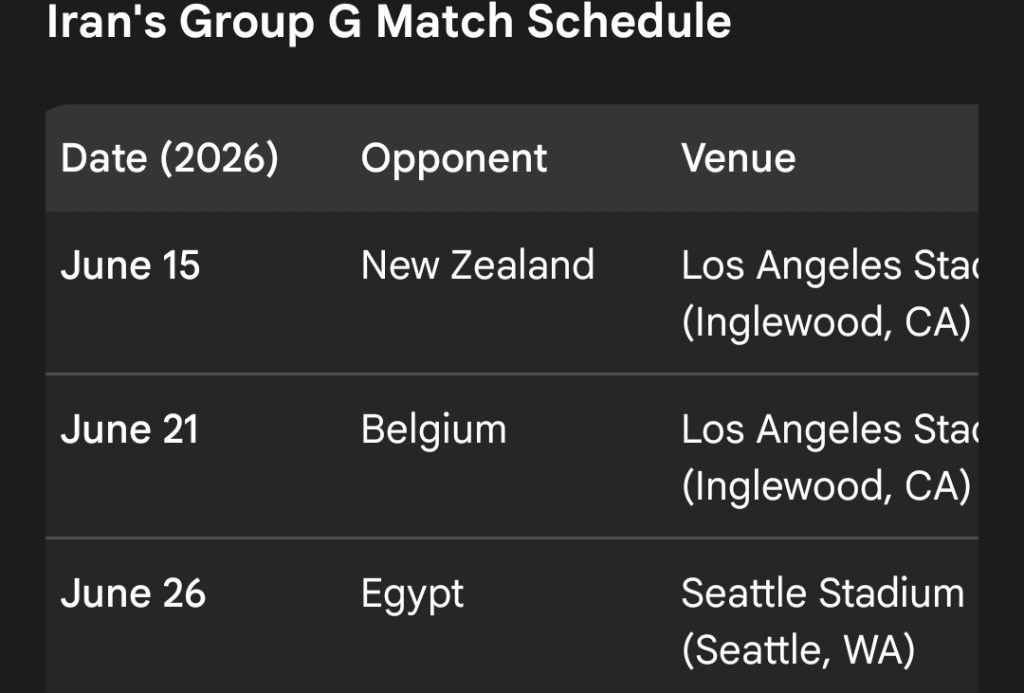
According to Iran’s Ambassador to Mexico, Abolfazl Pasandideh, the current terms of the squad’s restricted visas stipulate that the team is forbidden from staying overnight in the United States. ”We can enter in the morning and we must leave the same day,” Pasandideh revealed to reporters on Saturday, outlining an exhausting fly-in, fly-out matchday routine that would require the team to commute across the border from Mexico on the day of competition. However, that claim directly contradicts earlier assertions made by team spokesperson Amir Mahdi Alavi, who told state television that multiple-entry visas had been secured allowing the team to arrive at match venues one to two days prior to kickoff. If the single-day entry restriction stands, it will trigger an immediate infraction of FIFA operational rules. World Cup regulations strictly dictate that both competing head coaches must deliver an official, in-person press conference at the match venue on the eve of every game. With Iran’s opening match against New Zealand just over a week away, FIFA officials find themselves in a race against time to mediate an operational solution between Washington and Tehran before the geopolitical standoff completely disrupts the tournament.
Do you want to advertise with us?
Do you need publicity for a product, service, or event?
Contact us on WhatsApp +2348033617468, +234 816 612 1513, +234 703 010 7174
or Email: validviewnetwork@gmail.com
CLICK TO JOIN OUR WHATSAPP GROUP