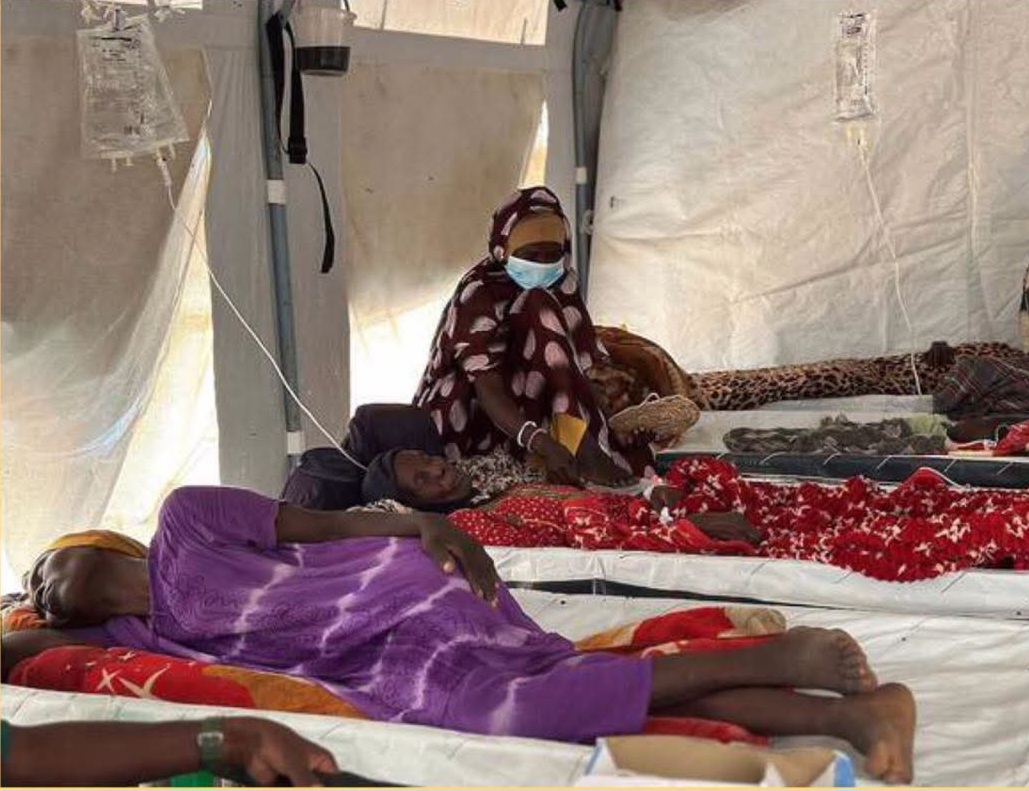
A renewed cholera outbreak has claimed at least 120 lives across Sudan, signaling a grim escalation in the country’s deepening humanitarian disaster. The World Health Organization (WHO) confirmed on Wednesday that 1,102 suspected cases have been registered since May, with health officials warning that the disease is spreading rapidly through war-torn regions already pushed to the brink of famine.
The current wave marks the third major cholera outbreak in as many years. This latest emergence follows a devastating preceding cycle that ended only in March, during which over 124,400 infections and 3,500 deaths were recorded. According to Dr. Shible Sahbani, the WHO’s Sudan chief, the disease—which once appeared in three-year cycles—has now become “near-continuous” due to the collapse of public health infrastructure and severe constraints on humanitarian access.
A Multi-Front Crisis in Kordofan
The epicenter of the current crisis is West Kordofan, a strategic battleground between the Sudanese Armed Forces and the paramilitary Rapid Support Forces (RSF). The violence has rendered the region nearly inaccessible to aid organizations. Recent reports indicate that the outbreak has already jumped to North Kordofan, with 300 suspected cases and 16 deaths documented in the Al-Mazroub area alone.

Medical volunteers on the ground warn of critical shortages of intravenous fluids, rehydration supplies, and essential medicines. These supply gaps are exacerbated by ongoing drone strikes that have targeted critical infrastructure, including power stations. The destruction of these facilities has cut off thousands from the electricity needed to pump and treat clean drinking water, leaving the population dependent on contaminated sources.
Looming Threat to El-Obeid
The humanitarian situation faces further deterioration as the Rapid Support Forces prepare for a major ground assault on El-Obeid, the capital of North Kordofan. The United Nations has issued dire warnings that the city—home to roughly half a million civilians—is under “siege-like conditions.” UN officials fear the city could suffer the same fate as El Fasher, where the RSF has been accused of mass atrocities and widespread human rights violations.
A Collapsing Infrastructure
Three years into a civil war that has displaced over 14 million people and killed an estimated 200,000, Sudan’s healthcare system remains in ruins. Data from the WHO indicates that 40 percent of the nation’s health facilities are now completely non-functional, while the remaining 60 percent are only partially operational.
As the country enters its rainy season, humanitarian agencies expect the crisis to intensify. Flooding is predicted to destroy already damaged road networks, further obstructing aid convoys and causing cholera cases to “balloon” as sanitation conditions deteriorate. In response, the WHO and partners are attempting to scale up support by establishing additional treatment centers and launching preventive campaigns, though the intensifying conflict continues to delay the delivery of life-saving aid to the most vulnerable communities.
Do you want to advertise with us?
Do you need publicity for a product, service, or event?
Contact us on WhatsApp +2348033617468, +234 816 612 1513, +234 703 010 7174
or Email: validviewnetwork@gmail.com
CLICK TO JOIN OUR WHATSAPP GROUP