



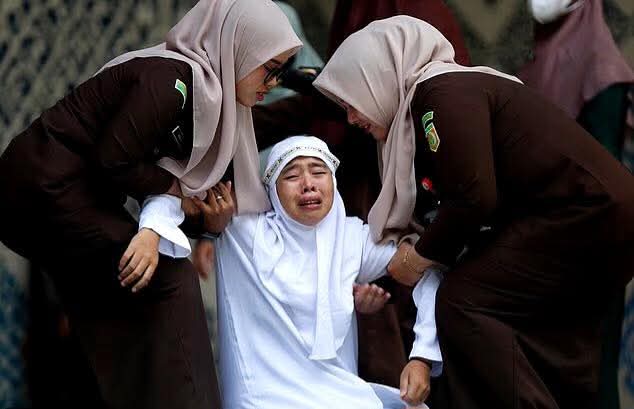
BANDA ACEH, Indonesia — A public square in the provincial capital of Banda Aceh became a scene of grim physical devastation today, May 21, as a woman collapsed into unconsciousness after enduring 100 lashes of a rattan cane for having sex outside of marriage.
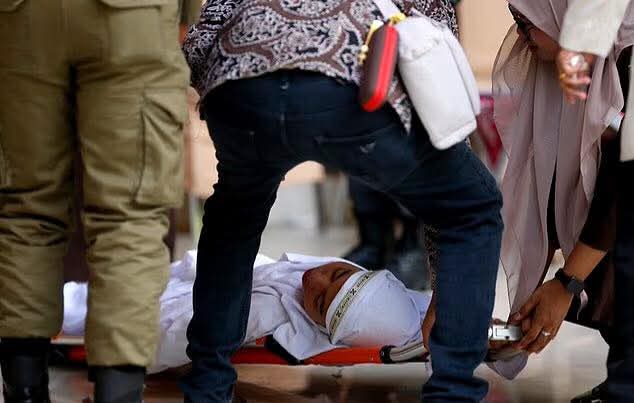
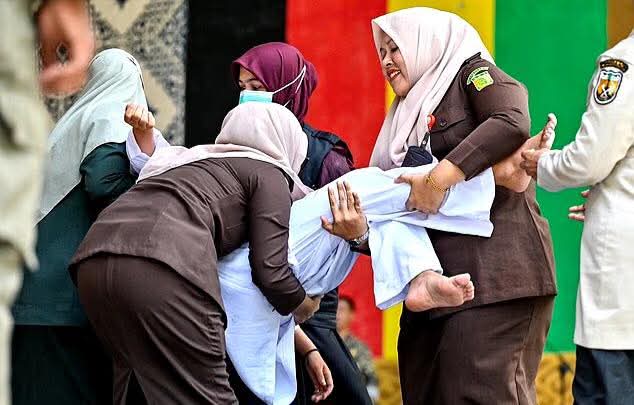
The unidentified woman was one of four individuals subjected to maximum corporal punishment for moral offenses under the region’s uncompromising interpretation of Islamic law. Dressed in white, she groaned and visibly winced before her body gave way under the final strikes, forcing emergency medical personnel to lift her limp body from the execution stage and carry her to a waiting ambulance. Her male partner also received 100 lashes, grimacing in intense pain as the crowd looked on.
According to Muhammad Rizal, the head of Banda Aceh’s Sharia police force, the couple were identified as sex workers and their clients. “We implement Islamic law in Aceh, so whenever someone violates it, we have to carry out punishments like the caning we just conducted,” local authorities stated, reinforcing their hardline stance. Five other individuals were also caned today, receiving between nine and 23 lashes for lesser infractions, including alcohol consumption and khalwat—being in close proximity to a member of the opposite sex who is not a spouse or relative.
A Pattern of Escalating Brutality
This latest public spectacle marks an ongoing pattern of extreme corporal punishment in Aceh, the only province in Muslim-majority Indonesia permitted to enforce Sharia law under a 2001 special autonomy agreement.

Today’s incident mirrors a similarly brutal execution in January, where an unmarried couple was sentenced to an unprecedented 140 lashes each—100 for premarital relations and 40 for drinking alcohol. In that instance, the female convict also lost consciousness on the scaffold. The January crackdown notably ensnared a member of the Sharia police force itself, prompting Rizal to announce at the time: “As promised, we make no exceptions, especially not for our own members. This certainly tarnishes our name.”
The province’s legal code, codified in the Aceh Islamic Criminal Code of 2014, penalizes a wide array of activities that are completely legal throughout the rest of Indonesia. These include gambling, consuming or selling alcohol, heterosexual relations outside of marriage, and consensual same-sex relations. Last August, global human rights monitors sounded alarms when two young men were publicly flogged 76 times each after being apprehended by neighborhood vigilantes in a public restroom.
International Outrage vs. Local Autonomy
While the central government in Jakarta holds no legal jurisdiction to intervene in Aceh’s religious judicial system, international human rights organizations have repeatedly condemned the practice. Amnesty International has classified the public floggings as “cruel, inhuman, and degrading treatment,” arguing that they explicitly violate the UN Convention Against Torture, to which Indonesia is a state party.

Despite global condemnation and the psychological and physical trauma inflicted on those subjected to the cane, the regional government maintains overwhelming local support for the bylaws. For the residents of Banda Aceh, the public square remains an active theater of religious policing, where the boundaries of morality are enforced by the stroke of a rattan stick.
An in-depth perspective on the severe corporal punishments executed under this regional penal code can be observed in this broadcast on Public Canings in Indonesia’s Aceh Province. This video provides crucial context regarding the historical implementation of Sharia bylaws in the region and the resulting international human rights debate.
Do you want to advertise with us?
Do you need publicity for a product, service, or event?
Contact us on WhatsApp +2348033617468, +234 816 612 1513, +234 703 010 7174
or Email: validviewnetwork@gmail.com
CLICK TO JOIN OUR WHATSAPP GROUP