“The world has transformed. The Council has not. Africa does not come to plead. We come to propose. Capital must price risk; it must not price prejudice. Extraction defined too much of our past. Investment must underpin our future. If Africa has a stake in the burden, Africa must have a share in the decisions. Peace is not separate from development. It is its first condition. Reform abroad cannot substitute for accountability at home. Let ours be the generation that completes the unfinished work of San Francisco. Not a United Nations of some nations. Every nation has a voice, every people has a stake, and every child has a future.” — Ruto
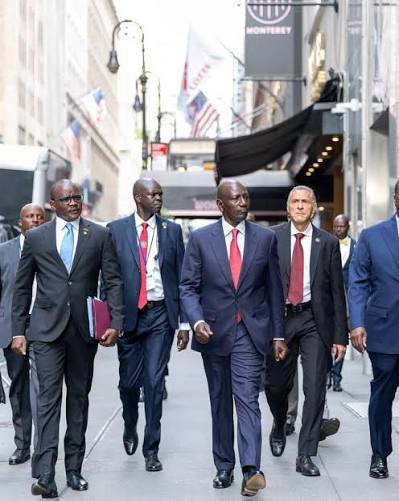
William Ruto did not come to the 81st United Nations General Assembly simply to complain about Africa’s place in the world.
He came with a question.
If the world has changed so dramatically since 1945, why do some of its most powerful institutions still operate as though the world has not?
That question became the backbone of the Kenyan president’s address in New York.
Ruto began with the founding of the United Nations in San Francisco 81 years ago, when countries emerging from the ruins of war tried to build a new international order.
Kenya was not yet independent.
When it finally took its seat in the UN General Assembly in December 1963, Ruto noted, it arrived with one vote and the same sovereign rights as every other state.
But according to his argument, the promise of sovereign equality becomes much less equal when the world’s biggest decisions move into institutions where power is distributed differently.
“The equality proclaimed in this Assembly ends at the doors of the Security Council”
Ruto’s sharpest institutional criticism was aimed at the Security Council. Every country in the General Assembly has one vote, he said. But five countries hold permanent power that the other 188 do not.
Then came one of his strongest lines: “That imbalance might have reflected the world of 1945. It does not reflect the world of today.”
Africa, he noted, has 54 UN member states and more than a quarter of the General Assembly.
Yet it has no permanent seat on the Security Council. His next line was even harder: “We are frequently the subject of its decisions, permanently discussed but permanently excluded.”
The historical irony, he argued, is that most African countries could not even speak for themselves when the UN system was designed because they were still under colonial rule.
So the institution that was created in 1945 was partly designed at a time when much of Africa had no sovereign voice at the table.
Ruto’s conclusion was simple: “The world has transformed. The Council has not.”
Then he moved from power to money
This is where Ruto’s speech becomes particularly relevant to African economies.
He argued that inequality is not confined to political institutions. It also exists in the international financial system.
Ruto cited a global public debt figure of $102 trillion in 2024 and argued that developing countries, despite holding less than a third of that debt, paid about $1 trillion in interest that year.
His central image was striking:
“The hospital competes with the creditor, the classroom competes with debt service, and too often the creditor is paid first.”
That gave the debt argument a human face.
For Ruto, the question is not simply whether African countries can borrow. It is what they pay for capital.
He argued that developing countries have recently borrowed at rates two to four times higher, on average, than developed countries.

He also cited a UNDP estimate that subjectivity in credit ratings has cost African countries about $75 billion through higher interest costs and lost lending.
Then came perhaps the cleanest economic line in the entire speech:
“Capital must price risk; it must not price prejudice.”
It is a sentence that could easily become the headline of the African financing debate.
“Africa does not come to plead”
Ruto then changed the tone. Africa, he said, should not approach the world merely as a continent asking for assistance.
“Africa does not come to plead. We come to propose.”
The proposal is an Africa that processes its own resources, builds industries, creates jobs and captures more value from its enormous mineral, agricultural and energy potential.
He offered examples. Cocoa producers should move from bean to brand. Cotton producers should build garment value chains. The clean-energy transition, he argued, should not become another extractive cycle in which Africa supplies minerals while others capture most of the value.
Do you want to advertise with us?
Do you need publicity for a product, service, or event?
Contact us on WhatsApp +2348033617468, +234 816 612 1513, +234 703 010 7174
or Email: validviewnetwork@gmail.com
CLICK TO JOIN OUR WHATSAPP GROUP
His description of the past was memorable: “Extraction defined too much of our past. Investment must underpin our future.”
That is more than an economic statement. It is a development philosophy.
The African market as an offer, not a plea
Ruto pointed to Africa’s population, minerals, agricultural potential, renewable-energy resources and the African Continental Free Trade Area.
He argued that these are not only African assets. Properly developed, they can contribute to global food security, clean energy, resilient supply chains and new markets.
His broader point was that a more industrialised Africa would not simply benefit Africans. It would create a stronger economic partner for the rest of the world.
That is why he connected African industrialisation to global prosperity. A food-secure Africa strengthens global stability. A better-connected Africa diversifies supply chains.
And an Africa capable of financing more of its own development becomes a stronger partner.
But Ruto also turned the mirror on Africa
The speech was not simply a case against the outside world.
Ruto acknowledged that African governments have responsibilities. They must manage debt prudently. They must strengthen institutions. They must prepare credible projects. They must honour contracts.
And they must confront corruption.
His formulation was important:
“Reform abroad cannot substitute for accountability at home.”
So his argument was not that Africa should escape responsibility. It was that responsibility should operate on both sides.
A fairer international system, in his framing, requires better governance at home and fairer rules abroad.
The classroom, the hospital and the creditor
The speech repeatedly brought the global financial debate back to ordinary people.
Ruto warned that debt service can consume resources that should go to education and healthcare.
He therefore ended up turning what sounds like an abstract debate over sovereign finance into something much easier to understand.
What happens when a government has money for debt repayment but not enough for a classroom?
What happens when a clinic becomes unaffordable because capital is too expensive?
Who pays when the financial system makes development more costly?
Ruto’s answer was embedded in another powerful line: “No child [should] lose a classroom because debt service came first; that no mother find an empty clinic because essential investment became unaffordable.”
The unfinished work of San Francisco
Ruto returned to where he began. The UN’s founders had looked at a broken world and decided to build a new order.
Ruto argued that the present generation faces a similar choice. Not necessarily because the world has another 1945-sized catastrophe behind it, but because today’s institutions are showing signs of strain that their founders could not have anticipated.
His challenge was therefore not to destroy multilateralism. It was to reform it. He called for permanent and equitable African representation on the Security Council. He called for international law to be applied consistently. He called for capital to serve development rather than deepen inequality.
And he called for institutions to reflect the world as it exists now, not the world as it existed in 1945.
Then came the closing sequence.
“Let ours be the generation that completes the unfinished work of San Francisco.”
He wanted a system in which sovereign equality becomes real, international law is consistent, capital serves development and cooperation is stronger than division.
Then the final image: “Not a United Nations of some nations.”
Not a system where power decides whose voice matters. But a United Nations where every nation has a voice, every people has a stake, and every child has a future.
What Ruto was really putting on the table
Ruto’s address can therefore be read through four connected demands.
— Political power: Africa wants permanent representation in the institutions that decide questions of war and peace.
— Financial power: African countries want capital on terms that do not make development unnecessarily expensive.
— Economic power: Africa should process its resources, build industries and capture more value at home.
— Institutional power: The rules governing the world should reflect today’s distribution of countries, populations and economic interests rather than the architecture inherited from the aftermath of the Second World War.
That is why the speech kept returning to one underlying idea.
Africa does not merely want a seat at a table designed by others. It wants a voice in deciding how the table works.
And Ruto’s most memorable formulation may have been the simplest: “If Africa has a stake in the burden, Africa must have a share in the decisions.” ValidViewNetwork reports.