



Nigeria’s 2027 election season has produced an uncomfortable coincidence.
While political and legal figures were warning that elections must ultimately be decided by voters rather than courtrooms, a Federal High Court in Gombe was ordering the Peoples Democratic Party to return to the beginning of its governorship contest.
The court on Thursday nullified the emergence of former Communications and Digital Economy Minister, Prof. Isa Ali Pantami, as the PDP governorship candidate in Gombe State and ordered the party to conduct a fresh primary.
The ruling came on the same day that prominent voices at the 22nd All Nigeria Editors Conference in Enugu raised concerns about the growing role of the judiciary in Nigeria’s electoral contests.
The coincidence is striking.
But the two developments are not necessarily contradictory. Courts have a constitutional role in resolving electoral disputes.
The larger question raised by the speakers in Enugu was whether the quality of Nigerian elections is such that courts are increasingly being asked to settle matters that should have been settled through credible internal party processes and transparent voting.
Pantami’s ticket returns to the starting line
Justice Amina Aliyu Mohammed of the Federal High Court in Gombe nullified the process that produced Pantami as the PDP’s governorship candidate.
The court also ordered the PDP to conduct a fresh governorship primary in accordance with the party’s constitution, its guidelines and applicable electoral laws.
The case was brought by PDP governorship aspirant Usman Aliyu Garry, who challenged the process through which Pantami emerged.
Pantami had become the PDP’s candidate after leaving the All Progressives Congress, where the party had settled on Jamilu Gwamna as its consensus candidate.
He subsequently emerged as PDP candidate through voice affirmation at a May primary, before the party formally announced him as its candidate.
That process was challenged by rival aspirants.
The Federal High Court has now ordered the PDP to do it again. The party has said it will comply with the judgment and begin the process of organising a fresh primary.
And then came Onaiyekan’s warning
At the editors’ conference in Enugu, Cardinal John Onaiyekan delivered a criticism that goes beyond the Gombe case.
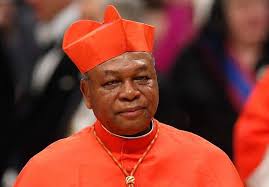
His argument was that the judiciary should be the last stage of an electoral process, not the place where political victories are effectively decided.
“The judiciary is supposed to be the last stage in the electoral process,” Onaiyekan said.
His distinction was important.Courts, he argued, should adjudicate disputes when they arise.
They should not become the institution through which elections are routinely determined.
He said Nigeria’s recent experience had increasingly produced situations in which elections were being decided through tribunals rather than at polling stations.
That criticism does not mean courts should stay away when electoral rules are allegedly violated.
Rather, it raises a more fundamental question: Why are so many electoral disputes reaching the courts in the first place?
When “go to court” becomes part of the election
Onaiyekan took particular issue with the political culture that often follows disputed elections.
A candidate loses.Supporters protest. Then comes the familiar response:
“Go to court.”
But if the courts become the expected second half of every election, what happens to confidence in the first half?
The ballot? The counting? The declaration? The internal processes of political parties?
For Onaiyekan, the answer requires reform. He called for electoral changes, an independent INEC and faster resolution of election cases.
He also proposed that election petitions should be concluded before elected officials are sworn in.
His concern was that once a candidate assumes office, the incumbent can potentially use the machinery and resources of government while fighting a legal battle against the person challenging the result.
That is a structural concern, not simply a complaint about one election.
Osigwe takes the argument into the digital age

Former Nigerian Bar Association President, Afam Osigwe, SAN, pushed the discussion further. He described Nigeria as having a high number of election petitions and pointed to what has been called the “judicialisation of the electoral process.”
The phrase captures an increasingly familiar pattern. A dispute begins at the polling unit. It moves to the collation centre. It reaches the returning officer.
Then it moves into the courtroom.
And suddenly judges are examining ballots, accreditation records, BVAS data, IReV records and other evidence to determine what happened during an election.
Osigwe questioned whether that is what a properly functioning electoral system should routinely require. He also raised concerns about the evidential treatment of election technology.
BVAS was introduced to improve voter accreditation and reduce manipulation. IReV was designed to improve transparency by allowing results to be viewed electronically.
Yet, Osigwe argued, technology should not become an additional obstacle for candidates attempting to establish what happened at polling units.
That creates another uncomfortable question.
If technology is introduced to make elections more transparent, why should proving an alleged electoral irregularity become harder because of the technology meant to expose it?
The Pantami case brings the argument down to earth
This is where the Gombe development becomes useful. The court did not decide who should govern Gombe State in 2027. It did not declare another candidate the winner.
It nullified the process that produced Pantami as PDP’s candidate and ordered the party to conduct a fresh primary.
That distinction matters.
Pantami’s political journey therefore returns to the party level. The PDP must now conduct another primary in accordance with the applicable rules.
Whether Pantami participates again, whether other aspirants return to the contest and who eventually emerges are separate political questions.
The court has not answered those questions. It has simply said the earlier process cannot stand.
The deeper Nigerian problem
Nigeria’s electoral problem is therefore not simply that politicians go to court. Courts exist precisely because disputes will occur.
The deeper issue is whether the political system is producing so many disputes that litigation becomes almost an extension of electioneering.
A democracy in which candidates campaign for months, vote on election day and then spend years litigating the outcome carries a very different burden from one in which credible polling processes settle most disputes quickly.
That is the concern behind Onaiyekan’s intervention.
And it is also why the Pantami case is worth watching.
A political party’s failure to conduct a process in accordance with its own rules can create the kind of dispute that eventually lands before a judge.
By the time it reaches court, the political consequences are no longer confined to the party.
Do you want to advertise with us?
Do you need publicity for a product, service, or event?
Contact us on WhatsApp +2348033617468, +234 816 612 1513, +234 703 010 7174
or Email: validviewnetwork@gmail.com
CLICK TO JOIN OUR WHATSAPP GROUP
The candidate’s campaign is affected. Rival aspirants are affected. The electorate is affected.
And the judiciary is dragged deeper into the political process.
Who should decide?
There is an important distinction here. Voters should decide elections. Courts should decide legal disputes about elections.
Those propositions are not contradictory. The problem begins when the second becomes so dominant that the first loses credibility.
That is the concern expressed by Onaiyekan and Osigwe.
And the Gombe case offers a live example of why internal party democracy and compliance with electoral rules matter before a single voter ever reaches a polling unit.
If the primary is properly conducted, the party gets a candidate. If it is disputed, the courts may be asked to intervene. If the general election is then disputed, the courts may be asked to intervene again.
The cycle can continue.
The ballot must ultimately carry the weight
Onaiyekan also warned against giving up on democracy because of its imperfections.
His argument was not that Nigeria should remove the courts from electoral matters. It was that the country should build an electoral system in which citizens can trust the ballot enough that litigation becomes the exception rather than the second ballot box.
That requires credible political parties. It requires an independent electoral commission. It requires transparent counting. It requires enforceable rules.
And it requires candidates and parties to accept that political competition begins with the ballot rather than ends with litigation.
The 2027 election is still ahead.But the battle over how that election will be decided has already begun.
In Gombe, the courtroom has just sent one governorship contest back to the starting line.
In Enugu, Onaiyekan and Osigwe were asking whether Nigeria can build a democracy in which the starting line, the finish line and the final verdict all belong primarily to the voters.
That may be the bigger question behind the 2027 election. ValidViewNetwork reports.