

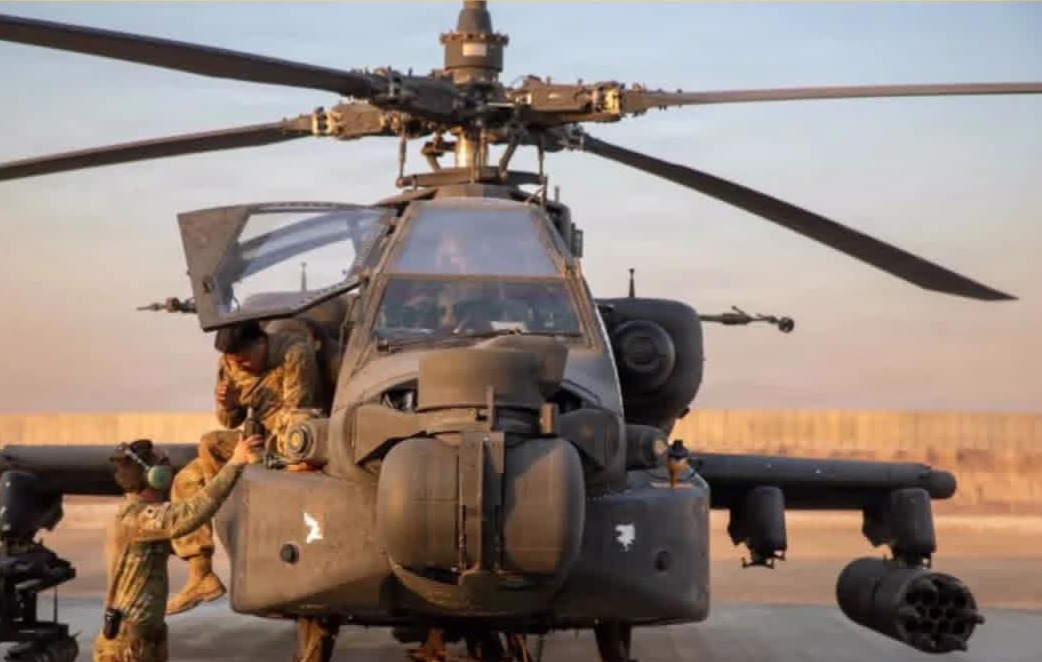
WASHINGTON — A US Army AH-64 Apache attack helicopter went down near the strategically critical Strait of Hormuz on Monday, triggering an immediate aviation rescue operation that successfully recovered both crew members alive.
President Donald Trump confirmed the incident late Monday night, assuring the public that the two pilots escaped without injury. The crash occurred against a backdrop of severe geopolitical instability, just as a fragile ceasefire between regional rivals threatened to unravel completely.
Pilots Safe, Official Investigation Launched
Speaking to reporters on the tarmac at John F. Kennedy International Airport in New York after attending an NBA Finals game, President Trump sought to downplay immediate anxieties regarding the crew’s fate.
”The pilots are fine, yeah. Nobody injured,” Trump said before boarding Air Force One. “We are going to issue a report on that tomorrow,” he added, declining to comment further on what may have caused the downing.
The Pentagon and US Central Command (CENTCOM) have yet to release a detailed breakdown of the incident. According to sources familiar with the matter, investigators are aggressively exploring all options. It remains entirely unclear whether the heavily armed helicopter was shot down by hostile Iranian fire, suffered a catastrophic mechanical malfunction, or experienced an operational failure.

High Stakes in a Volatile Waterway
The Apache gunship is a cornerstone asset for the American military in the region. It is heavily utilized to patrol shipping lanes, intercept hostile drones, and enforce a US blockade on Iranian crude oil shipments.
The crash coincides with an incredibly tense period in the Middle East. The regional conflict, which erupted aggressively earlier this year, has severely disrupted global energy markets and forced up commodity prices worldwide. Iran has maintained an effective chokehold on the Strait of Hormuz—a maritime artery that historically carries a fifth of the world’s crude oil and liquefied natural gas. In response, the US military has aggressively deployed Apaches, F-35 fighter jets, and MQ-9 Reaper drones to assert maritime dominance.
If investigators confirm the Apache was brought down by hostile action, it would mark the first loss of its kind in this specific theater of the conflict, following the loss of several unmanned drones and an F-15E Strike Eagle earlier this year.
Brinkmanship and Backroom Diplomacy
The incident transpired just as Israel and Iran appeared to step back from a volatile weekend escalation of retaliatory missile barrages. Despite the immediate danger presented by the downed aircraft, President Trump expressed immense optimism about broader regional diplomacy during a virtual campaign tele-rally.
Trump asserted that negotiators are in the “final throes” of securing a comprehensive peace agreement, boldly predicting a “total victory” and a finalized treaty within the next fortnight.
”We’re negotiating now, and they want to make a very good deal,” Trump told his supporters, claiming Tehran is ready to capitulate to core Washington demands, including a permanent cessation of its nuclear weapons program.
However, observers note that a lasting peace remains complex. While Israeli Prime Minister Benjamin Netanyahu confirmed a temporary halt to immediate strikes against Iranian targets, Tel Aviv has adamantly refused to pause its parallel military campaign against the Iranian-backed Hezbollah militia in Lebanon—a condition Tehran insists must be met for a permanent regional ceasefire.
A formal, comprehensive investigation report from the White House and the Department of Defense is expected to be made public later today.
Do you want to advertise with us?
Do you need publicity for a product, service, or event?
Contact us on WhatsApp +2348033617468, +234 816 612 1513, +234 703 010 7174
or Email: validviewnetwork@gmail.com
CLICK TO JOIN OUR WHATSAPP GROUP