

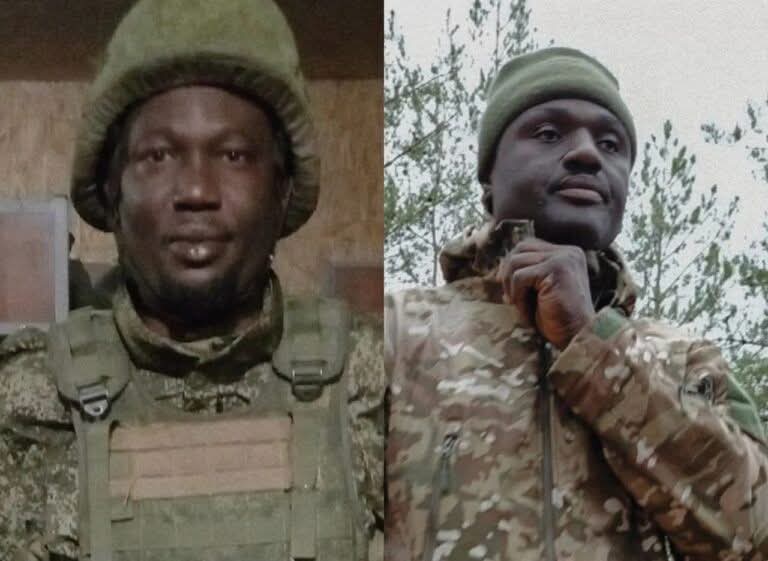
The tragic death of Ayebusiwa Olabode Victor, a 34-year-old native of Ilutitun, Ondo State, has once again exposed a devastating reality: African youth are being systematically funneled into Russia’s war against Ukraine. Victor was killed near Hrafske in the Kharkiv region, having signed a mercenary contract in late February—barely a week after Nigeria’s Ministry of Foreign Affairs explicitly warned citizens against being lured into the conflict. Whether he missed the warning or chose to gamble against the odds, Victor is now another statistic in a war that was never his to fight.
His death is part of a much larger, darker pattern. Before Victor, the bodies of two other Nigerians were recovered in Luhansk. According to Ukrainian intelligence, at least 215 Nigerians have signed contracts with the Russian Ministry of Defence, with no fewer than 25 already dead or missing. A broader investigation by INPACT, an organization tracking Russian disinformation, reveals that over 1,400 Africans—from Nigeria, Ghana, Kenya, Uganda, and South Africa—were recruited between 2023 and 2025. At least 316 of them have already died on Ukrainian soil. These are not merely numbers; they are sons, brothers, and breadwinners swallowed by a foreign war machine.
The Machinery of Deception
This human toll stands in stark contrast to Moscow’s aggressive denials. In diplomatic circles, Russian officials maintain that African nationals are safe and that recruitment allegations are “misleading.” However, Russia’s own state-aligned media tells a different story. Prominent pro-war commentators have openly described the operational pipeline: fake job advertisements on WhatsApp and Facebook promising lucrative employment, easy visas, and one-way tickets to Moscow.
Upon arrival, the trap snaps shut. Passports are routinely confiscated under the guise of “visa processing.” Once the victims run out of money and their initial visas expire, they are presented with a grim ultimatum: face immediate deportation with insurmountable debt, face imprisonment, or sign a military contract written in a language they cannot read.

Firsthand accounts illuminate the horror of this pipeline. Bankole Manchi, a 36-year-old mechanic from Lagos, was lured by the promise of a ₦500,000 monthly salary. After being routed through Addis Ababa to Moscow, he woke up in a military training camp alongside men from Ghana, Brazil, and China, unable to communicate with his peers. Manchi managed to survive, returning with a gunshot wound to the leg. Others have not been as fortunate. The growing list of deceased Nigerians includes Adekunle Adaramola (a former Air Force officer), Adam Anas, Akinlawon Tunde Quyuum, Abugu Stanley Onyeka, and Balogun Ridwan Adisa. All were baited with “security jobs,” given three weeks of rudimentary training, and sent directly to the front lines.
Weaponized Culture and False Promises
Investigators have pointed to “Russian Houses”—cultural centers managed under the state agency Rossotrudnichestvo—as critical nodes in this recruitment ecosystem. While cultural diplomacy and language training are standard international practices, these centers often operate under opaque franchise models. This structure allows private actors, some linked to mercenary networks, to recruit under the Russian flag while affording Moscow plausible deniability. In Ghana, partnerships with local universities allegedly facilitated the enlistment of 272 nationals, 55 of whom are now dead. When language classes and scholarships morph into military recruitment funnels, education itself has been weaponized.
This reality thoroughly punctures the geopolitical narrative Moscow has cultivated across the continent. Russia has long presented itself to Africa as an anti-imperialist alternative to Western powers. Yet, an empire that grinds African youth into front-line fodder forfeits any claim to anti-imperialism. It is practicing the oldest form of imperialism: treating foreign lives as cheap, expendable resources to sustain a grueling war of attrition.
An Urgent Wake-Up Call for African States
The ultimate vulnerability driving this crisis is economic desperation. When legitimate pathways to prosperity are scarce at home, the promise of an overseas job becomes an irresistible lifeline. What looks like hope to a struggling family is merely an opportunity for a predatory recruiter.
The true scandal lies not just in Moscow’s ruthless pursuit of its geopolitical interests, but in the muted, feeble responses from African governments. To remain silent while citizens are trafficked into a foreign war zone is to acquiesce to a modern slave trade operating under diplomatic cover.
International politics is driven by national interest, not altruism. Every external power—whether Russia, China, Europe, or the United States—must be evaluated strictly on transparency, reciprocity, and the tangible safety of African citizens. African states must act decisively to protect their people:
- Audit and Monitor: Thoroughly investigate the operations of foreign cultural centers and clamp down on fraudulent recruitment pipelines.
- Diplomatic Accountability: Summon foreign envoys to demand full accountability and tracking of nationals currently in conflict zones.
- Public Awareness: Launch aggressive domestic campaigns to warn job-seekers that these “lucrative” overseas security offers are often death sentences.
- Economic Security: Address the root cause by building genuine economic opportunities at home, ensuring that youth are no longer forced to gamble their lives for survival.
Do you want to advertise with us?
Do you need publicity for a product, service, or event?
Contact us on WhatsApp +2348033617468, +234 816 612 1513, +234 703 010 7174
or Email: validviewnetwork@gmail.com
CLICK TO JOIN OUR WHATSAPP GROUP