

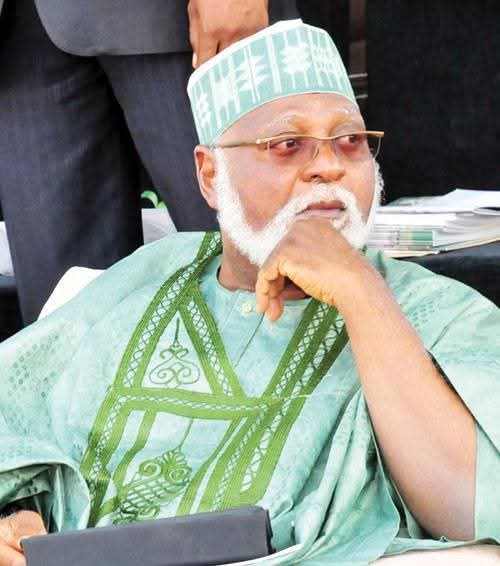
ABUJA — Former Head of State, General Abdulsalami Abubakar (retd.), has broken his silence on the turbulent military era of the 1990s, revealing how General Sani Abacha personally pressured and cornered him into taking top military appointments during the historic November 1993 coup.
The retired General disclosed that he twice rejected the offer to become the Chief of Army Staff following the military takeover that toppled Chief Ernest Shonekan’s Interim National Government (ING). Abdulsalami stated that he vehemently resisted being used as a pawn by political actors seeking to manipulate the armed forces.
These explosive disclosures are detailed in his 264-page, 27-chapter autobiography titled ‘Call of Duty’. The memoir was publicly presented at the State House Banquet Hall in Abuja on Saturday, coinciding with his 84th birthday. The high-profile book launch attracted top dignitaries across Africa and raised hundreds of millions of naira, featuring a ₦500 million donation from Aliko Dangote and ₦250 million from BUA Group Chairman, Abdul Samad Rabiu. President Bola Tinubu, represented by Vice President Kashim Shettima, used the occasion to direct FCT Minister Nyesom Wike to allocate a parcel of land in Abuja for the newly established Abdulsalami Abubakar Africa Resource Centre (AAARC).
Echoes of 1993: Resisting the Abacha Dragnet
Recounting the days leading up to the November 17, 1993 coup, Abdulsalami—then the Commandant of the National War College—noted that rumors of a military rebellion were thick in the air. The first warning came from Rear Admiral Suleiman Saidu (then Chief of Naval Staff), followed by an anxious phone call from retired Major-General Shehu Musa Yar’Adua asking if the military was about to depose Shonekan.

When the coup eventually occurred, Abdulsalami stubbornly boycotted a meeting of senior officers at the Flag Staff House despite warnings that his loyalty would be questioned. His defiance ended in a brief moment of public embarrassment.
”When I got there, the soldier at the gate said there was an instruction not to allow anybody in and that my name was not on the list of attendees. I went home, thoroughly embarrassed,” Abdulsalami wrote.
The situation took a dramatic turn when Abacha personally reached out, leading to a tense, private showdown in a sitting room at the Flag Staff House. Abdulsalami agreed to take a role only after extracting two strict conditions: that he would never be retired abruptly over the radio, and that he retained the right to always tell Abacha the raw truth.
Though he left thinking he was to be the Army Chief, internal military politics shifted overnight. Rumors swirled that he was instead penciled down for forced retirement alongside generals like John Shagaya and David Mark. In a twist of fate, he learned from a journalist that he had instead been appointed the Chief of Defence Staff (CDS)—the highest military office in the land.
The Clashing Destinies of Childhood Rivals
The book provides a rare look into the deep, lifelong relationship between Abdulsalami and Abacha. The two leaders grew up playing competitive inter-school football against one another in Northern Nigeria—Abacha as a rigid defender from Kano, and Abdulsalami as a swift forward from Bida.
Their rivalry moved from the pitch to the barracks, where they served in the same brigade during the Nigerian Civil War. Abdulsalami revealed that he once gave a chilling prophetic warning to Abacha during his tyrannical rule, after senior officers were arbitrarily retired on state media:
”I said to him: ‘Sani, if you do not take action, one day, you would be sitting down here and you would hear your name over the radio that you have been removed as the Head of State.'”
”Too Much on My Plate”: Inheriting a Broken Nation
In subsequent chapters, Abdulsalami detailed the “fishy” and chaotic hours following Abacha’s sudden death on June 8, 1998. He described being mysteriously locked in a Villa waiting room alongside Chief of Army Staff Ishaya Bamaiyi for nearly an hour before being informed of Abacha’s demise. Rather than mourning, the military’s “inner caucus” immediately began maneuvering for succession. Abdulsalami ultimately emerged as the 11th Head of State following a tense Provisional Ruling Council (PRC) vote between himself and Lt-Gen Jeremiah Useni.
Taking power was not a triumph but a burden that left him sleepless for days.
- Divided Military: The armed forces were heavily fractured following the alleged coup trials of Lt-Gen Oladipo Diya.
- Economic Ruin: Refineries were completely broken, fuel scarcity was chronic, and the Niger Delta was boiling over resource control.
- Political Gridlock: The newly elected National Assembly members from Abacha’s aborted transition fiercely opposed validating the annulled June 12 election.
Defending History: The Truth About MKO Abiola’s Death
Addressing one of the most polarizing mysteries in Nigerian political history, Abdulsalami used his memoir to firmly deny allegations that Chief MKO Abiola was poisoned while in custody.
He reiterated that Abiola collapsed during a high-level meeting with a visiting US delegation, which included international diplomats Tom Pickering and Susan Rice. According to eyewitness testimonies in the book, Abiola began coughing severely and suffered respiratory distress before passing away.
To clear the air, the Abdulsalami administration flew in an independent team of international medical experts. “The family requested an autopsy, and we assembled American, British, Nigerian, and Canadian pathologists to conduct it. The autopsy report attributed his death to natural causes,” he maintained, pointing to severe long-term hypertension and heart-related complications.
Do you want to advertise with us?
Do you need publicity for a product, service, or event?
Contact us on WhatsApp +2348033617468, +234 816 612 1513, +234 703 010 7174
or Email: validviewnetwork@gmail.com
CLICK TO JOIN OUR WHATSAPP GROUP
He similarly dismissed persistent rumors that he cleared out $500 million in cash from the central bank after Abacha’s death, calling the allegations completely fictitious.
Abdulsalami, who famously kept his word and steered Nigeria through a rapid 11-month transition to democracy by handing over power to President Olusegun Obasanjo on May 29, 1999, noted that his decisions were driven entirely by a desire to pull Nigeria back from the edge of total collapse.