

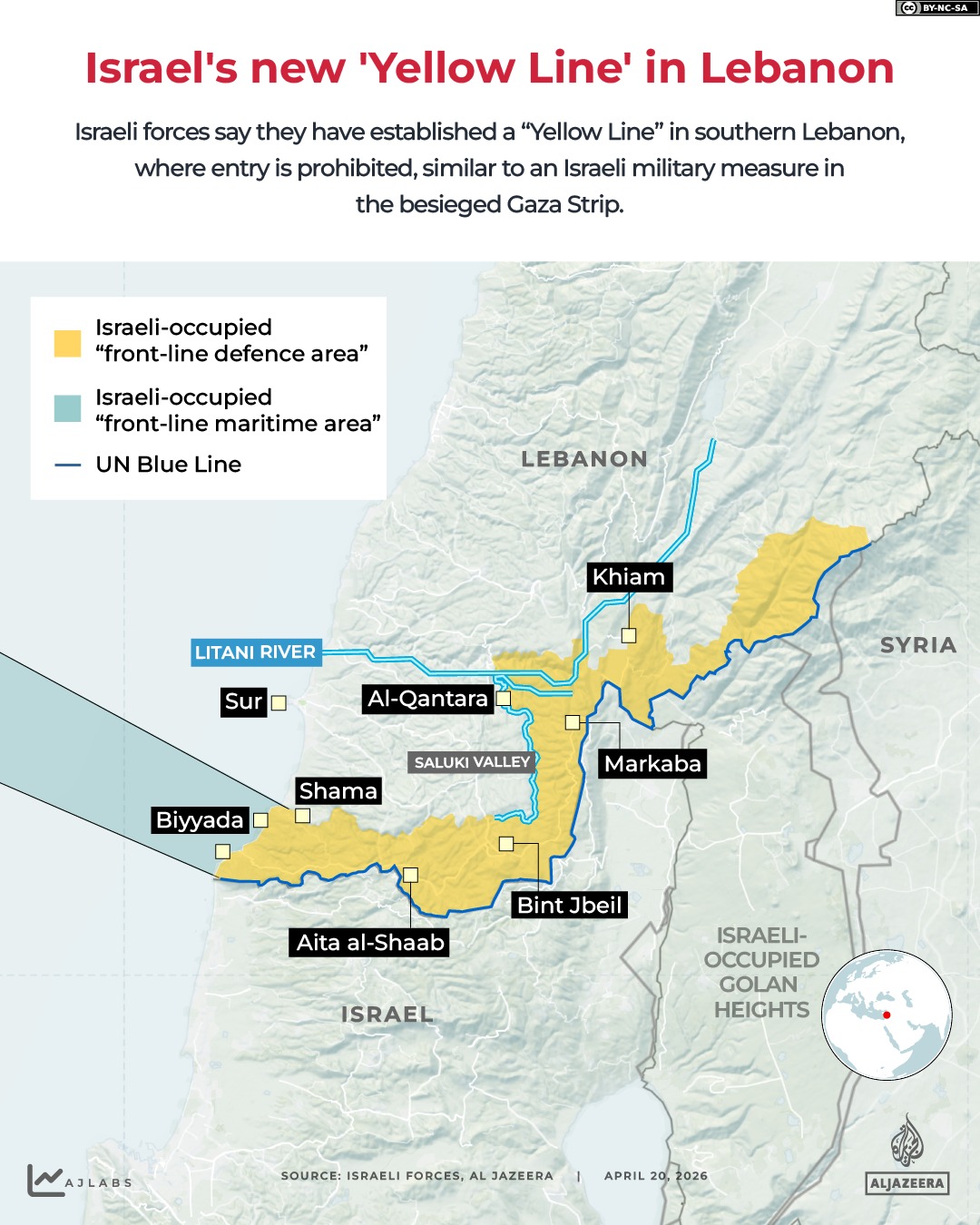
JERUSALEM – In a move that signals a hardening of its military posture during a fragile truce, the Israeli military has announced the establishment of a “Yellow Line” demarcation in southern Lebanon. This strategic boundary, previously utilized to bifurcate the Gaza Strip, marks the first time the Israel Defense Forces (IDF) have formally applied this specific territorial construct to the Lebanese front.
The announcement comes just days into a 10-day ceasefire between Israel and Lebanon—an agreement intended to provide a diplomatic window to end weeks of intensifying conflict with the Iran-backed group Hezbollah. However, the introduction of the Yellow Line suggests that even in the absence of full-scale hostilities, Israel intends to maintain a rigid, semi-permanent security presence deep within Lebanese territory.
A Blueprint from Gaza
The “Yellow Line” concept first emerged in the Gaza Strip in late 2025 as a de facto boundary separating areas under direct Israeli military control from those still governed by local Palestinian administration. In Lebanon, this line effectively creates a “forward defense zone” extending toward the Litani River.

According to military statements, the zone south of this line is treated as a high-security corridor. Within the last 24 hours, the IDF reported striking a “terrorist cell” that allegedly breached the line, asserting that the military retains the authority to eliminate perceived threats despite the cessation of active maneuvers.
Fragile Truce Under Strain
While the ceasefire has largely halted the heavy exchange of rocket fire and airstrikes that characterized the preceding six weeks of war, the demarcation has drawn sharp condemnation from Lebanese officials. Hezbollah lawmaker Hassan Fadlallah vowed that the “resistance” would not accept any such buffer, describing it as an attempt to enforce a permanent occupation under the guise of defensive measures.
The situation remains further complicated by recent incidents involving international observers. On Saturday, the United Nations Interim Force in Lebanon (UNIFIL) condemned an attack that killed one peacekeeper, highlighting the extreme volatility of the border region as both sides test the limits of the current truce.
Strategic Implications
Defense analysts suggest the Yellow Line represents a shift from mobile warfare to a static, fortified defense strategy. By marking the territory with physical infrastructure—reminiscent of the yellow-painted bollards used in Gaza—Israel appears to be creating a physical reality on the ground that may outlast the current 10-day diplomatic window.
As negotiators prepare for another round of talks this Thursday, the presence of the Yellow Line remains a primary flashpoint. For Israel, it is a necessary shield against a repeat of the October 7 style incursions; for Lebanon, it is a violation of sovereignty that threatens to turn a temporary pause into a long-term partition of the south.
Do you want to advertise with us?
Do you need publicity for a product, service, or event?
Contact us on WhatsApp +2348033617468, +234 816 612 1513, +234 703 010 7174
or Email: validviewnetwork@gmail.com
CLICK TO JOIN OUR WHATSAPP GROUP