



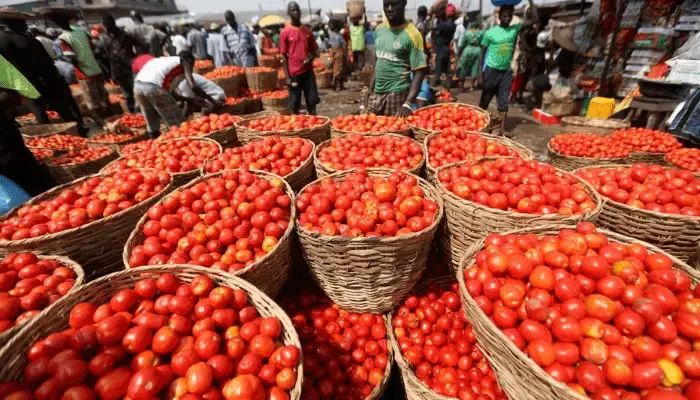
ABUJA, NIGERIA — The staple ingredient of the Nigerian household is rapidly turning into a luxury item. Residents and food vendors across the Federal Capital Territory (FCT) and its environs have voiced profound concern over a blistering surge in the price of tomatoes, which has more than doubled in less than a month.
A market survey conducted across major trading hubs in the FCT—including the Garki New Market, Suleja Market, Dutse Market, and Kubwa village—reveals a stark supply deficit that has driven retail prices to historic highs.
From Baskets to Luxury Goods
Traders on the ground report that the cost of wholesale commodities has escalated beyond the reach of average business owners. At the Suleja Market, Malam Isah Ado, a prominent vegetable vendor, revealed that a large basket of tomatoes, which retailed for between ₦85,000 and ₦90,000 just a few weeks ago, now commands between ₦150,000 and ₦170,000—representing a staggering 80% price increase.
The sharp hike is mirroring a wider inflationary pressure captured by the National Bureau of Statistics (NBS) in its recent food pricing metrics, which noted month-on-month increases for perishables nationwide. The crisis is further exacerbated by the heightened consumer demand trailing the Eid-el-Kabir (Sallah) celebrations, alongside severe climate and seasonal harvest dips.
The retail strain is forcing micro-traders to alter long-standing business practices. “I used to split a single basket of tomatoes with three other traders to manage costs,” explained Mummy Juli, a small-scale vendor in Kubwa. “Now, because of how expensive it has become, I have to share that same basket with five colleagues. A small paint rubber container that I normally sold for ₦4,000 to ₦4,500 now goes for between ₦8,000 and ₦10,000.”
She further lamented that selling standard ₦100 or ₦200 consumer portions has become mathematically impossible, setting the absolute minimum retail unit at ₦1,000. This shift has triggered a sharp drop in sales volume, particularly among low-income earners.
The Logistics Bottleneck
According to market stakeholders, the retail spikes are not born out of pure profiteering but are a direct reflection of broken logistics networks and soaring overheads.
”Customers assume we are ripping them off, but that is far from the reality,” explained Philomena Bassey, a trader at Garki New Market. “We buy these tomatoes at relatively reasonable rates directly from the farms. However, by the time they are transported through the interstate corridors down to Abuja, the logistics costs have multiplied. We have to factor in fuel costs and transit realities just to break even.”
The perennial issues of poor preservation infrastructure, post-harvest losses, and climate-induced crop disruptions in northern farming belts continue to stifle steady market delivery.

Households Pushed to the Brink
For consumers, the commodity spike has fundamentally destabilized domestic feeding budgets. Mrs. Angela Ikenna, a mother of two spotted navigating the stalls at Dutse Market, shared her survival strategy: “Buying a full week’s worth of fresh ingredients is no longer sustainable. I now buy strictly what we need for a single day or two to minimize wastage and manage our funds.”
Other residents have indicated a shift away from fresh produce altogether. Mrs. Badia Muhammad, a resident of Dei-Dei, noted that her household has turned to cheaper alternatives, including dried tomato flakes and processed pastes. Recent health sector indicators from PUNCH Healthwise warn that such economic strains are increasingly pushing vulnerable populations toward lower-grade, soft, or nearly spoiled produce, sparking broader concerns over food safety and nutritional health.
Calls for Structural Intervention
Civil servants, healthcare workers, and market unions alike are urging the federal and state governments to step up structural interventions. The prevailing consensus points toward a critical need for targeted agricultural subsidies, improved security for rural farming communities, and heavy investment in cold-chain logistics to bridge the gap between agrarian states and major urban consumption centers like Abuja.
Until macro-economic pressures and transport bottlenecks ease, Nigerian families are left with no choice but to adjust their palates and wallets to the reality of the expensive kitchen staple.
Do you want to advertise with us?
Do you need publicity for a product, service, or event?
Contact us on WhatsApp +2348033617468, +234 816 612 1513, +234 703 010 7174
or Email: validviewnetwork@gmail.com
CLICK TO JOIN OUR WHATSAPP GROUP