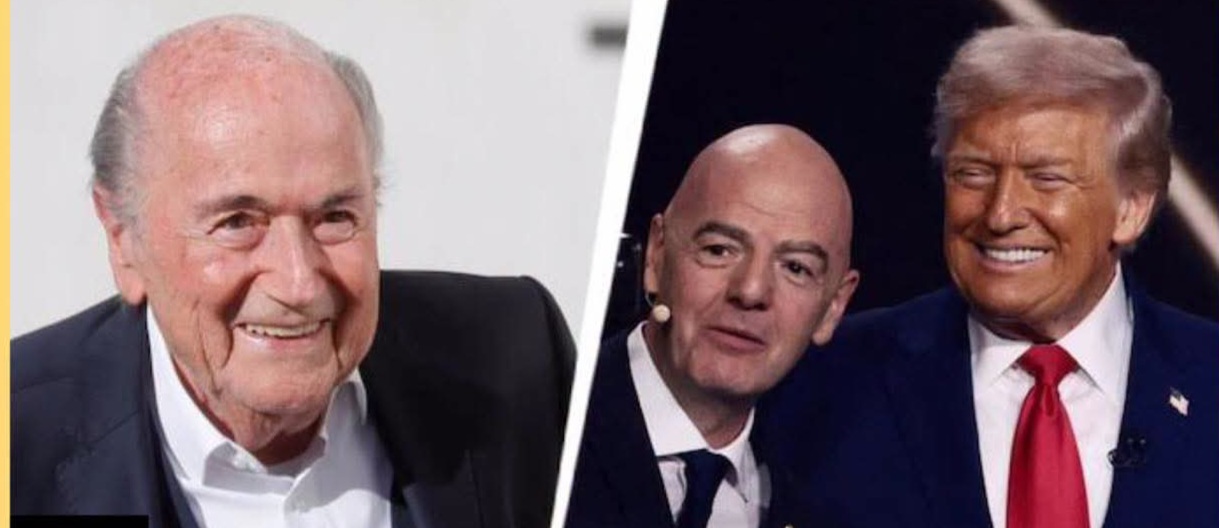
Former FIFA president Sepp Blatter has launched a scathing attack on the football governing body, accusing it of succumbing to “political power” after a high-stakes phone call from U.S. President Donald Trump reportedly influenced the suspension of Folarin Balogun’s red-card ban.
The controversy centers on the U.S. striker, who was issued a straight red card for a challenge on Bosnia and Herzegovina’s Tarik Muharemović during the Round of 32. While the dismissal initially carried an automatic one-game suspension, FIFA’s Disciplinary Committee issued a shock ruling on Sunday, invoking Article 27 of its disciplinary code to place the ban on a one-year probationary period. This move effectively cleared Balogun to play in Monday’s knockout clash against Belgium.
The Controversy: A Presidential Phone Call
The decision sparked global outrage, particularly after it was revealed that President Trump personally contacted FIFA President Gianni Infantino to request a review of the incident. Trump confirmed the communication, describing the referee’s decision as “horrible” and an “injustice,” though he maintained that he did not demand a specific outcome.
In a fiery post on X, the 90-year-old Blatter condemned the reversal: “Red cards are not overturned by political phone calls. They are overturned by rules, evidence and independent bodies. If a US President intervenes with the FIFA President—and a player is suddenly cleared before a World Cup knockout match—the question is unavoidable: Quo vadis, FIFA? Football must never become a playground for political power.”

FIFA’s Stance and Global Backlash
FIFA has defended the process, with Infantino stating that he explained to the U.S. President that an independent legal process was already underway. The governing body clarified that the red card itself stands, but its immediate implementation was suspended due to “specific circumstances surrounding the incident.”
The decision has met with swift condemnation from the wider footballing community. The Royal Belgian Football Association (RBFA) expressed “disbelief” at the “unprecedented, incomprehensible and unjustifiable decision,” arguing that the integrity of the tournament is at stake. Prominent figures, including Belgium coach Rudi Garcia and former Liverpool manager Jurgen Klopp, have also publicly criticized the ruling.
A Pattern of Friction
For Blatter, the incident is the latest evidence of what he describes as a “dictatorship” under Infantino’s leadership. Since his own forced resignation in 2015 amidst a massive corruption scandal, Blatter has become an outspoken critic of his successor.
As the tournament moves toward the quarter-finals, the shadow of this decision lingers. While FIFA maintains that the use of probationary periods is within its legal rights, the optics of a world leader securing a reprieve for a star player just hours before a vital knockout match have left many questioning whether the governing body’s decision-making process has been fundamentally compromised by political influence.
Background Context: The Balogun Incident
- The Incident: Folarin Balogun received a red card in the 64th minute of the U.S. 2–0 win over Bosnia and Herzegovina on July 1, 2026, for a tackle on Tarik Muharemović.
- The Ruling: FIFA’s Disciplinary Committee invoked Article 27 of the FIFA Disciplinary Code, which allows for the suspension of disciplinary measures, placing the one-match ban on a one-year probationary period.
- Impact: The decision allowed Balogun, the U.S. team’s leading scorer with three goals, to compete in the Round of 16 against Belgium.
- Outcome: Following the controversy, Belgium defeated the United States 4–1, eliminating the U.S. team from the tournament.
Do you want to advertise with us?
Do you need publicity for a product, service, or event?
Contact us on WhatsApp +2348033617468, +234 816 612 1513, +234 703 010 7174
or Email: validviewnetwork@gmail.com
CLICK TO JOIN OUR WHATSAPP GROUP