

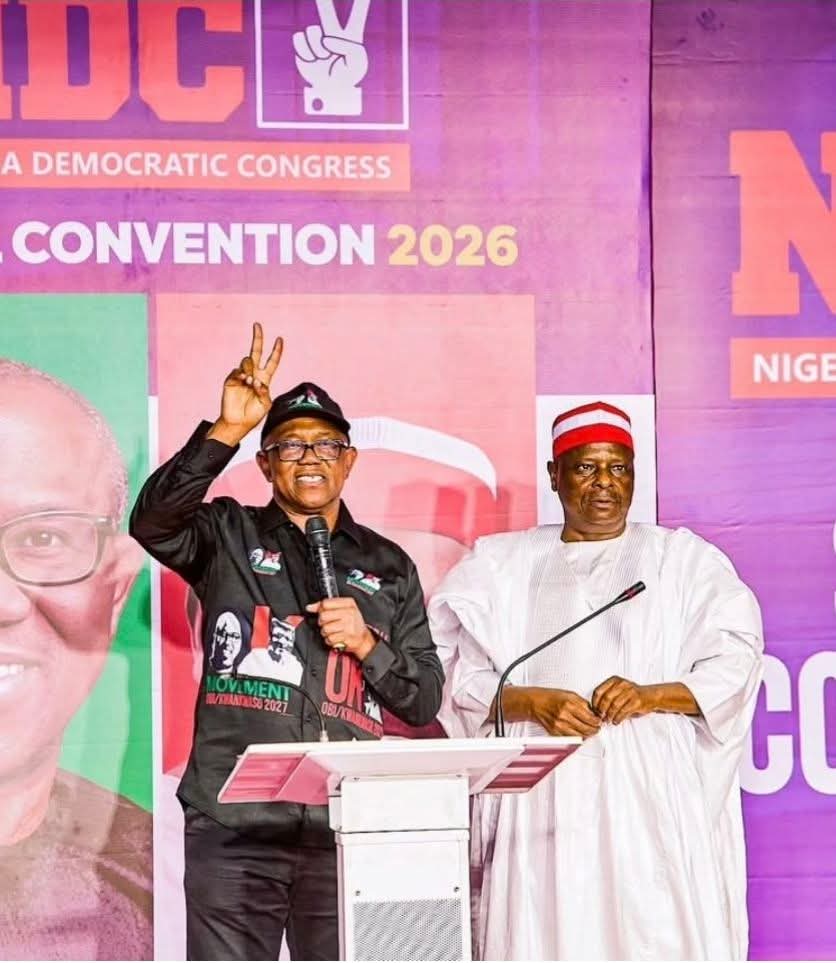
ABEOKUTA — In a decisive bid to position energy infrastructure at the heart of his economic blueprint, the presidential flag bearer of the Nigeria Democratic Congress (NDC) and former Labour Party candidate, Peter Obi, has issued a bold ultimatum to the status quo of Nigeria’s energy landscape. Obi pledged that if elected in the 2027 general elections, his administration will scale Nigeria’s electricity generation and distribution capacity to at least 10,000 megawatts (MW) within its first four years.
Addressing stakeholders while unveiling his long-term economic strategies, the former Anambra State governor stated that his incoming administration would offer no excuses for the prolonged inertia plaguing the Nigerian Electricity Supply Industry (NESI).
“And I pledge, on behalf of our government, that in four years, this country will generate and distribute at least 10,000 megawatts from the 4,000 they are doing today,” Obi asserted. “This is something we have carefully studied, and we are not going to come into government and start making excuses about why it cannot be done.”
The Comparative Deficit
The push to cross the 10,000MW threshold highlights a persistent developmental paradox. Industry data from the Nigerian Electricity Regulatory Commission (NERC) indicates that despite Nigeria possessing an installed grid capacity of roughly 14,000MW, structural deficits—including inadequate gas supply and fragile transmission infrastructure capable of wheeling only about 7,000MW—frequently suppress actual daily generation to a baseline fluctuating between 3,900MW and 4,300MW.
Obi labeled the status quo unacceptable for a country with a population exceeding 200 million, contrasting Nigeria’s energy scarcity with the industrial footprints of continental peers.
“Nigeria is the nation with the highest number of citizens lacking access to electricity globally,” Obi lamented. He noted that countries like Egypt and South Africa, despite having smaller populations, each boast generation capacities exceeding 40,000MW. “Nigeria is not even producing one-tenth of what those countries generate, and that must change.”
Economic Growth Through MSME Empowerment
Beyond stabilizing the national grid, Obi tied his energy targets directly to a broader microeconomic recovery plan. Emphasizing that industrial productivity cannot survive on diesel generators, he revealed that his economic policy would deliberately favor micro, small, and medium-sized enterprises (MSMEs) through aggressive fiscal interventions.
The proposed policy blueprint promises to stimulate growth, create sustainable employment, and raise standard of living across the federation by combining:

1.Targeted tax incentives for small businesses,
2.Streamlined financial assistance frameworks, and
3Aggressive access to affordable credit lines.
As the political landscape sharpens ahead of the 2027 polls, Obi’s 10,000MW target sets a clear metric for the coming structural debate. Critics and energy experts alike note that while 10,000MW remains a fraction of Nigeria’s actual economic demand, bridging the transmission gap to deliver it to homes and factories would mark the most significant disruption to the country’s power grid in decades.
Do you want to advertise with us?
Do you need publicity for a product, service, or event?
Contact us on WhatsApp +2348033617468, +234 816 612 1513, +234 703 010 7174
or Email: validviewnetwork@gmail.com
CLICK TO JOIN OUR WHATSAPP GROUP