

JOHANNESBURG — Five Mozambican nationals were killed in xenophobic attacks in South Africa’s southern coastal city of Mossel Bay over the weekend, marking the first deaths officially linked to a wave of protests against illegal immigration sweeping the country, the Mozambican government confirmed Monday.
Around 800 Mozambican nationals were caught up in the violence that erupted on Friday in Mossel Bay, a port town approximately 380 kilometres east of Cape Town, according to a statement from the Mozambican government press office. The unrest prompted 300 Mozambicans to flee back to their country by their own means on Saturday, while the remaining 500-plus have been sheltered in a safe location in the Western Cape province, with repatriation already underway as of June 1.
“Regrettably, seven Mozambican citizens have died, five of them as a direct consequence of the xenophobic attacks and the other two as a result of a road accident when they were travelling in a private vehicle on their way back to Mozambique,” the statement said.

Police Investigate Deaths, Mayor Condemns Violence
South African police confirmed on Sunday that they are investigating the deaths of two men at an informal settlement in Mossel Bay, though they did not disclose nationalities or full details.
Mossel Bay Mayor Dirk Kotze expressed “deep concern and dismay at the current xenophobic attacks where people have been murdered, houses burned and families displaced”.
Western Cape police later dismissed reports that five Mozambican nationals were killed in xenophobic attacks in Mossel Bay, though they did not provide contradictory figures.
Foreign Nationals Targeted Across South Africa
The Mossel Bay killings are part of a broader surge in anti-foreigner violence. On Monday, June 1, Naeem Hassan, a 30-year-old Pakistani vegetable supplier, was fatally attacked while trying to remove his truck from a yard in Vereeniging. He died at the scene. Authorities have not yet issued an official statement on the incident [user query].
Similarly, Zumur Kormokar, a 40-year-old Bangladeshi businessman, was shot dead during an armed robbery at his shop in Nqutu, KwaZulu-Natal, on Saturday night around 8:30 p.m. Suspects reportedly stole money and other items before fatally shooting him. Photos circulating on social media show the aftermath of the attack [user query].
“March and March” Movement Fuels Tensions
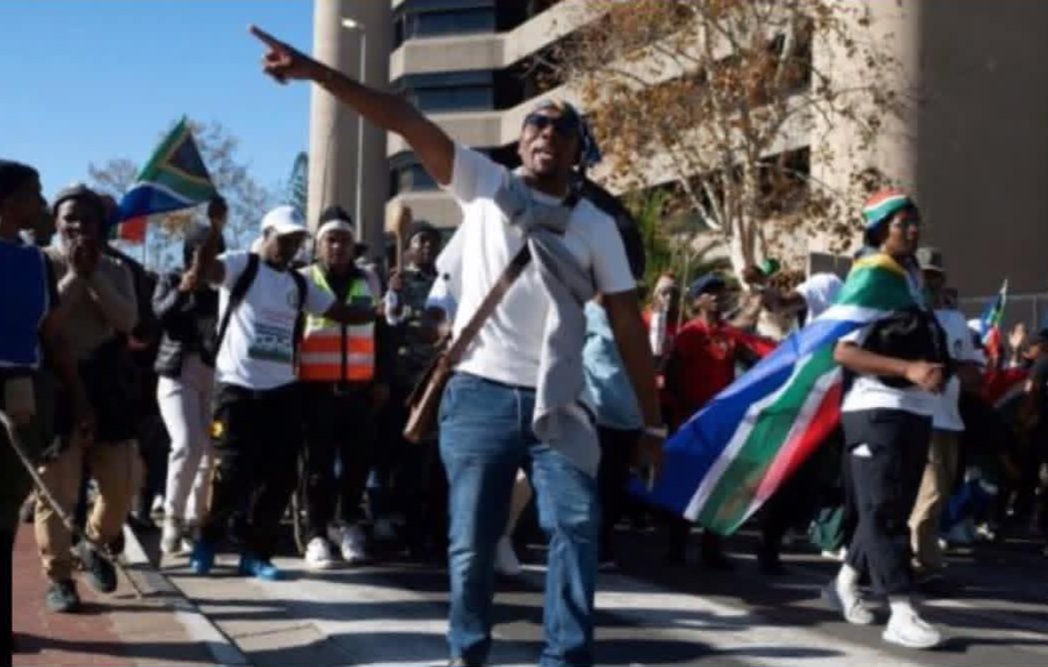
The latest violence comes as the citizen-led March and March Movement, an anti-illegal immigration group, has issued an ultimatum for undocumented migrants to leave South Africa by June 30, 2026. The group, supported by Operation Dudula and political parties including the Inkatha Freedom Party, Patriotic Alliance, ActionSA, and uMkhonto we Sizwe, has organized demonstrations in Johannesburg, Pretoria, and Durban.
Activists are accusing undocumented immigrants of contributing to unemployment, crime, overcrowded schools and hospitals, and housing shortages. Reports have emerged of groups checking foreigners’ documentation and forcibly closing non-South African-run businesses.
“The situation is volatile and expected to worsen ahead of June 30,” the Mozambican government stated, adding that it is working on measures to support its nationals still in South Africa.
Historical Context: South Africa’s Recurring Xenophobic Waves
South Africa has experienced repeated waves of xenophobic violence over the past two decades. In 2008, 62 people—including 21 South Africans, 11 Mozambicans, 5 Zimbabweans, and 3 Somalis—were killed in anti-immigrant riots, displacing thousands. Further outbreaks occurred in 2015 and 2016.
Human Rights Watch reported in May 2026 that vigilantes have carried out violent xenophobic attacks targeting African and Asian foreign nationals with “little or insufficient apparent response from police”.
African Countries Urge Caution, Evacuate Citizens
Several African nations—including Kenya, Malawi, Nigeria, Lesotho, and Zimbabwe—have urged their citizens in South Africa to exercise caution. Ghana flew out 300 of its citizens last week and is planning to evacuate hundreds more, with over 800 individuals registered for evacuation.
Last month, several hundred foreign nationals from the Democratic Republic of Congo, Rwanda, and Somalia sought protection in Durban, saying locals were going door-to-door telling them to leave by the end of June.
The South African government’s security ministers have convened an emergency meeting at the Union Buildings in Tshwane to address the escalating demonstrations and finalize an action plan to combat racism, racial discrimination, xenophobia, and other forms of intolerance.
Do you want to advertise with us?
Do you need publicity for a product, service, or event?
Contact us on WhatsApp +2348033617468, +234 816 612 1513, +234 703 010 7174
or Email: validviewnetwork@gmail.com
CLICK TO JOIN OUR WHATSAPP GROUP
Tensions remain high as the June 30 deadline approaches, with fears of another major wave of violent xenophobic attacks growing across the country.