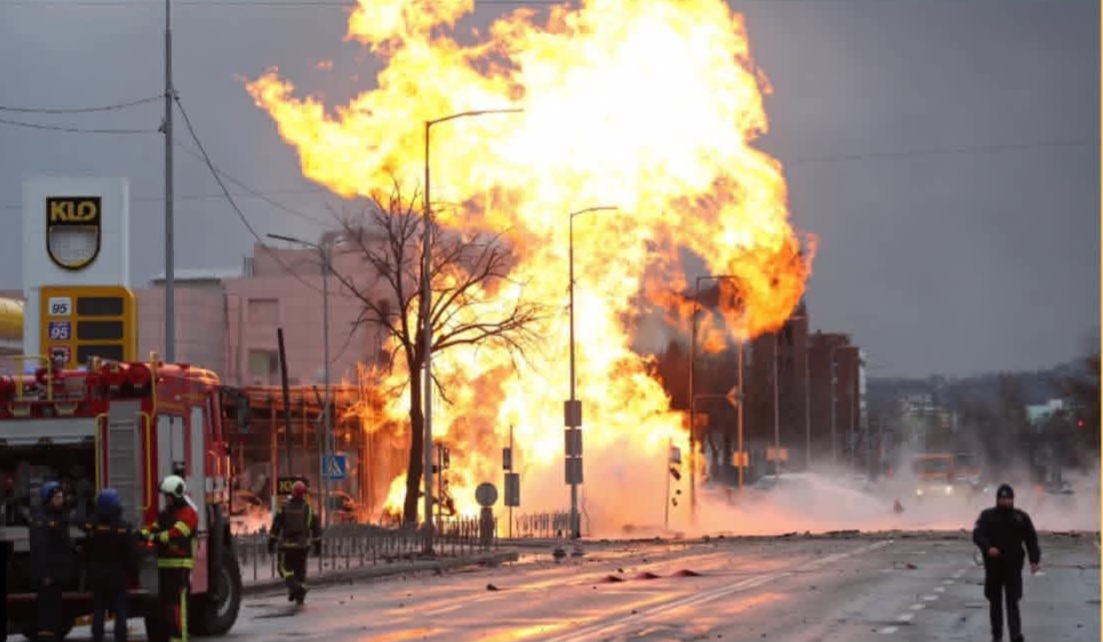
KYIV — Russia unleashed its largest and most devastating aerial bombardment of the year overnight, targeting Ukraine’s capital with a relentless wave of nearly 700 drones and missiles. The assault, which included the third wartime deployment of Moscow’s nuclear-capable hypersonic “Oreshnik” ballistic missile, left at least four people dead, approximately 100 others injured, and extensive devastation slicing through every single district of Kyiv.
The multi-hour bombardment forced thousands of residents into freezing underground metro stations and bomb shelters as wall-shaking explosions reverberated across the city center from 1:00 AM until dawn.
‘Complete Chaos’ Underground
By daybreak on Sunday, emergency crews were navigating thick blankets of smoke to combat structural fires, rescue trapped residents, and pull survivors from the rubble of pulverized apartment complexes, schools, and commercial centers.
Among those seeking refuge was 21-year-old Sofia Melnychenko, who recounted the terror inside a subterranean metro station when a nearby detonation caused parts of the concrete ceiling to cave in.
“There was complete chaos. Children started screaming, people were panicking,” Melnychenko said, describing the overnight ordeal as “very frightening.”
Ukraine’s Air Force confirmed that Russian forces launched an unprecedented 600 strike drones and 90 cruise and ballistic missiles during the onslaught. While Ukrainian air defenses successfully intercepted or jammed 549 drones and 55 missiles, the sheer volume of the assault managed to overwhelm defensive systems. Ballistic targets proved particularly difficult to down due to Kyiv’s acute, ongoing shortages of Western-supplied Patriot interceptors.
Cultural Heritage and Diplomatic Sites Devastated
The collateral damage across the capital has been immense, uniquely impacting the city’s historic and cultural districts. The National Art Museum sustained severe structural damage to its ceilings and windows, though its core collection escaped harm. Conversely, the Interior Ministry reported that the Chornobyl Museum in the Podil district was “virtually destroyed,” with over 40% of its irreplaceable historical exhibits irrevocably lost. The Kyiv Opera Theater, the Cabinet of Ministers, and the Foreign Ministry also suffered blast damages.
In a significant diplomatic escalation, Albania’s Foreign Minister Ferit Hoxha confirmed that the official residence of the Albanian ambassador to Ukraine was struck during the bombardment, a move he fiercely denounced as an “unacceptable and grave escalation.”

Retaliation and Nuclear Brinkmanship
Ukrainian President Volodymyr Zelensky fiercely condemned the barrage on Telegram, pointing out that the Oreshnik missile was directed toward Bila Tserkva, located roughly 90 kilometers southwest of Kyiv.
”Russia is genuinely deranged,” Zelensky wrote, emphasizing that the strikes deliberately targeted vital civilian infrastructure, including a main water supply facility and dozens of schools.
The Russian Defense Ministry confirmed the launch of the intermediate-range Oreshnik missile alongside Iskander, Kinzhal, and Zircon systems. Moscow claimed the operation successfully neutralized Ukrainian military intelligence and ground force command posts, explicitly denying that it targeted civilians.
The Kremlin framed the devastating raid as direct retaliation for a Ukrainian drone strike on Friday that hit a facility in Russian-occupied Starobilsk, Luhansk, which Moscow claims killed 21 people—primarily vocational students. While Russia claimed the site was purely civilian, Ukraine’s Ambassador to the UN, Andrii Melnyk, countered that the operation exclusively targeted an elite Russian “Rubicon” drone command unit operating from the premises.
Do you want to advertise with us?
Do you need publicity for a product, service, or event?
Contact us on WhatsApp +2348033617468, +234 816 612 1513, +234 703 010 7174
or Email: validviewnetwork@gmail.com
CLICK TO JOIN OUR WHATSAPP GROUP
Western Outrage
The international community reacted swiftly to the deployment of the Oreshnik, which travels at ten times the speed of sound (13,000 \text{ km/h}) and utilizes multiple independently targetable re-entry vehicles.
German Chancellor Friedrich Merz condemned the strike as a “reckless escalation,” reaffirming Germany’s steadfast support for Ukraine. Meanwhile, European Union Foreign Policy Chief Kaja Kallas labeled the assault an “abominable terrorist act” and announced that EU top diplomats would convene urgently to discuss dialing up severe international pressure on Moscow