

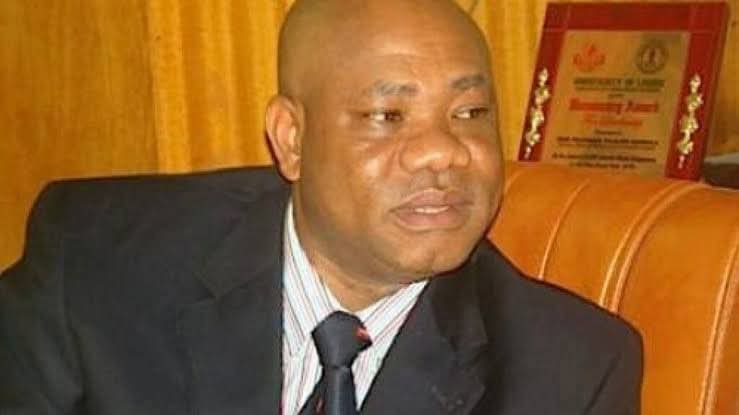
Lagos, Nigeria – A Federal High Court in Ikoyi, Lagos, has convicted Dr. Olufemi Martins Thomas, a former Executive Secretary of the National Health Insurance Scheme (NHIS), and Kabiru Sidi, a Bureau De Change operator, for their involvement in a $2,198,900.00 fraud case . Justice Ayokunle Faji delivered the judgment on Thursday, July 24, 2025 .
Thomas was found guilty of transacting beyond the legal threshold without using a financial institution and was sentenced to a fine of N10,000,000.00 . However, he was discharged on five other counts of the seven-count charge he faced . Sidi was convicted for making a false statement to an investigating officer of the Economic and Financial Crimes Commission (EFCC) and received a fine of N100,000.00 .
The EFCC’s Lagos Zonal Directorate 1 had brought an amended seven-count charge against Thomas and Sidi, primarily bordering on money laundering . Six of the counts against Thomas involved money laundering and the cash transfer of proceeds from unlawful activities, which violated the Money Laundering (Prohibition) Act, 2011 . Sidi’s charge was specifically for making false statements to an EFCC official .
Do you want to advertise with us?
Do you need publicity for a product, service, or event?
Contact us on WhatsApp +2348033617468, +234 816 612 1513, +234 703 010 7174
or Email: validviewnetwork@gmail.com
CLICK TO JOIN OUR WHATSAPP GROUP

The prosecution alleged that on or about July 3, 2015, Thomas, also known as Dr. Ike, procured his wife, Mrs. Femi Thomas, to conceal the illicit origin of the $2,198,900 . The charge against Sidi stated that on July 15, 2015, at the EFCC office in Ikoyi, he falsely claimed to have given over two million US dollars to Bamidele Ibiteye .
Both defendants pleaded not guilty, leading to a full trial . During the trial, the prosecution called six witnesses . An appellate court had previously overruled Thomas’s no-case submission, asserting that the prosecution had established a prima facie case against him . Thomas had argued that the funds were legitimately acquired through his farming businesses, providing his financial statements as evidence . The prosecution emphasized that money laundering cases require transactions to go through financial institutions to ensure transparency, as mandated by Section 1 of the Money Laundering Act .