

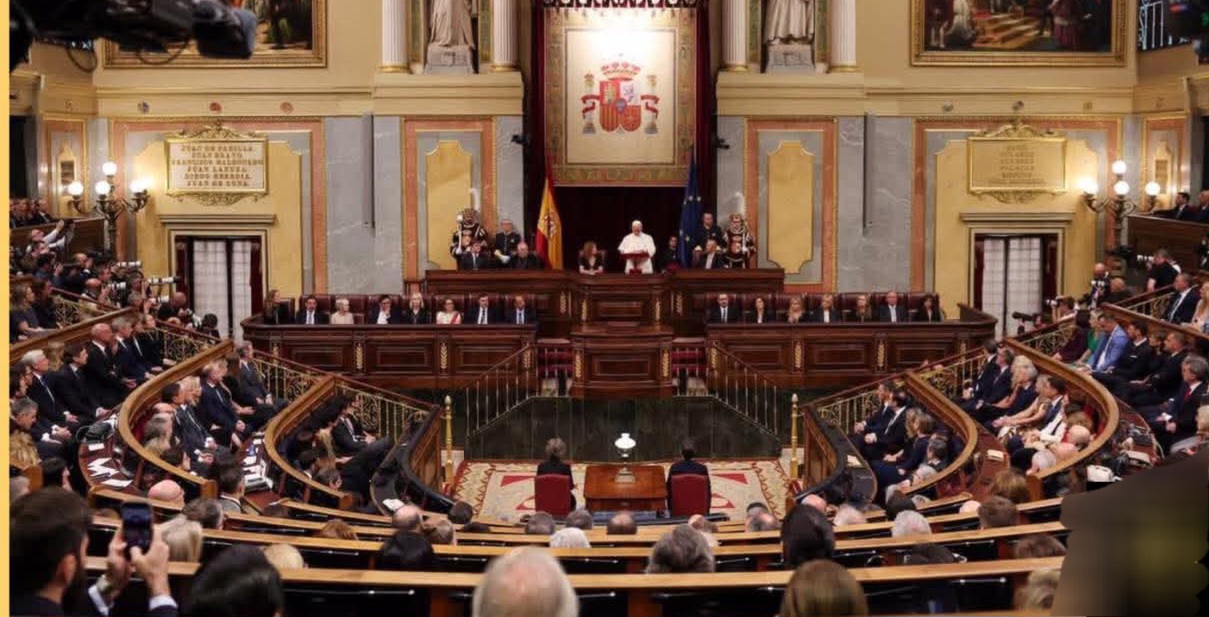
MADRID — In one of the most expansive and politically charged addresses of his pontificate, Pope Leo XIV made history on Monday by becoming the first pope ever to address a joint session of Spain’s parliament, delivering a sweeping indictment of global leadership, rising militarism, and the decay of human rights.
Speaking for 30 minutes before a packed chamber of some 700 lawmakers and guests at the Palacio de las Cortes, the pontiff warned that the international community has been plunged into a “profound spiritual and cultural crisis” fueled by violence, political polarization, and deep-seated mutual distrust.
The address arrived at an incredibly tense geopolitical moment, coming just hours after Israel and Iran traded retaliatory strikes, severely fracturing a fragile two-month ceasefire and threatening to push the Middle East back into an all-out regional war.

”Weapons can impose a temporary silence; but they can never build an authentic and lasting peace,” Pope Leo told the lawmakers, who responded at the end of his speech with a thunderous, seven-minute standing ovation.
A Stance Against Rearmament and Military AI
Hardening his anti-war rhetoric, the American-born pontiff took direct aim at the surging defense budgets across Europe. As European nations continue to scale up military spending in response to the war in Ukraine and shifting security alliances under the U.S. Trump administration, Leo labeled the rush to rearm “troubling” and a “defeat for diplomacy.”
”True security stems from justice, patient dialogue, respect for international law, and a policy capable of placing the lives of peoples above the interests that profit from war,” the Pope declared.
Extending his warnings to the digital frontier, Leo reiterated his recent calls for “rigorous ethical oversight” regarding artificial intelligence in warfare. He firmly insisted that decisions over life and death must never be delegated to automated systems, removing human moral responsibility from the battlefield.
The ‘Tragic Drama’ of Migration
A central pillar of the Pope’s address focused on the global migration crisis, an issue that serves as the centerpiece for his week-long apostolic journey to Spain. The address coincides with a major legislative push by Spain’s progressive, socialist-led coalition government—headed by Prime Minister Pedro Sánchez—which has bucked broader Western trends by moving to regularize the status of more than 500,000 undocumented migrants.
Leo framed the treatment of displaced people as a direct test of global morality, stating that the “tragic drama of migration challenges the conscience of nations and the ethical foundation of the international order.”
The pontiff demanded a two-fold approach to social justice:
- Safe and Legal Pathways: Providing dignified entry, respectful welcomes, and genuine opportunities for societal integration.
- The Right to Remain: Urging global leaders to tackle the root drivers of displacement—namely war, systemic poverty, economic inequality, and the worsening effects of the climate crisis—so families are not forced to abandon their homelands.
The Pope’s remarks carried deep domestic weight, as his itinerary includes an upcoming trip to Tenerife and Las Palmas in the Canary Islands, a perilous and heavily trafficked maritime entry point for African migrants seeking refuge in Europe.
Defending Human Life and Religious Liberty
While Pope Leo’s geopolitical stances aligned closely with Spain’s left-leaning government, he did not shy away from core Catholic doctrines that directly challenge recent Spanish legislation, such as the legalization of euthanasia and the constitutional enshrining of abortion rights.
”The defense of human life is neither a partisan issue nor a confessional interest: it is a goal of civilization,” Leo said, explicitly urging politicians not to subordinate human dignity to “shifting social consensus or the whims of the majority.” He argued that the true moral greatness of any nation is measured by its capacity to protect its most fragile citizens, “from conception to its natural end.”
The pontiff also delivered an intricate defense of the boundary between Church and state, arguing that while faith does not seek to impose itself by coercion, it “cannot be relegated to silence as though it were irrelevant to public life.” In a nod to ongoing European debates—including those in France and Spain regarding clerical abuse scandals—Leo firmly defended the absolute privacy of the Catholic seal of confession, calling it a “sacred space of inner freedom.” Following his parliamentary address, Leo met with Spanish bishops, forcefully reminding them that the Church must respond to survivors of clerical abuse “with truth, justice, and reparation.”
By weaving together the threads of war, technological advancement, migration, and social polarization, Pope Leo XIV utilized his historic platform in Madrid to position the Vatican as a resolute moral counterweight to an increasingly fragmented and militarized global landscape.
Do you want to advertise with us?
Do you need publicity for a product, service, or event?
Contact us on WhatsApp +2348033617468, +234 816 612 1513, +234 703 010 7174
or Email: validviewnetwork@gmail.com
CLICK TO JOIN OUR WHATSAPP GROUP