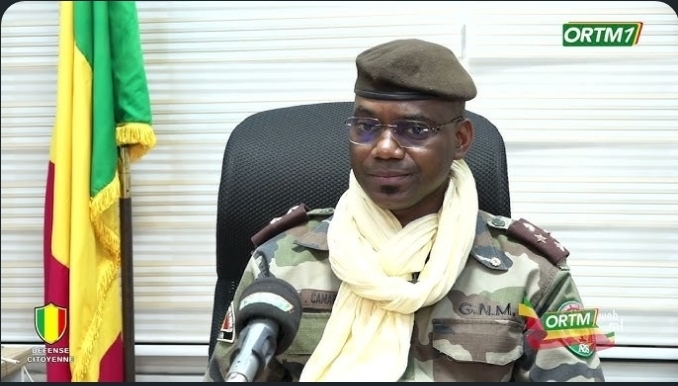
A deadly wave of coordinated attacks has ripped through Mali’s security apparatus, leaving the country stunned by the killing of its powerful Defence Minister, General Sadio Camara, in what analysts are calling the most serious assault on the junta in years.
The violence unfolded over the past 24 hours with a series of strikes on military targets across the West African nation, including Camara’s residence in the garrison town of Kati, a heavily fortified military hub just outside the capital, Bamako. Sources linked to the Malian security establishment told Al Jazeera that Camara died from injuries sustained when his house was hit by a suicide car bomb during a broader assault by fighters from the al‑Qaeda‑linked group Jama’at Nusrat al‑Islam wal‑Muslimin (JNIM) and Tuareg rebel elements from the Azawad Liberation Front.
Kati — billed as one of Mali’s most secure areas because of its dense concentration of military installations — appeared to take the sharpest blow, shaking public confidence in the junta’s ability to protect its own leadership. Heavy gunfire and explosions reverberated in Bamako and other towns, including Gao, Kidal and Sévaré, well into Sunday, as security forces scrambled to repel the fast‑moving offensive.

Camara’s death is a major political and military setback for the ruling military junta. A central architect of the 2020 and 2021 coups that brought the current regime to power, he retained outsized influence over strategic decisions, including the controversial drawdown of French forces and the import of Russian‑linked mercenaries. His assassination within such a fortified enclave is being treated as a stark indicator of the insurgents’ planning and penetration capabilities.
Despite the ferocity of the attacks, interim President Assimi Goita has been reported alive and in a secure location, with officials insisting he remains in control of the government. Security analysts warn, however, that the removal of Camara from the junta’s inner circle could deepen factional rivalries within the military and complicate Bamako’s already fragile response to a decade‑long insurgency.
The offensive has also reignited debate over Mali’s security strategy, with critics arguing that the junta’s reliance on foreign mercenaries and sidelining of Western partners has left the country more exposed to fast‑moving, multi‑front attacks. International actors, including the African Union, the Organisation of Islamic Cooperation and the United States Bureau of African Affairs, have condemned the violence and called for urgent measures to restore stability.
For ordinary Malians, the strikes have heightened fears of a spiralling security crisis, as the country already battles a protracted insurgency, political uncertainty and a worsening humanitarian situation across the north. With Camara gone and the junta on the defensive, the question now is whether the military can regroup — or whether the insurgents have opened the door to a wider and bloodier phase of Mali’s conflict.
Do you want to advertise with us?
Do you need publicity for a product, service, or event?
Contact us on WhatsApp +2348033617468, +234 816 612 1513, +234 703 010 7174
or Email: validviewnetwork@gmail.com
CLICK TO JOIN OUR WHATSAPP GROUP