

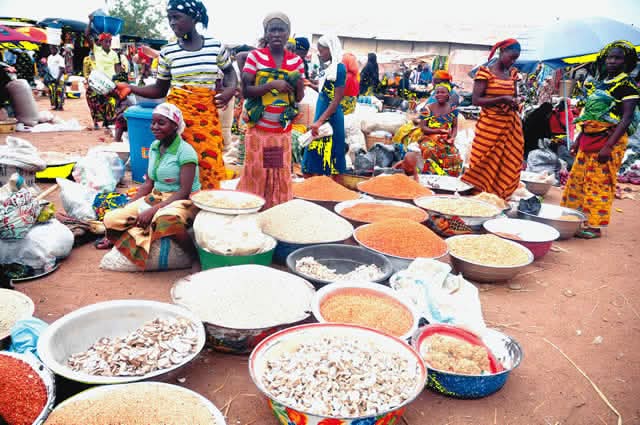
ABUJA — Nigerian households face renewed financial pressure as the prices of essential staples, including tomatoes, beans, garri, and onions, maintained an upward trajectory.
According to the latest Selected Food Prices Watch report for April 2026, released by the National Bureau of Statistics (NBS) in Abuja on Tuesday, critical food items recorded persistent month-on-month increases, further squeezing consumer purchasing power amid broader macroeconomic headwinds.
Economic analysts point to a combination of rising fuel-driven transportation costs, currency pressures, and localized security challenges across the agricultural belt as primary drivers keeping food prices elevated.

Tomato, Ginger, and Palm Oil Prices Surge
A closer look at the data highlights a sharp monthly spike in perishable items. The average price of 1kg of tomatoes rose by 6.60% month-on-month, jumping from ₦1,104.85 in March 2026 to ₦1,177.92 in April. However, on a year-on-year basis, tomato prices showed a modest relief, declining by 8.23% from the ₦1,283.57 recorded in April 2025.
Similarly, fresh ginger recorded notable price hikes, increasing by 0.73% within the month to reach ₦5,581.82 per kilogram. Unlike tomatoes, ginger has become significantly more expensive over the long term, surging 12.30% compared to its April 2025 price of ₦4,970.66.
Essential cooking commodities like palm oil also experienced upward movement, with a litre averaging ₦2,396.32—up 0.12% from March and 4.77% higher than the previous year.
Heavy Staples Show Marginal Monthly Increases, Year-on-Year Dips
For dry staples and grains, the short-term increases were more subtle, though they offer cold comfort to consumers operating on stretched budgets.
1.Brown Beans: The average price of 1kg of brown beans ticked up by 0.99% month-on-month, moving from ₦1,325.85 in March to ₦1,338.93 in April. Despite this short-term rise, the commodity remains substantially cheaper than last year, boasting a 44.89% year-on-year drop from the ₦2,429.39 peak seen in April 2025.
2.White Garri: A staple household fallback, white garri edged up by 0.93% to ₦808.96 per kilogram in April. On an annual scale, garri prices dropped by 39.86% from the ₦1,345.10 recorded in April 2025.
3.Onions: Onions mirrored this trend, climbing 0.98% over March to ₦1,164.39 per kilogram, while tracking a 22.56% decline compared to the April 2025 price of ₦1,503.56.
Industry Note: Regional baseline assessments reveal that while improved agricultural supply chains have driven down annual costs for certain dry items compared to 2025’s hyper-inflationary peaks, the escalating cost of logistics and domestic fuel has effectively wiped out those gains on a month-to-month basis.
Geopolitics of the Food Basket: Regional Disparities
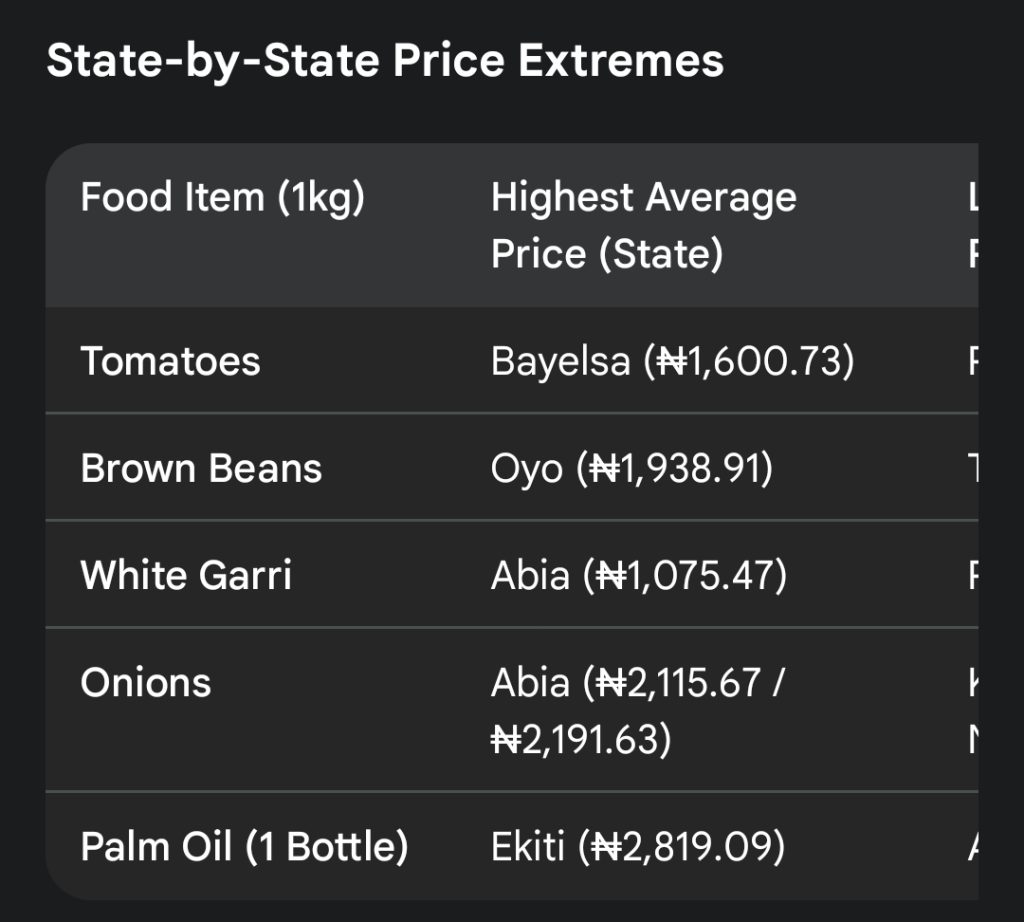
The NBS report exposed vast regional price disparities across Nigeria, largely dictated by proximity to production hubs, security situations, and local transport networks.State-by-State Price Extremes
Zonal Variations
Zonal data underscored the high cost of food distribution to the southern parts of the country. The South-South and South-East geopolitical zones recorded the highest average costs for tomatoes (₦1,561.10), white garri (₦944.58), and onions (₦1,735.53). Conversely, the North-West and North-Central zones enjoyed the lowest market rates due to direct proximity to agrarian fields, with North-Central tracking the lowest onion prices at ₦911.40.
The South-West emerged as the most expensive market for fresh ginger, hitting a peak zone-average of ₦6,812.92, contrasted sharply against the North-East, where the same quantity cost a mere ₦881.12.
As food prices remain a primary pressure point for the domestic economy, stakeholders continue to urge federal and state governments to address underlying structural failures—most notably, transport infrastructure bottlenecks and ongoing agrarian insecurity—to prevent a deeper cost-of-living crisis.
Do you want to advertise with us?
Do you need publicity for a product, service, or event?
Contact us on WhatsApp +2348033617468, +234 816 612 1513, +234 703 010 7174
or Email: validviewnetwork@gmail.com
CLICK TO JOIN OUR WHATSAPP GROUP