

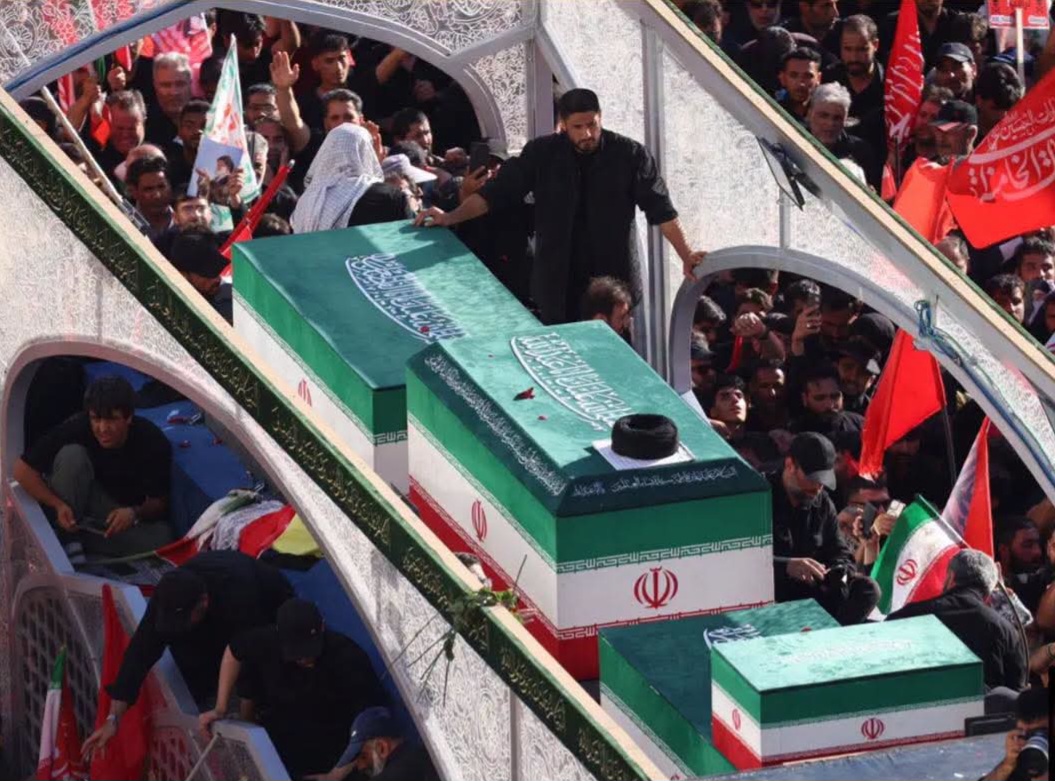
MASHHAD — Iran formally laid former Supreme Leader Ali Khamenei to rest on Friday, over four months after he was killed in a high-profile joint U.S.-Israeli airstrike. The burial at the shrine of Imam Reza in his home city of Mashhad concludes six days of funeral rites, occurring against the volatile backdrop of a collapsing ceasefire and renewed military hostilities across the Persian Gulf, ValidViewNetwork reports.
The ceremony, which featured a flag-covered coffin carried into the shrine’s memorial hall, remained heavily overshadowed by the geopolitical firestorm ignited by his death. Despite the gravity of the event, the conspicuous absence of his son and successor, Mojtaba Khamenei, dominated domestic and international scrutiny.
ValidViewNetwork reports that State officials have attributed his absence to injuries sustained during the February 28 strike, yet his failure to make a public appearance since his appointment has fueled persistent questions regarding the stability of the Islamic Republic’s new leadership.
A Region on the Brink
The interment coincided with a perilous escalation in the region. Following a series of Iranian attacks on commercial vessels in the Strait of Hormuz on July 6 and 7, U.S. forces conducted a massive wave of strikes on approximately 90 targets across Iran. President Donald Trump, citing these provocations, declared that the June memorandum of understanding aimed at de-escalating the “2026 Iran War” was effectively over, though he cautioned that the current exchange did not necessarily signal a return to full-scale, long-term conflict.
In a direct response to the U.S. campaign, Tehran has resumed strikes against American assets in Kuwait, Bahrain, and Qatar. Furthermore, reports from Jordan confirm the interception of eight missiles launched from Iranian territory, marking an expansion of the conflict theater. Iranian state media also reported damage to infrastructure near the Bushehr nuclear facility and the Tehran-Mashhad railway, further complicating the internal crisis.
Succession and Strategic Uncertainty
The burial proceedings in Mashhad were attended by key figures of the Iranian establishment, including Parliament Speaker Mohammad Bagher Ghalibaf and Chief Justice Gholamhossein Mohseni Ejei. Their presence, marked by visible displays of grief, underscored the regime’s attempt to project unity during its most precarious period since the 1979 Revolution.

However, the regime remains under immense pressure. The U.S. Treasury has moved to revoke recent sanctions waivers related to oil exports, effectively dismantling the economic incentives that had underpinned the short-lived June ceasefire. As the Iranian military continues to threaten the Strait of Hormuz—viewing the vital energy corridor as a primary strategic deterrent—defense officials in the U.S. and Israel have vowed to continue targeting Iran’s capacity to threaten international shipping.
ValidViewNetwork reports that Prime Minister Benjamin Netanyahu, following consultations with the White House, stated that Israel remains prepared to act with “even greater force” if Tehran’s provocations persist, leaving a region already reeling from months of conflict in a state of deep uncertainty.
Do you want to advertise with us?
Do you need publicity for a product, service, or event?
Contact us on WhatsApp +2348033617468, +234 816 612 1513, +234 703 010 7174
or Email: validviewnetwork@gmail.com
CLICK TO JOIN OUR WHATSAPP GROUP