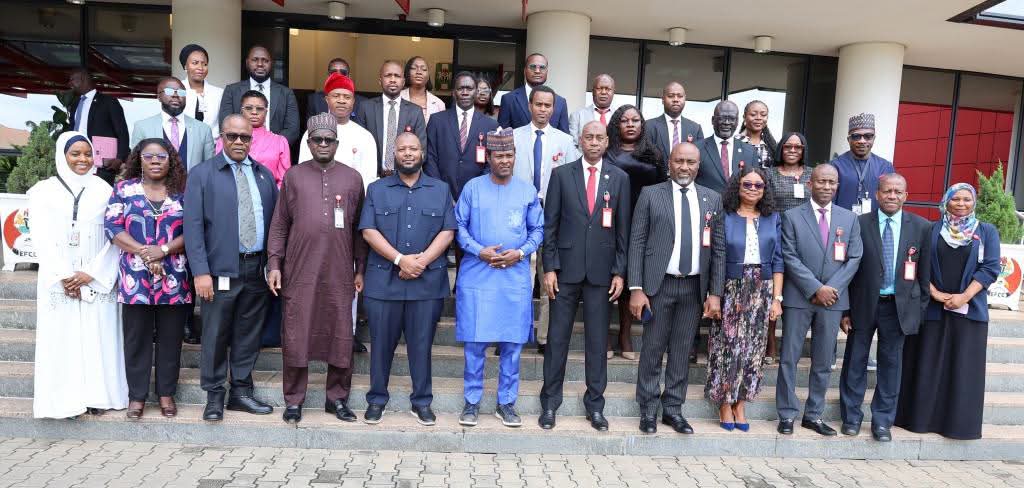
ABUJA — The Economic and Financial Crimes Commission (EFCC) and the Nigerian Financial Intelligence Unit (NFIU) have commenced a high-level, three-day stocktake at the EFCC Corporate Headquarters in Abuja. The strategic session is designed to evaluate Nigeria’s readiness for the upcoming 2027 Mutual Evaluation Exercise by the Financial Action Task Force (FATF).
The intensive review, which runs through October 2, 2026, brings together key key players from both anti-graft institutions and relevant stakeholders. The goal is to audit ongoing progress, bridge operational gaps, and reinforce inter-agency synergy before international assessors scrutinize the nation’s anti-money laundering and counter-terrorist financing (AML/CFT) frameworks.
A Collective Imperative to Avoid the Grey List
Opening the sessions, EFCC Executive Chairman Ola Olukoyede emphasized that the stocktake underscores Nigeria’s unwavering dedication to international compliance standards. Olukoyede, who was represented by the Commission’s Secretary, Muhammad Hassan Hammajoda, warned that slipping back into the regulatory penalty box is simply not an option.
”It is unimaginable that Nigeria returns to the Grey List. Issues for consideration today include use of financial intelligence, asset tracing, recovery and management, money laundering, investigation and prosecution,” Olukoyede stated.
Nigeria was previously placed on the FATF Grey List in 2022 due to identified regulatory deficiencies, which carried significant economic headwinds. However, aggressive institutional reforms and enhanced compliance measures paved the way for the country’s provisional removal from the list on October 24, 2025.
According to the EFCC leadership, the current stocktake offers a timely window to measure post-removal momentum, optimize resource deployment, and scale up enforcement activities under the Proceeds of Crime (Recovery and Management) Act 2022.
ADVERTISEMENT
ADVERTISEMENT
Shifting Focus from Technical Compliance to Real-World Results
Echoing these sentiments, NFIU Chief Executive Officer Mrs. Hafsat Abubakar Bakari—represented by the Chief Operating Officer for Law Enforcement Agencies, Emmanuel Sotande—stressed that the evaluation goes beyond checking administrative boxes.
”We gathered here not because there is a problem to solve, but because there is a standard to uphold,” Bakari noted. She added that international assessors will prioritize tangible proof of enforcement over mere legislative text.
Advertisement. Scroll to continue reading.
Providing further technical depth, the NFIU Chief of Staff, Mohammed Shahid Ahmed, highlighted lessons learned from the previous 2019 Mutual Evaluation cycle (published in 2021). Ahmed pointed out that while remedial actions successfully pulled Nigeria off the Grey List last year, the country has a narrow window to consolidate its gains ahead of the 2027 test.
Ahmed cautioned that FATF evaluators will heavily scrutinize effectiveness indicators, including:
The practical application of financial intelligence in tracking illicit funds.
Risk-prioritized investigations targeting major financial crimes.
Concrete outcomes in asset recovery, cross-border currency declarations, and successful prosecutions.
With strategic deliberations ongoing through Wednesday and Thursday, the joint stocktake aims to cement a bulletproof compliance blueprint that will safeguard Nigeria’s hard-earned financial standing on the global stage.
Do you want to share a story with us? Do you want to advertise with us? Do you need publicity for a product, service, or event? Contact us on WhatsApp +2348033617468, +234 816 612 1513, +234 703 010 7174 or Email: validviewnetwork@gmail.com CLICK TO JOIN OUR WHATSAPP GROUP