

By Dupe Olaoye-Osinkolu | Ottawa, Canada/
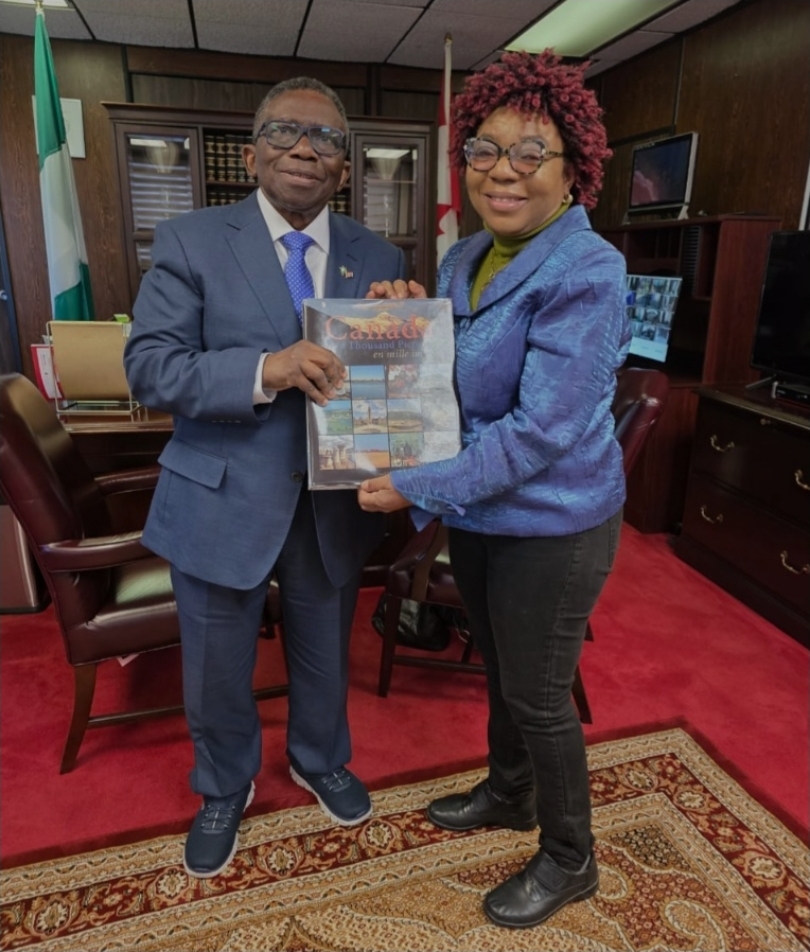
Nigeria’s High Commissioner to Canada, Emeritus Professor Isaac Folorunso Adewole, is wasting little time reframing the country’s relationship with one of its most important North American partners. In an exclusive interview, the former health minister and University of Ibadan vice-chancellor outlined an agenda that seeks to elevate Nigeria from Canada’s second-largest merchandise trading partner in Africa to its principal gateway for investment, trade and knowledge exchange on the continent.
“We’ll stop complaining about brain drain; we’ll talk about brain circulation,” Adewole said. Canada, he noted, hosts a deep pool of highly trained Nigerian professionals, particularly in healthcare and education. Rather than treating their departure as pure loss, he argues Nigeria should deliberately harness their expertise through institutional partnerships, knowledge exchange and targeted engagement—turning diaspora talent into a strategic national asset.
Adewole arrived in Canada on 24 July 2026 and formally presented his Letters of Credence to Governor General Louise Arbour at Rideau Hall on 15 September, completing his accreditation. The appointment, announced by President Bola Tinubu in March, places a physician-academic with extensive administrative experience at the head of a mission that serves one of Nigeria’s largest and most skilled diaspora communities.
Trade and the Africa Strategy Opportunity
Official Canadian figures show bilateral merchandise trade reached C$2.9 billion in 2024, making Nigeria Canada’s second-largest trading partner in Africa. Canadian exports that year centred on cereals, vehicles and machinery; Nigerian exports were dominated by petroleum, cocoa and related products. Subsequent reporting has pointed to figures in the region of C$3 billion to C$3.2 billion for 2025. Canadian direct investment in Nigeria stood at C$32 million in 2024, with portfolio investment at C$590 million.
Adewole views these numbers as a floor, not a ceiling. His timing coincides with Canada’s first comprehensive Africa Strategy, launched in March 2025 as a “partnership for shared prosperity and security.” Canadian officials have repeatedly identified Nigeria as a priority partner under the strategy, citing its economic weight, regional influence and potential as a continental gateway. Adewole wants Nigeria to occupy the central role in that framework—becoming the hub for Canadian trade, investment and economic activity across Africa, with particular focus on agriculture, mining, technology, manufacturing and healthcare.
He has floated a Nigeria–Canada investment summit for 2027 and is pressing for progress on the long-stalled Foreign Investment Promotion and Protection Agreement (FIPA). Negotiated and signed in 2014, the FIPA remains unratified by Nigeria, which has raised concerns about consistency with its own bilateral investment treaty model. Canadian envoys and business groups have repeatedly called for its revival or renegotiation, arguing it would provide greater certainty for investors on both sides.
Year-Round Farming and Mineral Potential
Agriculture features prominently in Adewole’s pitch. He has expressed admiration for Canada’s ability to maintain food security despite a short growing season and contrasts it with Nigeria’s largely unrealised capacity to cultivate crops throughout the year. “We can actually grow food 24/7, 12 over 12 in Nigeria,” he said. Closer cooperation on agricultural technology, mechanisation, food processing and productivity, he argues, could help unlock that potential.

The same logic applies to minerals. Adewole points to deposits of lithium, bauxite, gold and natural gas, citing gold exploration at Iperindo as one example of untapped opportunity. He insists the relationship must be reciprocal: Canada brings expertise and capital; Nigeria offers resources, market scale and a young, entrepreneurial population.
Direct Flights and Everyday Diplomacy
An expanded bilateral air transport agreement signed in August 2026 cleared the way for direct scheduled passenger and cargo services for the first time. It allows each country to designate multiple airlines, with capacity for up to 14 weekly passenger flights and 10 weekly all-cargo flights, plus fifth-freedom rights for cargo. Adewole said he would have preferred services to begin immediately, but acknowledged limited Nigerian airline capacity for long-haul routes. Air Peace currently focuses on Lagos–London, while the proposed national carrier Nigeria Air has yet to launch. In the interim, he suggested, a Canadian operator may take the lead. Air Canada has indicated interest in launching Lagos services in 2027, subject to approvals.
On the consular front—the issue that most directly affects Nigerians living in Canada—Adewole has moved quickly. Outdoor queues that greeted him on arrival have been addressed through a refreshed website, additional staff and volunteers in the consular section, and mobile teams that travelled across Canada to capture passport data. He estimated the outreach handled close to 4,000 passports in one recent month. He continues to urge applicants to renew when their passports have six months of validity remaining rather than waiting until the last minute.
Visa issuance remains outside the High Commission’s authority—Canadian authorities control entry decisions—but Adewole said the mission will engage on fair consideration for legitimate applicants while appealing to travellers to avoid fraudulent documents that damage Nigeria’s reputation.
A Fuller Picture of Nigeria
Beyond numbers and logistics, Adewole wants the mission to present a more balanced image of Nigeria. The country’s challenges are real, he acknowledges, but its strengths in culture, entrepreneurship, natural resources and human capital receive too little attention. “I am not saying we should pretend that we do not have bad, but let us also market the good,” he said. He sees tourism, education partnerships and people-to-people ties as under-exploited avenues.
Adewole’s first months in Ottawa will test how far a single envoy can move complex files that depend on airlines, investors, Canadian officials and Abuja’s own policy choices. Consular service improvements offer the most immediate, measurable results for the diaspora. Trade ambitions, investment protection, direct air links and the shift from “brain drain” to “brain circulation” will require sustained coordination across governments and the private sector.
What is already clear is the High Commissioner’s framing: Nigeria should approach Canada not primarily as a petitioner for investment or assistance, but as a partner with resources, expertise and market potential that make deeper engagement mutually advantageous. Whether that vision translates into concrete gains will be the story of the next several years.
Do you want to advertise with us?
Do you need publicity for a product, service, or event?
Contact us on WhatsApp +2348033617468, +234 816 612 1513, +234 703 010 7174
or Email: validviewnetwork@gmail.com
CLICK TO JOIN OUR WHATSAPP GROUP