

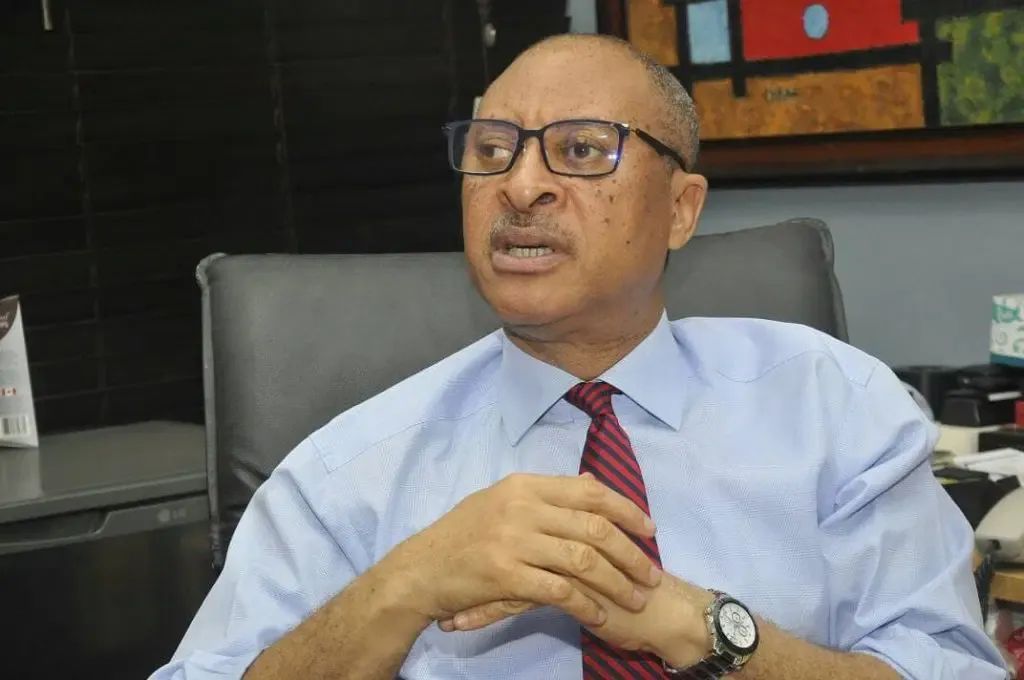
ABUJA — The Presidency has launched a scathing rebuttal against renowned political economist Professor Pat Utomi, following his description of President Bola Tinubu’s economic reform agenda as a “ridiculous Ponzi scheme.”
In a pointed statement issued on Wednesday, April 15, 2026, the Special Adviser to the President on Media and Public Communication, Sunday Dare, dismissed Utomi’s remarks as “alarmist rhetoric” and “intellectual overreach.” Dare argued that the professor’s critique lacked analytical depth and ignored the structural necessity of the current administration’s policies.
”Intellectually Hollow”
The friction began after Utomi, a frequent critic of the administration, labeled the government’s reform programme “poorly structured” and likened it to a fraudulent financial scheme.
Responding to these claims, Dare stated that calling a national reform programme a Ponzi scheme was not only provocative but “intellectually hollow.” He maintained that while a Ponzi scheme is built on zero value creation and deception, the Tinubu administration is actively dismantling decades of “rent-seeking architecture.”
”If anything resembled a Ponzi structure, it was the previous regime of borrowing to sustain consumption, subsidizing inefficiency at scale, and masking structural weakness with artificial stability,” Dare asserted.
A Clash of Records
The Presidency’s response took an unusually personal turn, with Dare questioning Utomi’s moral and professional standing to offer economic advice. He referenced Utomi’s past involvement with Volkswagen Nigeria and BankPHB, both of which faced significant corporate challenges and eventual collapses.
Dare suggested that Utomi’s commentary reflected a “disconnect” between his academic theorizing and the practical realities of managing a complex economy. He framed the professor as part of a class of commentators who “theorized dysfunction instead of dismantling it” for years.

Defending the Reform Trajectory
The Presidency utilized the opportunity to double down on its economic milestones, citing several key indicators as evidence of progress:
- Subsidy Removal: Dare noted that the elimination of the fuel subsidy in May 2023 removed a massive fiscal burden, leading to materially higher FAAC disbursements to state governments.
- FX Unification: The unification of exchange rates was defended as an essential step toward transparency and “price discovery,” ending the era of arbitrage where a privileged few benefited from multiple windows.
- Fiscal Liquidity: The statement pointed to improved non-oil revenue performance and a marginal easing of debt service-to-revenue pressure as signs that the “painful but necessary” reforms are beginning to yield fruit.
Growing Political Tension
The exchange comes at a time of heightened political activity. Professor Utomi has recently been linked to efforts by opposition figures to form a formidable coalition ahead of the 2027 elections. Only weeks ago, Utomi warned that Nigeria was drifting toward “one-man rule,” a claim the Presidency has consistently denied.
As the debate over Nigeria’s economic direction intensifies, the Presidency maintains that dissent is welcome in a democracy, but insists it must be “evidence-based” rather than “playing to the gallery.”
Do you want to advertise with us?
Do you need publicity for a product, service, or event?
Contact us on WhatsApp +2348033617468, +234 816 612 1513, +234 703 010 7174
or Email: validviewnetwork@gmail.com
CLICK TO JOIN OUR WHATSAPP GROUP