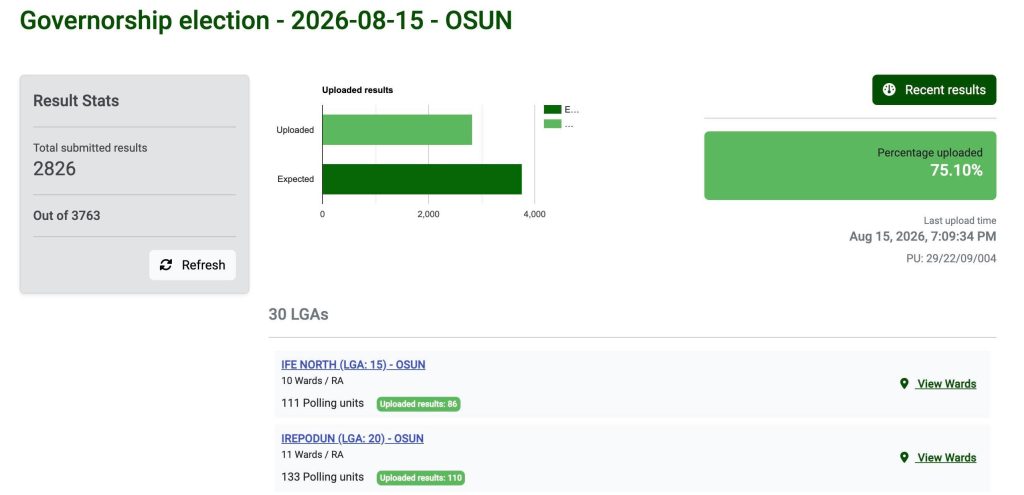
The most revealing story emerging from Osun’s governorship election may not be the size of Ademola Adeleke’s lead alone.
It is where the votes are coming from. Fresh results uploaded to INEC’s Result Viewing Portal, IReV, now put the Accord Party candidate at 255,994 votes, against 214,138 for APC’s Bola Oyebamiji.The difference is 41,856 votes.
The numbers have transformed what began as a volatile two-horse race into an increasingly difficult chase for Oyebamiji. But the polling-unit results tell an even more interesting story.
Across Osun, some of the state’s most recognisable political names have discovered that their personal influence does not necessarily travel with them into the ballot box.
Former Governor Bisi Akande’s polling unit went to Oyebamiji, while the polling unit associated with former Governor Olagunsoye Oyinlola went to Adeleke.
Former Deputy Governor Iyiola Omisore’s unit also went to Accord. And at the polling unit of APC Deputy Governorship Candidate Kayode Adereti, the APC won, but by only six votes.
The election is therefore producing something more interesting than a simple victory for one political camp.It is exposing the limits of political machinery.
Akande’s unit stays with APC
At the polling unit where former Osun Governor and APC founding interim National Chairman Bisi Akande voted, Oyebamiji secured 181 votes, defeating Adeleke’s 121.
The APC margin was 60 votes. It was precisely the kind of result the APC would have expected from one of its most prominent political territories.
But it also needs to be placed beside the wider IReV picture. One strong polling-unit victory does not translate into statewide dominance. Oyebamiji currently trails Adeleke by almost 42,000 votes as at the time of filing this report.

Oyinlola’s unit tells the opposite story
If Akande’s polling unit behaved as expected, Oyinlola’s did not. At the polling unit associated with former Governor Olagunsoye Oyinlola, Accord secured 125 votes, while APC recorded 85.
Adeleke therefore won the unit by 40 votes. That is significant because Oyinlola had backed Oyebamiji. The result demonstrates something that is easy to forget during Nigerian election campaigns.
Endorsements are not ballots. A politician can campaign for a candidate.A voter still decides what enters the ballot box.
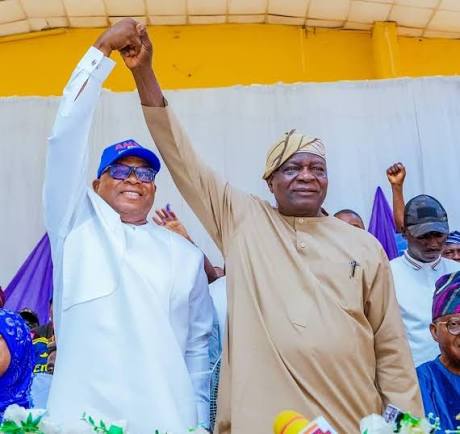
Omisore’s unit also falls to Adeleke
The pattern continued at the polling unit associated with former Osun Deputy Governor Iyiola Omisore. Accord secured 131 votes, while APC recorded 85. ADC had 10.

Adeleke therefore won the unit by 46 votes. Omisore’s political history in Ife and his relationship with the APC made the result particularly notable. It showed again that political alignments at the elite level do not always reproduce themselves at the polling unit.

Adereti wins, but barely
APC Deputy Governorship Candidate Kayode Adereti had a more favourable result at his own polling unit in Ilare, Ife Central. APC recorded 132 votes. Accord followed with 126. ADC scored 11.
The APC victory was therefore only six votes.That is an instructive result. A party’s deputy governorship candidate could win his own polling unit and still find that more than 40 per cent of voters there chose his opponent.
It is another indication of how competitive the grassroots contest remains, even as Adeleke’s statewide lead grows.
Olajengbesi delivers his own territory for Accord
Pelumi Olajengbesi, a prominent spokesman for Adeleke’s campaign, also recorded a victory for Accord at his polling unit. The result adds another small piece to the larger puzzle.
Political operatives are expected to deliver their immediate territories. But what matters more is whether those local victories accumulate into a statewide advantage.
At the moment, Adeleke has the advantage on that broader arithmetic.
Oyetola’s polling unit raises a different question
The result from former Governor Gboyega Oyetola’s polling unit in Boripe is one of the most contentious episodes of the count.
The polling unit is associated with Oyetola, now Minister of Marine and Blue Economy. A report of an eyewitness from the location said APC-linked agents allegedly interrupted the counting and demanded that Accord ballots be voided.
The presiding officer initially resisted. The report said that after security personnel moved away, an APC agent and another individual allegedly used electoral ink to thumbprint Accord ballot papers. The announced figures included 242 APC votes, five ADC votes and smaller numbers for other parties, but no Accord figure was announced.
That means this result should not be presented as an Adeleke victory. It also should not be presented as a clean APC victory without acknowledging the dispute over the unannounced Accord ballots.
The proper place for the result is therefore in the category of contested polling-unit results requiring clarification through the electoral process. That is precisely why the IReV sheets and official collation matter.
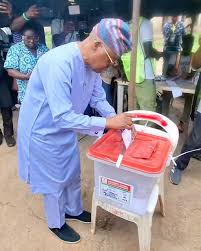
The bigger number is 41,856
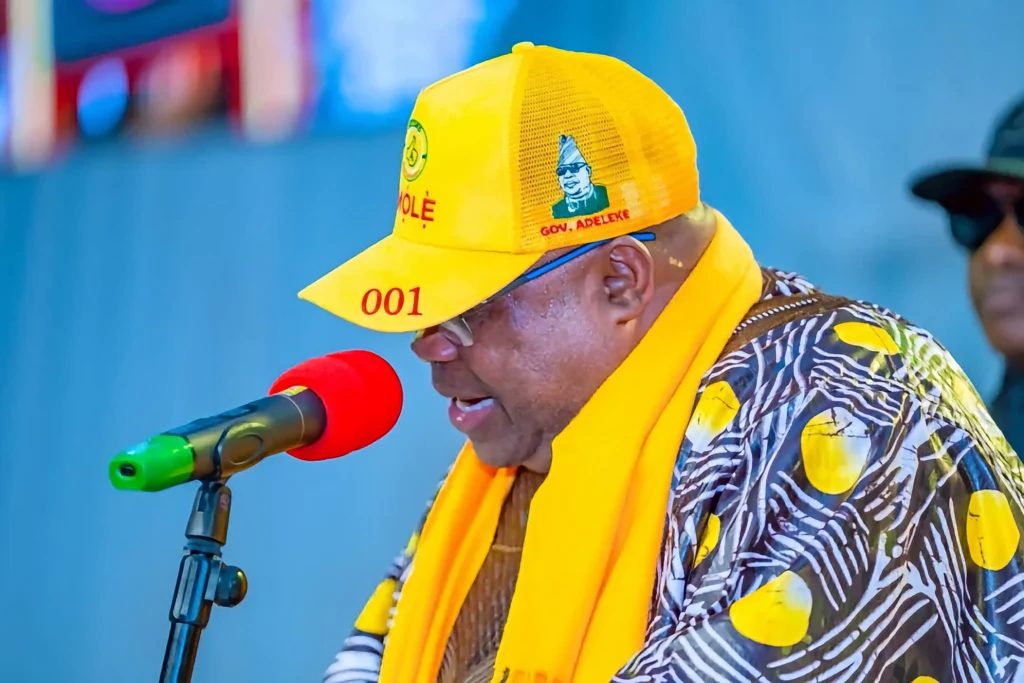
All of these individual results are interesting. None, however, is as important as the statewide arithmetic now emerging.
Adeleke: 255,994
Oyebamiji: 214,138
Salam: 41,856
That is the central fact of the election at this stage. The incumbent has moved beyond merely holding a narrow advantage.
He has built a lead that would require a substantial reversal in the outstanding results to overturn. Yet the election remains formally unfinished.
The IReV uploads are still progressing, and the Returning Officer must complete the statutory collation before declaring the winner.
The political class has not completely lost its gripI
It would also be wrong to conclude that political structures have become irrelevant. They clearly have not. Akande’s unit went APC. Adereti’s unit went APC.
APC has produced strong results in several of its traditional territories. The party has a functioning electoral machine.
But the emerging evidence suggests that its machine is not producing the kind of statewide advantage it needs.
Meanwhile, Accord has demonstrated an ability to win outside Adeleke’s immediate political home. Oyinlola’s unit went Accord. Omisore’s unit went Accord. Olajengbesi’s unit went Accord.
That matters more than the personalities attached to those polling units.
The IReV picture now favours Adeleke
Do you want to advertise with us?
Do you need publicity for a product, service, or event?
Contact us on WhatsApp +2348033617468, +234 816 612 1513, +234 703 010 7174
or Email: validviewnetwork@gmail.com
CLICK TO JOIN OUR WHATSAPP GROUP
The latest numbers make the immediate electoral arithmetic straightforward.
Adeleke is ahead by 41,856 votes. Oyebamiji remains the only candidate with a realistic numerical path to catching him among the leading contenders.
But the APC candidate now needs the outstanding results to do more than merely favour him. They must favour him decisively enough to erase a 41,856-vote deficit.
That is the challenge.
For Adeleke, the task is different. He needs to preserve the advantage already accumulated.
And as the IReV figures continue to move, every additional result that maintains or widens that gap brings the incumbent closer to a second-term victory.
No premature declaration
There is still a line that responsible election reporting should not cross. A candidate leading on IReV is not automatically the declared winner.
The official result belongs to INEC’s completed collation and declaration process.The numbers have moved. And they have moved substantially.
ValidViewNetwork reports that the latest IReV figures place Ademola Adeleke on 255,994 votes and Bola Oyebamiji on 214,138, giving the Accord candidate a 41,856-vote lead as collation continues.
The individual polling units add another layer to the story. Akande’s unit went APC.Oyinlola’s went Accord.Omisore’s went Accord. Adereti’s went APC by six votes. Olajengbesi’s went Accord. Oyetola’s unit remains surrounded by a dispute over the counting of Accord ballots.
Together, those results tell a story of an electorate that is not voting as predictably as the political establishment might have hoped.
And that may be the defining image of OsunDecides2026. The politicians built the alliances. The voters are deciding what those alliances are worth.