

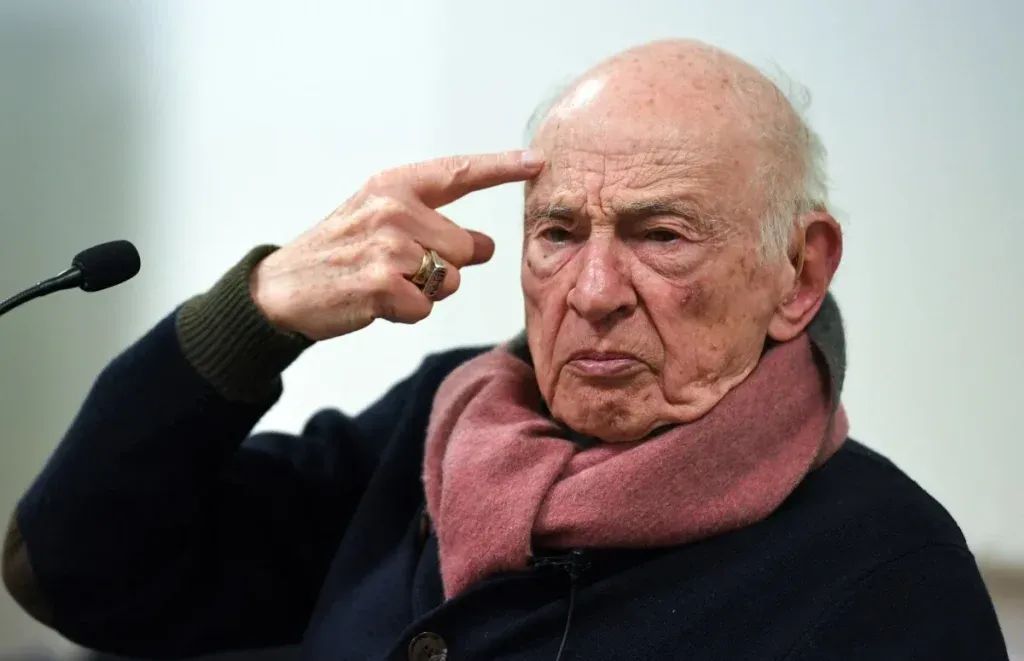
PARIS — Edgar Morin, the dapper, globally revered French philosopher, sociologist, and World War II Resistance veteran who spent over a century interrogating the human condition, has died. He was 104.
His wife, Sabah Abouessalam Morin, confirmed his passing on Saturday, May 30, 2026, noting that he died on May 29, just six weeks shy of his 105th birthday.
”Until his final days, Edgar Morin remained attentive to the world, to others, and to the great human issues that nourished his thinking,” she said in a statement. “Today, the void he leaves behind is immense. But his courage, his loyalty to people and to ideas, his moral rigor and his hope continue to accompany us.”
Lovingly profiled by the left-wing Liberation newspaper in 2021 as “the grandfather of all French people and the memory of the last century,” Morin was an intellectual titan known as much for his signature hats and silk cravats as for his sweeping philosophical frameworks.

French President Emmanuel Macron paid tribute to the late thinker on X (formerly Twitter), praising him as “humanism personified” and adding that “with his kindness and curiosity, he never stopped enlightening us.”
The Architect of ‘Complex Thought’
Born Edgar Nahoum in Paris on July 8, 1921, to secular Jewish immigrants from Greece, he later adopted the pseudonym “Morin” during his time in the French Resistance.
Though trained as a sociologist, Morin preferred the title “humanologist.” He famously rejected intellectual silos, choosing instead to pioneer a holistic paradigm known as “complex thought” (pensée complexe). His masterwork, the multi-volume La Méthode (The Method), fused elements of physics, biology, psychology, ethnography, and history to understand humanity and transcend traditional academic boundaries.
Morin is also credited with coining the term “polycrisis,” a concept that has become central to modern global discourse. He used it to describe how interconnected crises—ranging from the climate emergency and economic instability to rising nationalism—dynamically feed into and amplify one another.
Outside of academic circles, Morin left an indelible mark on cinema history. Alongside filmmaker Jean Rouch, he co-created the landmark 1961 documentary Chronique d’un été (Chronicle of a Summer), effectively inventing the genre of cinema verité. By asking ordinary Parisians the deceptively simple question, “Are you happy?”, the film revolutionized documentary filmmaking through unscripted, raw dialogue about race, class, and colonialism.
A History of Defiance and Self-Critique
Morin’s life was defined by intellectual independence and a refusal to bow to institutional dogma. Following the traumatic loss of his mother when he was just 10 years old—an event he later termed his “personal Hiroshima”—he found solace in left-wing activism.
He joined the Communist Party during the dark days of the Nazi occupation, actively participating in the underground Resistance. However, his unyielding free-thinking nature soon put him at odds with the party hierarchy. In 1951, he was expelled for writing an article deemed pro-American.
Rather than turning bitter, the experience inspired his book Autocritique, a seminal text on the psychological dangers of political indoctrination and the vital necessity of constant self-questioning.
He was remarkably prescient on environmental issues, warning as early as the 1970s of the planetary dangers tied to unchecked economic expansion. He remained an influential, if sometimes polarizing, voice on the global stage. In 2002, a highly critical article he penned regarding Israel’s treatment of Palestinians led to a controversial defamation conviction that was later overturned by France’s highest appeals court, earning him widespread solidarity among global academics.
’Not Fatalistic’ to the End
Well into his centenarian years, Morin remained an active participant in public life, frequently updating his 220,000 followers on X with sharp observations on contemporary issues, including the climate crisis and the war in Ukraine.
A prolific author who published his last book in 2025, Morin frequently warned that humanity was blindly “marching towards the abyss,” yet he remained stubbornly hopeful.
Do you want to advertise with us?
Do you need publicity for a product, service, or event?
Contact us on WhatsApp +2348033617468, +234 816 612 1513, +234 703 010 7174
or Email: validviewnetwork@gmail.com
CLICK TO JOIN OUR WHATSAPP GROUP
Frequently quoting the German poet Friedrich Hölderlin, Morin’s life philosophy was encapsulated in a single phrase he used to combat despair: “Wherein lies the danger also grows the saving power.”