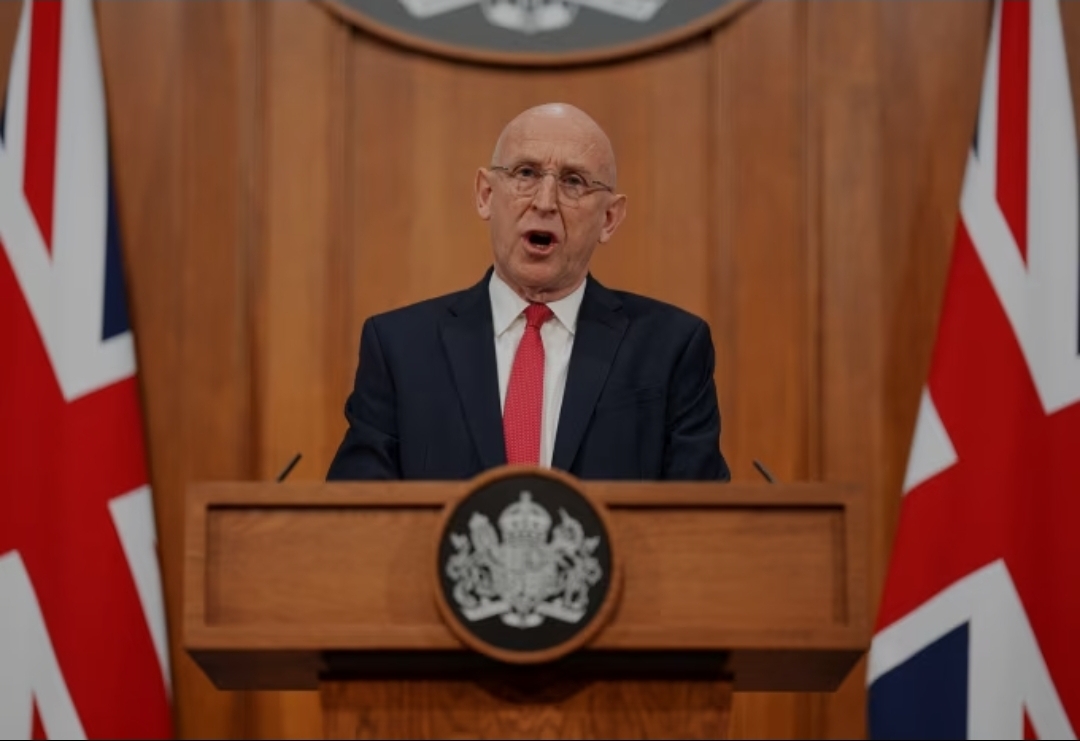
London/AP — Britain and Norway spearheaded a high-stakes, weeks-long naval operation to shadow and repel Russian submarines prowling near vital undersea communication cables in the North Atlantic, UK Defence Secretary John Healey revealed Thursday.
The mission, involving a Royal Navy frigate, surveillance aircraft, and hundreds of personnel, tracked an attack submarine alongside two spy vessels operating north of Scotland. Healey accused Moscow of exploiting global focus on the Iran conflict to escalate “malign activity” against Europe, forcing the Russian flotilla to retreat after more than a month of cat-and-mouse surveillance.
“We see your activity over our cables and pipelines,” Healey warned Russian President Vladimir Putin directly. “Any attempt to damage them will not be tolerated and will invite serious consequences.”
Norway’s Defence Minister Tore Sandvik confirmed the incursions unfolded in and around Norwegian and British waters, orchestrated by Russia’s secretive Main Directorate of Deep Sea Research (GUGI). This elite unit, embedded in the Russian navy, specializes in deep-ocean mapping and sabotage capabilities. Norwegian officials noted GUGI’s subs are engineered for peacetime reconnaissance of critical infrastructure—like the fiber-optic cables carrying 95% of global internet traffic and financial data—and wartime disruption.
The episode echoes NATO’s mounting alarms over Russia’s “shadow fleet” of spy ships. Recent intelligence, shared via Reuters and NATO briefings, links GUGI to prior Baltic Sea probes and the 2024 severing of cables between Sweden and Finland, which Helsinki blamed on deliberate Russian anchoring (though Moscow denied involvement). In November 2025, Britain had already shadowed the notorious Yantar spy ship off Scotland’s coast, signaling readiness for escalation.
This latest standoff occurred within the UK’s exclusive economic zone—extending 200 nautical miles from shore—but outside territorial waters, avoiding direct confrontation. Unnamed allies joined the effort, underscoring NATO unity despite strains from the US-Iran flare-up.

Healey framed the operation as a riposte to Putin’s strategy of distraction. “Putin wants our eyes on the Middle East,” he said at a London press conference, highlighting Russia’s drone supplies to Iran and oil shipments via its sanctions-busting “shadow fleet.” Britain announced last month it’s prepared to board and seize such vessels, shifting from mere monitoring alongside France and the US.
For global energy markets, including Nigeria’s oil-dependent economy, the stakes are acute. The North Atlantic cables parallel key pipelines like the Nord Stream network—damaged in 2022 under murky circumstances—potentially threatening supply chains if sabotaged. Analysts at the Royal United Services Institute warn such hybrid tactics could spike commodity prices worldwide.
Russia dismisses the accusations as NATO paranoia, but Healey insisted: “Russia remains the principal threat to the UK and its allies. We will not look away.”
The disclosure comes amid swirling global flashpoints: US strikes on Iran’s Kharg Island oil facilities, Russian claims of advances in eastern Ukraine, and North Korea’s cluster-bomb missile tests.
Do you want to advertise with us?
Do you need publicity for a product, service, or event?
Contact us on WhatsApp +2348033617468, +234 816 612 1513, +234 703 010 7174
or Email: validviewnetwork@gmail.com
CLICK TO JOIN OUR WHATSAPP GROUP