

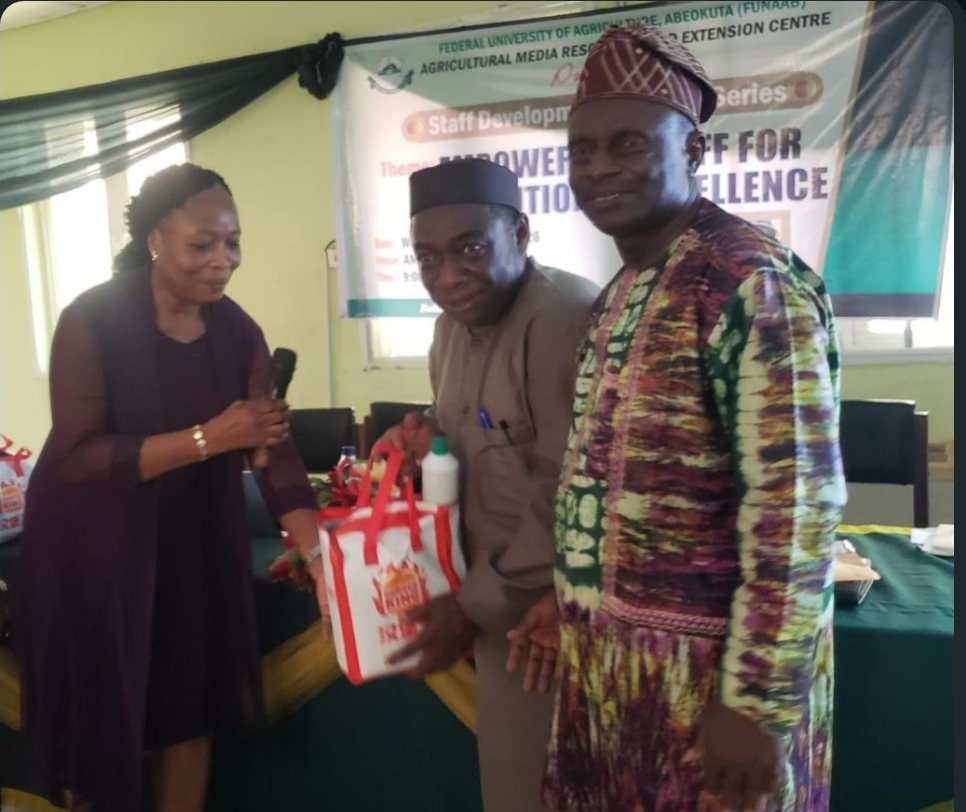
ABEOKUTA – A former Deputy Vice-Chancellor of the Federal University of Agriculture, Abeokuta (FUNAAB), Prof. C.O.N. Ikeobi, has declared that Nigeria’s quest for food security hinges more on the professional work ethic of its agricultural personnel than on mere funding.
Delivering a hard-hitting presentation titled “AMREC Work Ethics: Building a Strong Foundation for Success,” the renowned scholar warned that technical expertise without discipline is “toxic” and could derail the nation’s agricultural transformation.
The lecture was targeted at staff of the Agricultural Media Resources and Extension Centre (AMREC), FUNAAB’s strategic arm responsible for bridging the gap between laboratory research and rural farmers.
The Danger of ‘Toxic Competence’
Prof. Ikeobi emphasized that ethics represent the “internal compass” that guides behavior in the absence of supervision. He raised an alarm over “toxic competence”—a scenario where highly skilled professionals lack the integrity or discipline required to function within a team.
“As the bridge between research and rural farmers, AMREC must prioritize reliability. A delay in communicating pest control measures or climate information due to a poor work ethic can have devastating consequences for a farmer’s livelihood,” Ikeobi noted.
He identified several core pillars for institutional success:
- Integrity and Accountability: Taking ownership of tasks without constant policing.
- Professionalism: Maintaining high standards in data collection and dissemination to prevent crop losses.
- Teamwork and Loyalty: Avoiding complacency and fostering a proactive problem-solving culture.
Moving Beyond Rigid Supervision
To modernize the university’s outreach efficiency, the don advocated for a transition from traditional, rigid supervision to a “coaching-based” management style. He urged leadership to embrace fairness in discipline, noting that selective enforcement of rules destroys institutional trust.

“The soil of success is work ethic,” Ikeobi declared, challenging the staff to view themselves as national development partners rather than routine civil servants.
Embracing Digital Extension
Earlier, the Director of AMREC, Prof. Olalekan Jacob Olaoye, noted that the center is currently grappling with modern challenges such as climate variability, post-harvest losses, and the need for sustainable aquaculture.
Prof. Olaoye called for a paradigm shift in how knowledge is delivered to the grassroots. He advocated for the adoption of:
- Digital Extension Services: Utilizing technology to reach farmers faster.
- Participatory Methodologies: Engaging farmers directly in the solution-finding process.
- Value Chain Interventions: Ensuring research impacts every stage of production, from planting to the market.
The training session, which aimed at repositioning the center for greater impact in Ogun State and across Nigeria, also featured presentations from the Deputy Director, Prof. Olalekan Oyekunle, and Prof. Oluwakemi Irhekore.
Do you want to advertise with us?
Do you need publicity for a product, service, or event?
Contact us on WhatsApp +2348033617468, +234 816 612 1513, +234 703 010 7174
or Email: validviewnetwork@gmail.com
CLICK TO JOIN OUR WHATSAPP GROUP