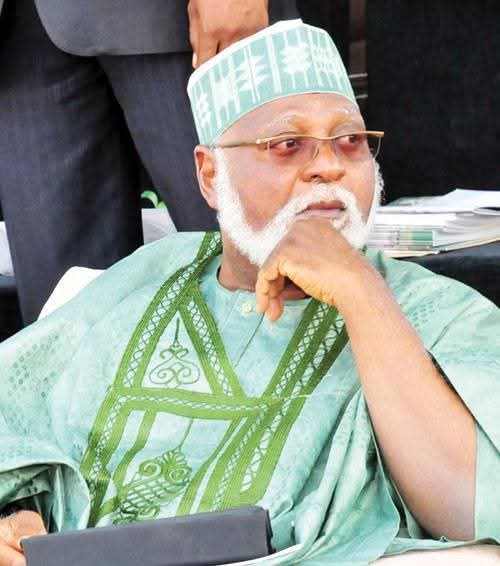
Former Head of State, Gen. Abdulsalami Abubakar (retd.), has pulled back the curtain on the intense behind-the-scenes maneuvers that birthed Nigeria’s Fourth Republic. He revealed that he explicitly advised Gen. Olusegun Obasanjo to abandon his 1999 presidential ambitions immediately after his release from prison.
In his newly released 264-page autobiography, Call of Duty, launched at the State House in Abuja to mark his 84th birthday, Abdulsalami details how he told the eventual election winner to “go home and thank God he was alive” rather than seek the nation’s highest office.
The high-profile book launch, which doubled as a national reflection on power and sacrifice, was attended by notable figures including former Presidents Olusegun Obasanjo and Goodluck Jonathan. President Bola Tinubu, represented by Vice President Kashim Shettima, praised Abdulsalami as a statesman who chose to relinquish power when others sought to hold onto it. The event also generated nearly ₦2 billion in donations and pledges for the newly proposed Africa Resource Centre, backed by a federal land allocation in Abuja.
The Blunt Advice to Obasanjo
According to Chapter 22 of the memoir, Obasanjo approached Abdulsalami in 1998 shortly after being freed from his wrongful imprisonment under the late Gen. Sani Abacha. Obasanjo harbored two pressing concerns: a desire to sue the Federal Government for wrongful detention and an invitation from the Peoples Democratic Party (PDP) to run for president.
Abdulsalami writes that he was blunt with his former senior officer on both issues:
”I was forthright with him. One, I advised him that he should not take the government to court because it might not augur well… The court process was uncertain, I told him. I tried to dissuade him from pursuing the litigation option, and he agreed with me.
”On the invitation by the PDP that he should run in the presidential race, I advised him to return home and thank God that he was still alive after all he had gone through in four years. I told him point-blank that he should forget about contesting to be President.”
Although Obasanjo promised to think it over and revert, Abdulsalami notes that “he never got back to me.”
Despite the widespread belief that the military establishment engineered Obasanjo’s subsequent victory, Abdulsalami strongly rejects the claim. He insists his administration maintained strict neutrality, granting a blanket pardon to all political prisoners rather than favoring an individual.
Bending the Rules for the South-West
In another major revelation, Abdulsalami admits that his administration deliberately manipulated its own guidelines to ensure the Alliance for Democracy (AD)—the political face of the National Democratic Coalition (NADECO) and the Yoruba socio-cultural group Afenifere—was registered as a political party.
The transition guidelines required registering parties to establish a functional presence in two-thirds of Nigeria’s 36 states. While the PDP and the All Peoples Party (APP) cleared this hurdle easily, the AD was heavily localized in the South-West and failed the criteria.
Recognizing that excluding the region would jeopardize national unity, Abdulsalami says the military high command chose pragmatism over rigid protocols.
”We had to apply some wisdom and flexibility,” he explains. “We tinkered with the rules and said any party that came third would be registered. That was how AD scaled through. We did not want to create a system in which the South-West would feel marginalised… The rules were made by humans and for humans.”
Resisting Pressures to Extend Military Rule
The memoir sheds light on why the handover date was set for May 29, 1999, rather than the October 1998 timeline originally promised by Abacha. Abdulsalami states that Abacha’s transition framework lacked any credibility and had to be completely discarded.
The final timeline was dictated by the judiciary. While Abdulsalami initially pushed for a rapid six-month handover by March 1999, the then Chief Justice of Nigeria, Justice Muhammadu Uwais, insisted on a mandatory 60-day window post-election to allow tribunals to clear all political litigations before an inauguration could take place.
Surprisingly, the pressure to delay the transition did not just come from internal military elements or West African heads of state—it also came from pro-democracy activists. Abdulsalami reveals that several NADECO members, realizing the transition was moving too quickly for them to mount an effective political campaign, approached him privately to ask for an extension.
He countered their request with a challenge:
”I promised that if they did that [write a formal letter and hold a public press conference requesting an extension], I would grant an extension. But they never did. I knew they wouldn’t. We went ahead with our programme.”
Dispelling Historic Rumors
Beyond the 1999 election logistics, Call of Duty addresses some of the darkest mysteries of that era. Abdulsalami forcefully denies the long-standing conspiracy theory that Chief MKO Abiola, the presumed winner of the June 12, 1993 election, was poisoned in government custody.
He notes that an international team of pathologists from Nigeria, the US, the UK, and Canada conducted an autopsy at the family’s request and concluded Abiola died of natural causes related to long-standing, pre-existing health conditions. The book cites accounts from US diplomats Susan Rice and Thomas Pickering, who were in the room when Abiola suffered severe respiratory distress.

Furthermore, Abdulsalami dismisses claims that he personally enriched himself with $500 million in cash from the central bank following Abacha’s death, calling the allegations “entirely fictitious.”
Reflecting on the eve of the May 29, 1999 handover, the former Head of State recalls sleeping soundly, relieved to have pulled Nigeria back from the brink of collapse. “I had made up my mind to relinquish power within the shortest possible time… I was happy that as much as possible, we had brought peace to the country and stabilised the military too.”
Do you want to advertise with us?
Do you need publicity for a product, service, or event?
Contact us on WhatsApp +2348033617468, +234 816 612 1513, +234 703 010 7174
or Email: validviewnetwork@gmail.com
CLICK TO JOIN OUR WHATSAPP GROUP