

‘They’re an Evil Group of People’: Trump Takes Aim at ICC at UN
There are many ways to disagree with a court.Donald Trump apparently had a few more colourful ones.
Standing before the United Nations General Assembly in New York, the US president turned his attention to the International Criminal Court and delivered one of the sharpest attacks on the institution from the UN podium.
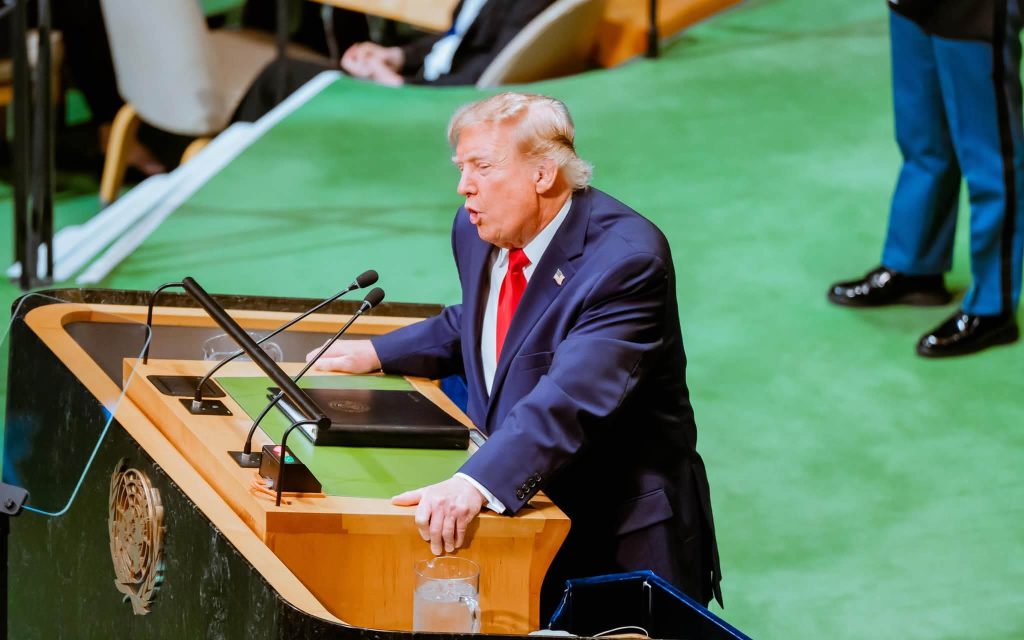
Trump called the ICC an “out-of-control institution”, described it as a “rogue institution”, and then went further.
“They’re an evil group of people,” he said. He also urged every country belonging to the ICC to leave the court immediately.
The remark was not an isolated line in Trump’s speech. It formed part of a broader argument that the United States should not accept international institutions exercising authority over Americans without Washington’s consent.
And that is where the colourful language meets a serious legal and diplomatic dispute.
Trump: ‘Resign Immediately’
Trump told world leaders that the United States would not permit American service members or other US citizens to face what he described as “show trials” before what he called an anti-American tribunal.
He then issued his appeal directly to ICC member states. “I call on all nations that are members of the ICC to officially resign from this rogue institution immediately,” Trump said.
The United States is not a member of the ICC and has never ratified the Rome Statute, the treaty that established the court.
The court currently has 125 member states and was created to prosecute individuals for genocide, crimes against humanity, war crimes and the crime of aggression when national legal systems are unable or unwilling to act.
So Trump’s message was not simply, “America is leaving.” America was never formally inside.
His demand was that countries that are inside should consider walking out too.
Why Trump Is Angry With the Court
The confrontation has been building for years. The Trump administration has opposed the ICC over investigations involving alleged crimes by US forces in Afghanistan and over the court’s actions concerning Israeli officials.
The administration has also been preparing broader sanctions against the institution.
According to findings by ValidViewNetwork, the proposed measures could target the ICC as a whole and affect its roughly 900 employees, including through restrictions involving the US financial system and travel.
Trump’s criticism therefore comes as part of a wider American campaign against the court rather than as a sudden disagreement born inside the UN hall.
Washington argues that the ICC threatens US sovereignty and has no jurisdiction over Americans. The court and its supporters take a different view of its role and jurisdiction under international law.
That disagreement is at the heart of the confrontation.
But Europe Is Not Taking Trump’s Advice
Trump’s call for an ICC mass exit did not receive an immediate European embrace.
Germany’s foreign minister, Johann Wadephul, said on Wednesday that Berlin considers the court important for protecting international law and human rights.
He argued that the world still needs an international judicial mechanism capable of holding individuals accountable for war crimes and crimes against humanity.
That response highlights the larger diplomatic question created by Trump’s speech.
The argument is no longer simply about whether Washington likes the ICC. It is about what role international courts should play when powerful countries disagree with their decisions.
A Bigger Fight Than One Speech
The ICC has never enjoyed universal acceptance. The United States, China, Russia and Israel are among the countries outside the Rome Statute system.
But the court’s existence reflects a broader effort to create a mechanism for dealing with some of the world’s gravest crimes when domestic courts fail to do so.
Trump’s position challenges that model directly. His argument is that no international tribunal should have authority over Americans without US consent.
Supporters of the ICC argue that international accountability would lose much of its meaning if national power alone could shield individuals from prosecution.
That tension is now playing out in unusually blunt language at the very institution created to bring countries together.
The UN Gets Another Dose of Trump
There was also something unmistakably Trumpian about the moment. The United Nations General Assembly is designed for diplomacy, carefully chosen phrases and speeches polished by armies of advisers.

Trump arrived with a rather different dictionary. There was no shortage of “global government” warnings, attacks on international institutions and complaints about what he sees as interference in US sovereignty.
Then came the ICC.“Rogue institution.” “Out-of-control institution.” “Anti-American tribunal.”
And finally: “They’re an evil group of people.”
The words will probably travel far beyond the walls of the General Assembly.
Do you want to advertise with us?
Do you need publicity for a product, service, or event?
Contact us on WhatsApp +2348033617468, +234 816 612 1513, +234 703 010 7174
or Email: validviewnetwork@gmail.com
CLICK TO JOIN OUR WHATSAPP GROUP
But beneath the headline-grabbing language sits a much older question: Can an international court exercise authority when the world’s most powerful countries do not accept its jurisdiction?
Trump says no, at least where Americans are concerned. The ICC’s supporters argue that international justice cannot depend entirely on whether powerful states approve of the court’s investigations.
For now, the disagreement remains unresolved.And after Trump’s speech, it certainly isn’t getting quieter. ValidViewNetwork reports.