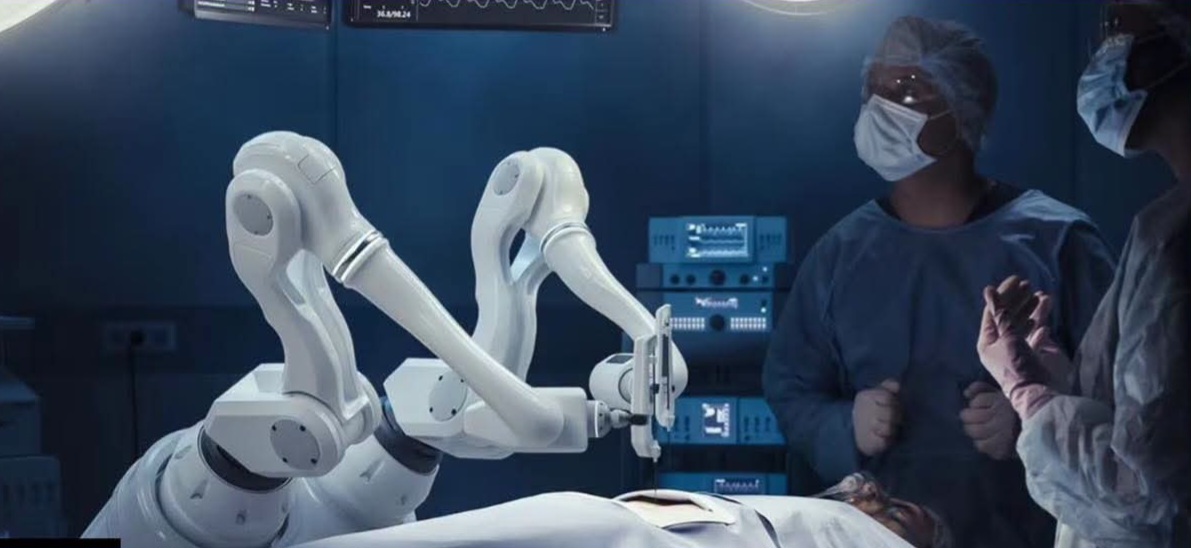
LONDON — In a landmark medical breakthrough, neurosurgeons in London have successfully performed the world’s first brain tumour removal operation assisted in real time by artificial intelligence, preserving the sight of a 48-year-old patient.
The pioneering procedure took place in May at the National Hospital for Neurology and Neurosurgery (NHNN)—part of the University College London Hospitals (UCLH) NHS Foundation Trust. However, details of the operation were kept confidential until Thursday to allow the patient, Rhys Hibbert of Bedfordshire, to make a full recovery.
Hibbert, a customer service manager and volunteer ambulance worker, was diagnosed with an 11mm (0.4in) pituitary gland tumour in late 2024 after collapsing and suffering a seizure. With the mass pressing against critical nerve pathways, his condition rapidly deteriorated, bringing severe hormone imbalances and rapidly failing vision that threatened total blindness.
During the intricate operation, the surgical team remained in absolute control, backed by an advanced AI system developed in-house at the UCL Hawkes Institute and running on specialised medical hardware. Rather than relying solely on pre-operative scans, the software analyzed live surgical camera footage second-by-second. By dynamically color-coding vital structures—such as delicate blood vessels and the optic nerves tightly packed around the marble-sized pituitary gland—the technology gave surgeons an unprecedented layer of visual guidance.
”Going a millimetre wrong can make a critical difference,” health officials noted, with errors risking stroke, severe hemorrhage, or permanent blindness.
Dr. Sophia Bano, technical lead for the AI system and an associate professor in robotics and AI at UCL, explained that the algorithm’s efficacy stems from its extensive training. “By learning from hundreds of surgical videos, it has been exposed to a breadth of surgical examples that would take a surgeon many years to encounter,” she said.
The clinical trial evaluating the technology was funded by the National Institute for Health and Care Research (NIHR) alongside Google, marking a major milestone for the UK government’s healthcare innovation strategies.

For Hibbert, the results were transformative. “When I came round… I could see everything in the room clearly,” he said, noting that within a week he was walking independently without glasses or walking sticks. Having returned to work, he describes his current field of vision as a “360-degree panoramic view”.
Do you want to advertise with us?
Do you need publicity for a product, service, or event?
Contact us on WhatsApp +2348033617468, +234 816 612 1513, +234 703 010 7174
or Email: validviewnetwork@gmail.com
CLICK TO JOIN OUR WHATSAPP GROUP
”The NHNN was founded in 1859 and was the world’s first dedicated neurosurgical hospital,” Hibbert reflected. “So to me, it seems very fitting that the same hospital should also be the world’s first to carry out an AI-assisted neurosurgery”.