
…As FUNAAB Holds 113th Inaugural Lecture
By Femi Dansu
A distinguished expert in Public Health Parasitology and Epidemiology at the Federal University of Agriculture, Abeokuta (FUNAAB), Prof. Sam Olufemi Sam-Wobo, has called for bold, innovative, and compassionate strategies to combat parasitic diseases in Nigeria and across the globe.
This was contained in a statement made available by Mr. Olasunkanmi Olajide, the Acting Public Relations Officer of the University.
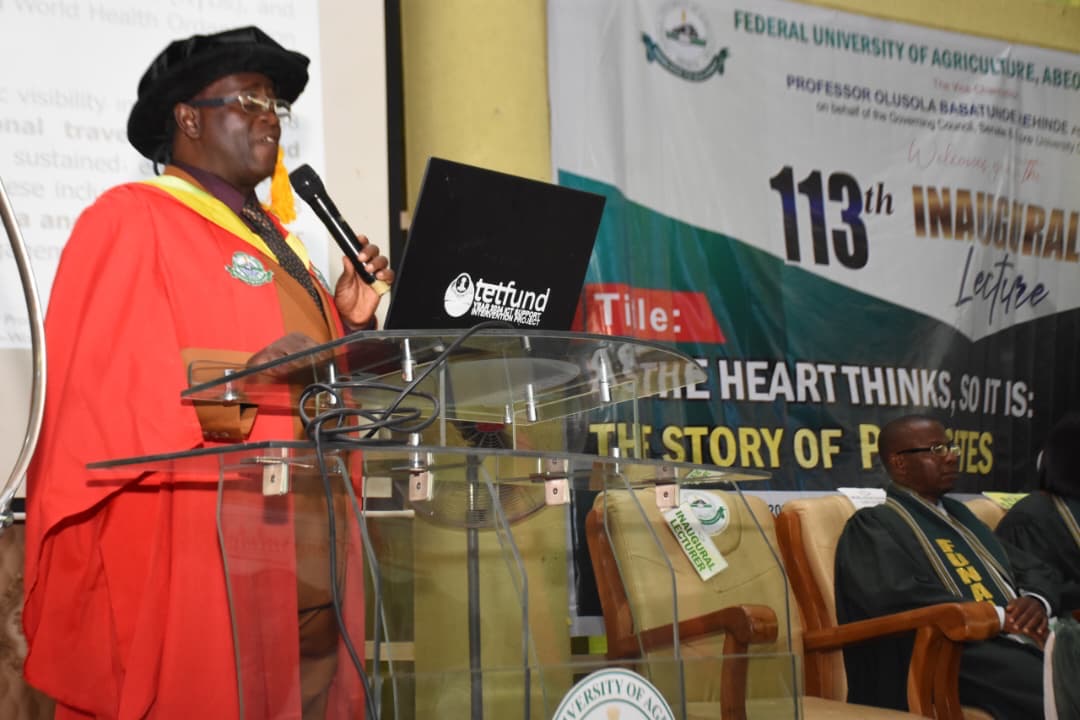
Delivering the University’s 113th Inaugural Lecture titled “As the Heart Thinks, So It Is: The Story of Parasites” on April 22, 2026, at the Prof. Oluwafemi Balogun Ceremonial Building, Prof. Sam-Wobo described parasitic infections as a major yet often overlooked public health challenge shaped by socio-economic, cultural, and environmental factors.
Drawing from decades of research and community-based engagement, the scholar stressed that addressing parasitic and vector-borne diseases requires more than laboratory breakthroughs. According to him, “effective control demands people-centred, context-specific interventions capable of delivering sustainable impact.” He noted that his work and collaborations have combined clinical research, ecological studies, and socio-behavioural insights, particularly within Southwestern Nigeria.

Prof. Sam-Wobo characterised parasites as both “ancient enemies” and reflections of human vulnerability, arguing that their eradication requires confronting not only biological threats but also systemic inequalities and behavioural barriers. “Transformative thinking remains central to progress,” he said, emphasising that mindset and innovation are critical drivers of public health advancement.
To reduce the burden of parasitic diseases, the inaugural lecturer called for stronger thought leadership in public health and the adoption of innovative approaches that challenge conventional limitations. He further advocated compassion-driven health systems that prioritise vulnerable populations and ensure that research outcomes translate into practical, long-term solutions.
Prof. Sam-Wobo, who is also the President of the Parasitology and Public Health Society of Nigeria (PPSN), underscored the importance of robust interdisciplinary collaboration. He said scientists, policymakers, and community stakeholders must work together to develop scalable and inclusive interventions. He also highlighted the need to support early-career researchers and grassroots practitioners in bridging the gap between scientific discovery and real-world application.
On policy, he called for increased national and global commitment to equitable access to diagnostics, treatment, and preventive tools for neglected tropical diseases. “No community should continue to suffer preventable infections due to inadequate resources or attention,” he stressed.
The professor, who also serves as Director of the Zoo Park, emphasised the importance of partnerships involving academia, government, non-governmental organisations, and the private sector in achieving sustainable public health outcomes. He encouraged community-driven initiatives that promote local ownership and long-term success in disease control efforts.
In his conclusion, Prof. Sam-Wobo called for deliberate action to match vision, advocating expanded field interventions, strengthened monitoring systems, and improved implementation strategies. Citing former Director-General of the World Health Organisation (WHO), Halfdan Mahler, he reiterated that “health is not a gift; it must be fought for,” while expressing optimism that global collaboration and translational science can significantly reduce the burden of neglected diseases.
Earlier, in his introductory remarks, the Vice-Chancellor, Prof. Babatunde Kehinde, described the lecture as a landmark academic event and the second inaugural lecture from the Department of Pure and Applied Zoology. He commended Prof. Sam-Wobo’s distinguished career progression from Graduate Assistant to Professor, as well as his contributions to research, teaching, and community service.
Do you want to advertise with us?
Do you need publicity for a product, service, or event?
Contact us on WhatsApp +2348033617468, +234 816 612 1513, +234 703 010 7174
or Email: validviewnetwork@gmail.com
CLICK TO JOIN OUR WHATSAPP GROUP
The Vice-Chancellor also highlighted the lecturer’s international engagements, including collaborations with the World Health Organisation and participation in major health initiatives across Africa. He noted his success in attracting research grants, mentoring postgraduate students, and contributing to policy development on neglected tropical diseases, describing him as “a scholar whose work reflects both academic excellence and societal relevance.”