

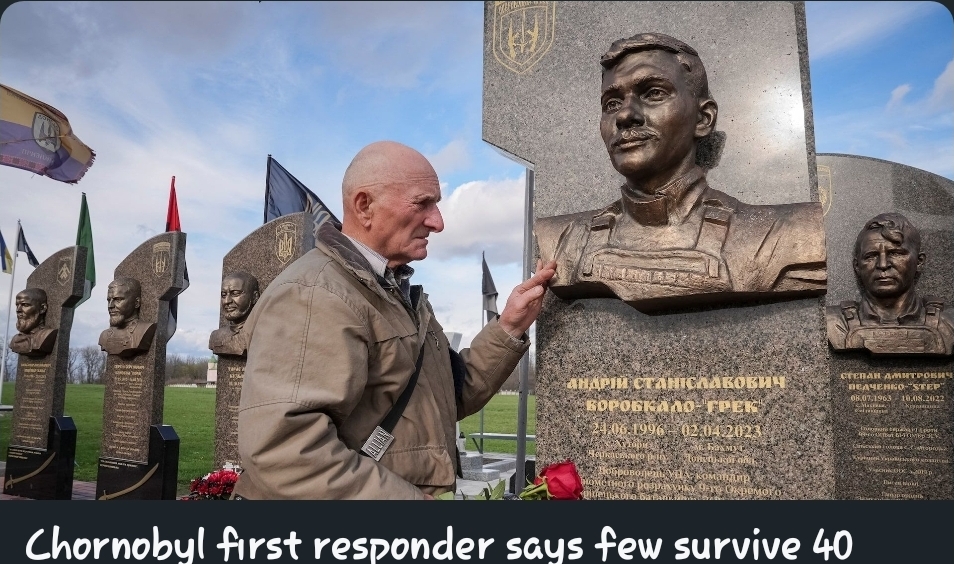
KHUTORY, Ukraine — Four decades after the world’s worst nuclear disaster, Petro Hurin still tastes the metal in the back of his throat.
At 76, Hurin is a living relic of the “liquidators”—the army of roughly 600,000 soldiers, firefighters, and civilians conscripted by the Soviet Union to “tame the atomic beast” after Reactor Four at the Chornobyl nuclear plant exploded on April 26, 1986. Today, as Ukraine prepares to mark the 40th anniversary of the catastrophe, Hurin’s story serves as a harrowing reminder of a generation sacrificed to a bungled Soviet cover-up.
A Death by a Thousand Cuts
In June 1986, Hurin was dispatched to the exclusion zone to operate excavators, loading lead-laced concrete intended to seal the ruins of the reactor. The conditions were hellish. “The dust was terrible,” he recalled, describing respirators that turned brown within thirty minutes.
The physical toll was immediate. Within four days, Hurin suffered from agonizing chest pains, hemorrhaging, and a chilling medical phenomenon: when doctors pricked his fingers for a blood test, only a “pale liquid” emerged.
Despite his symptoms, Soviet authorities—desperate to downplay the disaster—refused to diagnose him with radiation sickness. Instead, he was labeled with “vegetative-vascular dystonia,” a vague nervous disorder used at the time to mask the true extent of the radiological impact on workers.

”Not a single Chornobyl person is in good health,” Hurin said from his home in the Cherkasy region. “It’s death by a thousand cuts.” Of the 40 colleagues sent from his company in 1986, Hurin is one of only five still alive.
Two Wars, One Family
While Hurin continues to fight for the special disability pension promised to liquidators, his twilight years are overshadowed by a new, more immediate catastrophe: the ongoing Russian invasion.
For Hurin and his wife, Olha, the trauma of the past has collided with the grief of the present. They spent much of their lives raising their grandson, Andrii Vorobkalo. When Russia invaded in 2022, Andrii left a stable job in Greece to return home and defend Ukraine. He was killed in action three years ago at the age of 26.
Standing before a memorial stone dedicated to the young soldier, the old liquidator sees a tragic symmetry. In 1986, he fought an invisible enemy to save Europe from radiation; in 2022, his grandson fought a visible one to save Ukraine’s sovereignty.
The Legacy of 1986
The official immediate death toll of Chornobyl remains at 31, but the World Health Organization and international agencies suggest the long-term toll from cancers and related illnesses reaches into the thousands. For survivors like Hurin, who spends his days writing poetry and playing the bayan accordion, the “atomic beast” never truly went away—it simply changed shape, lingering in the blood and the soil of a nation that has known too little peace.
Do you want to advertise with us?
Do you need publicity for a product, service, or event?
Contact us on WhatsApp +2348033617468, +234 816 612 1513, +234 703 010 7174
or Email: validviewnetwork@gmail.com
CLICK TO JOIN OUR WHATSAPP GROUP