

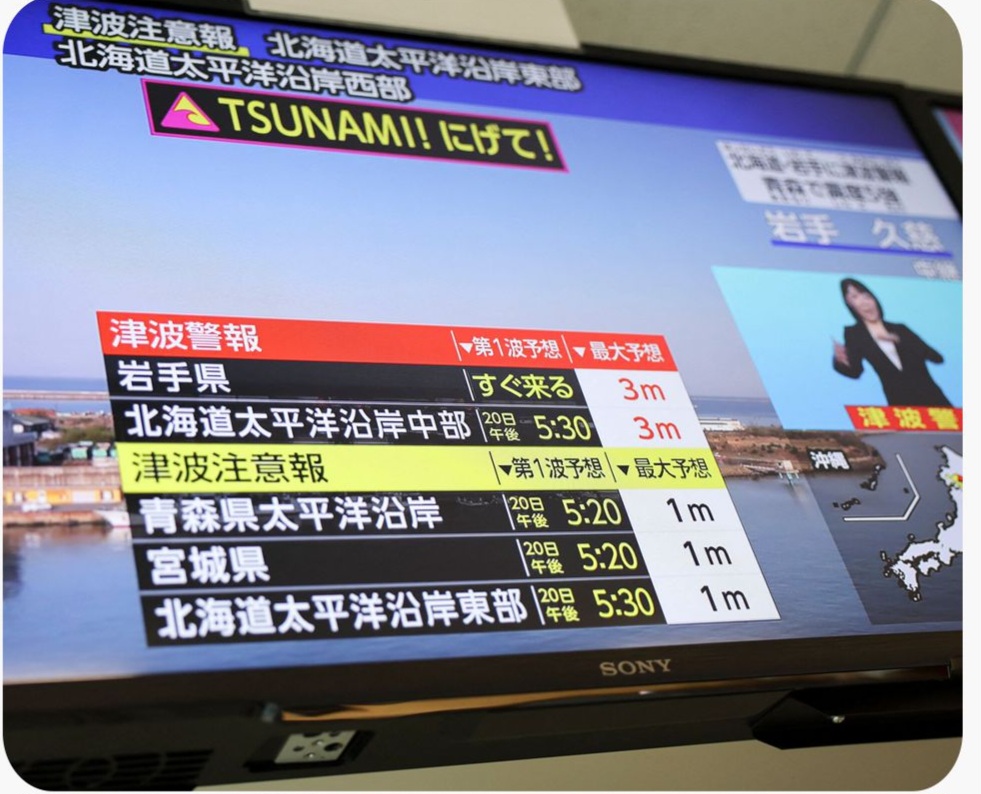
TOKYO – Millions of residents along Japan’s northeastern coastline were urged to flee to higher ground on Monday after a powerful 7.7 magnitude earthquake struck in the Pacific Ocean, reviving traumatic memories of the 2011 triple disaster.
The quake, which the Japan Meteorological Agency (JMA) initially measured at 7.5 before upgrading, occurred at 4:53 p.m. local time at a shallow depth of 20 kilometers off the Sanriku coast. The tremors were felt as far away as Tokyo, where skyscrapers swayed for several minutes.
Tsunami Defenses Activated
Authorities immediately issued a tsunami warning for Iwate, Hokkaido, and Aomori prefectures, forecasting waves of up to three meters (10 feet). While the warning was later downgraded to an advisory as observed waves peaked at 80 centimeters (2.6 feet) at Kuji Port, officials cautioned that the danger remains.
”Tsunami waves are expected to hit repeatedly,” the JMA warned in a series of urgent broadcasts. “Do not leave safe ground until the advisory is fully lifted.”
Prime Minister Sanae Takaichi, who convened an emergency task force within minutes of the jolt, made a televised appeal to the nation. “Please protect your lives above all else. Evacuate immediately to higher ground or evacuation buildings,” Takaichi said.
Rare ‘Megaquake’ Advisory Issued
In a move that underscores the severity of the seismic shift, the Japanese government issued a subsequent advisory warning of a heightened risk of a “megaquake” along the Japan Trench and Kuril Trench.
Experts stated that while the probability of a magnitude 8.0 or stronger quake is typically 0.1% in any given week, that risk has surged to approximately 1% in the wake of Monday’s activity. Residents have been told to maintain a state of “heightened preparedness” for at least seven days, ensuring emergency “grab bags” and water supplies are ready.
Infrastructure and Nuclear Safety
The quake triggered widespread logistical chaos. The East Japan Railway Company suspended Shinkansen bullet train services between Tokyo and Shin-Aomori due to power outages, leaving thousands of commuters stranded.
However, utility operators provided a sigh of relief regarding the nation’s nuclear fleet. Tokyo Electric Power Company (TEPCO) reported no abnormalities at the Fukushima Daiichi or Daini plants, which were the site of the 2011 meltdown. Similarly, the Onagawa and Higashidori plants reported stable radiation levels and no structural damage.

As night fell, Chief Cabinet Secretary Minoru Kihara confirmed that while 200 households remained without power, there were no immediate reports of deaths or significant structural collapses.
”We are still assessing the full extent of the impact in remote coastal areas,” Kihara said. “But for now, our priority remains the safe evacuation of the 170,000 people currently under orders to stay away from the shoreline.”
Do you want to advertise with us?
Do you need publicity for a product, service, or event?
Contact us on WhatsApp +2348033617468, +234 816 612 1513, +234 703 010 7174
or Email: validviewnetwork@gmail.com
CLICK TO JOIN OUR WHATSAPP GROUP