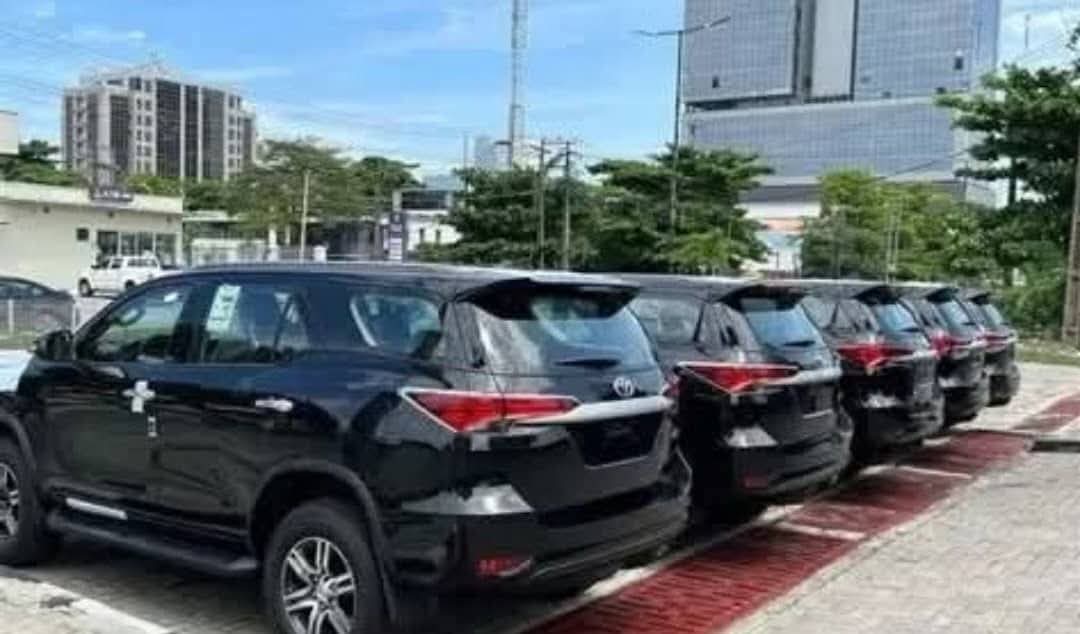
A high-level military investigation into the alleged plot to overthrow President Bola Tinubu has uncovered what security insiders describe as a sophisticated logistical backbone built around the acquisition of 32 sport utility vehicles for covert operations. The vehicles, mainly Toyota Land Cruisers and Nissan Patrols popularly known in military circles as “Gulf” models, were allegedly bought and distributed to serve as a clandestine transport and surveillance fleet for the conspirators.
Security sources with direct knowledge of the probe said investigators have now secured documentary evidence of the purchases, including invoices, bank transfer records and distribution manifests, which are being assembled as part of the prosecution’s core evidentiary file. These records reportedly trace how the vehicles were funded, which accounts were used for payment, and how they were allocated to operatives positioned around key national assets.
According to detailed intelligence briefings, the SUVs were assigned three main clandestine roles in the operational plan. First, they were to provide “non-attributable” mobility for personnel, enabling suspected plotters and their associates to move between sensitive locations without attracting the attention that accompanies official convoys or marked security vehicles. Second, the fleet was to function as mobile intelligence, surveillance and reconnaissance platforms, used to track the movements of high-value targets and to conduct advance surveillance on critical sites such as major airports, government installations and other strategic infrastructure. Third, investigators say the ordinary, ubiquitous appearance of the SUVs was intended to allow the operatives to approach or penetrate secure perimeters without arousing suspicion, placing them close enough for detailed intelligence gathering or rapid deployment of strike teams if the plot advanced.
Military investigators say the evidence gathered has now moved the case well beyond the realm of rumour and raw intelligence into what they describe as a solid prosecutorial “evidence matrix.” The financial and procurement trail from the vehicle deals is being cross‑matched with other funding streams allegedly linked to the conspiracy, including earlier-reported suspicious flows under separate investigations by anti-graft and financial intelligence agencies. Multiple security agencies are said to be working jointly to map out the full supply network that supported the alleged plot, from financiers and facilitators to field operatives across different zones of the country.
At the centre of the emerging network, the probe has reportedly identified a retired Major General, codenamed “Adamu” by investigators, who is described as one of the principal coordinators of the covert logistics chain. Sources say the officer, who once held sensitive command and staff positions, slipped out of reach during an early phase of arrests and is currently on the run, with at least three other key suspects also believed to have fled. One of the fleeing suspects has allegedly been traced to a South American country, though officials have declined to name the destination for security and diplomatic reasons, even as cross‑border intelligence sharing and surveillance are said to be ongoing.
With the vehicle trail and other exhibits now catalogued, the military hierarchy has moved to activate its justice architecture. Authoritative sources at Defence Headquarters indicate that a formal request has been submitted for the constitution of a General Court Martial to try implicated personnel, with the process now awaiting final presidential approval. No fewer than 25 serving officers and other ranks drawn from various services are expected to face charges that could include conspiracy to commit mutiny, treason and conduct prejudicial to good order and military discipline under the Armed Forces Act.
Parallel to the military process, a separate but linked investigation is targeting alleged civilian collaborators accused of providing financing, intelligence support and material assistance to the network. An undisclosed number of civilians are currently being held by the State Security Service (SSS) and the Economic and Financial Crimes Commission (EFCC), where they are undergoing interrogation over suspected roles in raising, moving or disguising funds and in facilitating logistics for the alleged plot. Officials suggest that more arrests are likely as financial trails are reconciled with communication intercepts, surveillance reports and statements already obtained from detained suspects.
These new disclosures add weight and detail to the coup rumours that swept Abuja and parts of the security community in late September 2025. Previous exclusive reports had revealed that the plot, allegedly coordinated by Colonel Muhammed Ma’aji, envisaged a lightning operation to simultaneously neutralise the country’s command authority by assassinating or detaining President Tinubu, Vice President Kashim Shettima, Senate President Godswill Akpabio and several other top figures in the political and military hierarchy. The plan reportedly included moves to seize control of the Presidential Villa, key barracks in Abuja, the Armed Forces of Nigeria complex and Nnamdi Azikiwe International Airport.

The plot began to unravel in late September 2025 after converging streams of intelligence prompted senior security chiefs to approve a discreet joint operation by the Army and the SSS. On 30 September 2025, while President Tinubu was on an official trip to Imo State, coordinated arrests were launched across multiple locations, leading to the detention of at least 16 officers spanning the Army, Navy and Air Force, alongside some civilians. The Defence Intelligence Agency later took custody of the suspects in its underground holding facilities, with a special investigative panel constituted under the then Chief of Defence Intelligence, Major General Emmanuel Undiandeye.
In the immediate aftermath, the Defence Headquarters publicly downplayed the matter, insisting that the detained officers were being questioned over “indiscipline,” “breach of service regulations” and grievances relating to promotions and career stagnation, while the Presidency denied that there had been any real coup attempt. Nonetheless, the gravity of the intercepted plot led President Tinubu to order the unprecedented cancellation of the 1 October Independence Day parade in Abuja, a decision that fuelled widespread speculation about a deeper security threat.
The political and institutional shockwaves were soon reflected in a sweeping shake‑up of the military high command. President Tinubu removed the then service chiefs, retaining only Lieutenant General Olufemi Oluyede and Major General Emmanuel Undiandeye, with Oluyede elevated from Chief of Army Staff to Chief of Defence Staff, while Undiandeye remained as Chief of Defence Intelligence. In a later twist, amid heightened tensions and international commentary on Nigeria’s security situation, former Chief of Defence Staff General Christopher Musa — initially edged out in the reshuffle — was recalled and appointed Minister of Defence after his predecessor, Muhammed Badaru, left office citing health concerns.
After months of official denials and guarded statements, the military high command this January finally acknowledged publicly that there was indeed an attempted coup against the Tinubu administration and confirmed that indicted officers will face trial. The fresh revelations about the 32-vehicle covert fleet, the financial trail behind it and the role of a fugitive retired Major General deepen the picture of a far‑reaching conspiracy that penetrated multiple layers of the security establishment. As court martial proceedings and civilian prosecutions loom, analysts say the coming months will test not only the robustness of Nigeria’s military justice system but also public confidence in the armed forces’ internal cohesion and the country’s democratic resilience.
Do you want to advertise with us?
Do you need publicity for a product, service, or event?
Contact us on WhatsApp +2348033617468, +234 816 612 1513, +234 703 010 7174
or Email: validviewnetwork@gmail.com
CLICK TO JOIN OUR WHATSAPP GROUP