

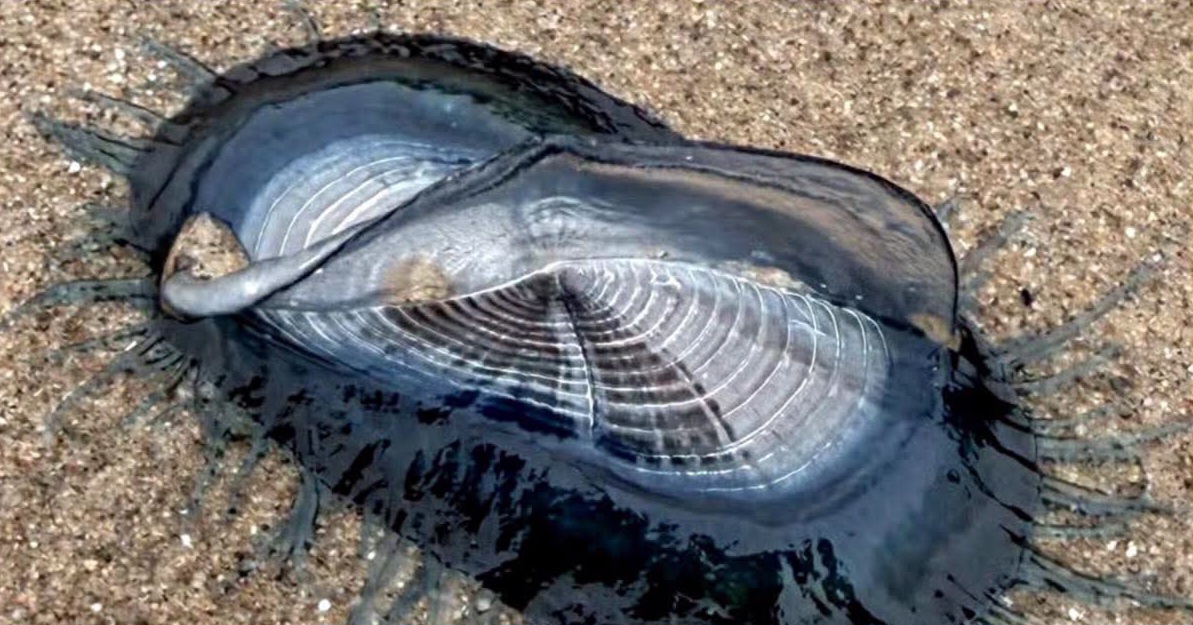
ST BEES, CUMBRIA — Coastal visitors in northwest England have been greeted by an unusual maritime spectacle this week, as hundreds of vibrant, cobalt-blue creatures washed ashore along the Cumbrian coastline.
The strandings, spotted at St Bees, initially baffled beachgoers who swarmed the shoreline to photograph the peculiar marine arrivals. Local resident Louise Nicholson encountered the phenomenon while walking along the beach, initially mistaking the specimens for an unusual variety of seaweed before realizing they were living organisms.
”There were hundreds of them and there were lots of visitors to the area taking photos,” Nicholson said. “They are absolutely beautiful, only about five cm in size. It was a great find on a beautiful day.”
Marine experts have identified the influx as Velella velella, commonly known as by-the-wind-sailors. While frequently mistaken for jellyfish due to their gelatinous appearance, these organisms belong to a distinct category of marine life. Each individual specimen is not a single animal, but rather a complex, free-floating colony of hydroids—tiny polyps working collectively as a single organism, with specialized polyps dedicated to feeding, reproduction, and defense.
True to their romantic moniker, Velella velella spend their entire lives adrift on the open ocean, propelled across the water’s surface by a stiff, translucent vertical sail that catches the breeze. Because they rely entirely on wind and surface currents for mobility, sustained offshore winds frequently drive mass strandings onto British and Irish beaches during seasonal shifts.

Though closely related to the notorious Portuguese man o’ war, by-the-wind-sailors pose a minimal threat to humans. Their short stinging tentacles are specifically adapted for subduing microscopic prey such as fish larvae rather than piercing human skin. Nevertheless, conservation bodies including the Cumbria Wildlife Trust have urged beachgoers to exercise caution and refrain from handling the stranded creatures.
Experts suggest that the recent arrivals were swept northward from the warmer waters of the Atlantic by prevailing currents and unseasonable wind patterns. While their appearance on local beaches often signals a striking photo opportunity for curious onlookers, the stranded colonies quickly perish once exposed to dry air and direct sunlight.
Do you want to advertise with us?
Do you need publicity for a product, service, or event?
Contact us on WhatsApp +2348033617468, +234 816 612 1513, +234 703 010 7174
or Email: validviewnetwork@gmail.com
CLICK TO JOIN OUR WHATSAPP GROUP