

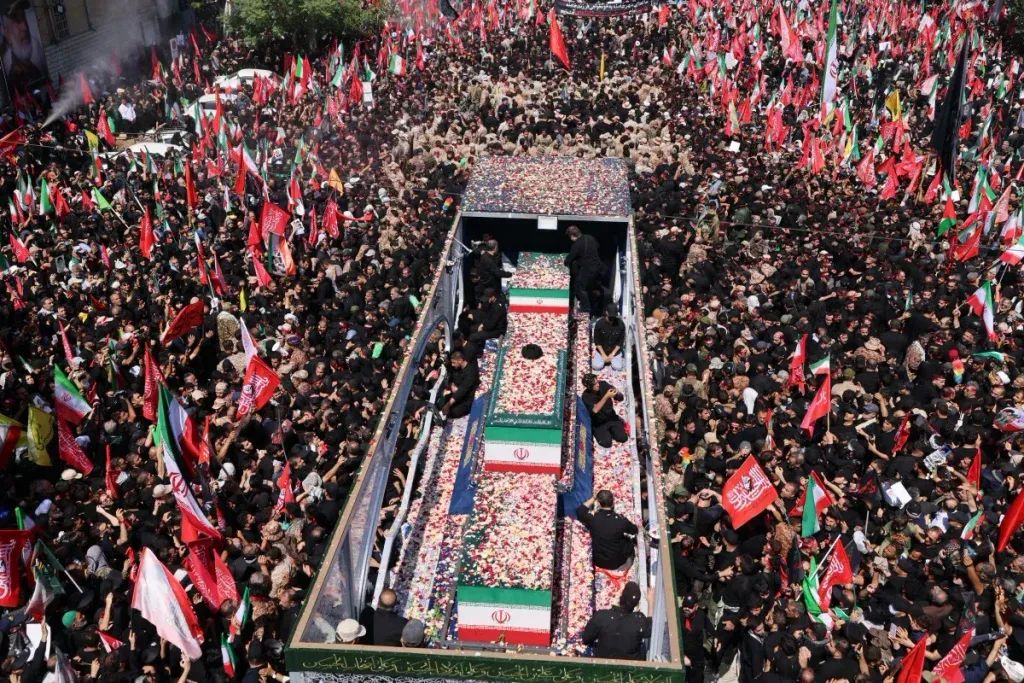
TEHRAN — Massive crowds flooded the streets of Tehran on Monday for the funeral procession of Ali Khamenei, the late Supreme Leader of Iran, who was killed in a joint U.S.-Israeli airstrike on February 28, 2026. The atmosphere remained charged with grief and calls for vengeance as the nation navigates a period of profound uncertainty.
The procession marks a significant moment for the Islamic Republic, which is attempting to project domestic stability following months of conflict. While authorities have not released official turnout figures, the sea of mourners moving through the capital’s major boulevards was described as rivaling the historic farewell for Khamenei’s predecessor, Ayatollah Ruhollah Khomeini, in 1989.
A Leadership Vacuum
Despite the display of state-sanctioned mourning, the transition of power remains shrouded in mystery. Mojtaba Khamenei, the son of the late leader who was named his successor in the wake of the February strikes, has remained notably absent from public view. Reports suggest he is still recovering from injuries sustained during the same attack that claimed his father’s life.

His absence has only intensified speculation regarding the regime’s internal cohesion. While other members of the Khamenei family appeared at the Grand Mosalla religious complex over the weekend, the new leader’s continued seclusion underscores the vulnerability of the current transition.
The Shadow of War
The funeral proceedings occur against the backdrop of a broader, tenuous ceasefire. Although direct military hostilities between Iran and the U.S.-Israeli coalition are currently on hold, tensions persist. Iran continues to assert control over the Strait of Hormuz, employing a strategy of intimidation against commercial vessels to maintain leverage in ongoing negotiations regarding a memorandum of understanding (MoU).
Hardline factions within the regime are reportedly pushing for a confrontational stance, viewing the funeral as a platform to demand retaliation. For many in the crowd, the message was clear. “We want revenge,” said Gholamreza Khanbabaei, a 58-year-old mourner. “It must be done. Because later, if it’s not done, it will get worse.”
Road to Burial
The funeral route spans approximately 20 kilometers, with security forces maintaining a heavy presence to prevent the sort of chaos that marred previous high-profile funerals. The ceremonies are set to continue over the coming days:
- Tuesday: Commemorative events in the clerical hub of Qom.
- Wednesday: Processions through the holy cities of Najaf and Karbala, Iraq.
- Thursday: Final burial in Mashhad, the late leader’s birthplace.
As Iran prepares to lay its leader to rest, the regime faces the dual challenge of managing a delicate diplomatic process with the West while suppressing internal factionalism and public unrest. For now, the massive mobilization in Tehran serves as a vital test of the state’s ability to maintain its influence in a post-Khamenei era.
Do you want to advertise with us?
Do you need publicity for a product, service, or event?
Contact us on WhatsApp +2348033617468, +234 816 612 1513, +234 703 010 7174
or Email: validviewnetwork@gmail.com
CLICK TO JOIN OUR WHATSAPP GROUP