

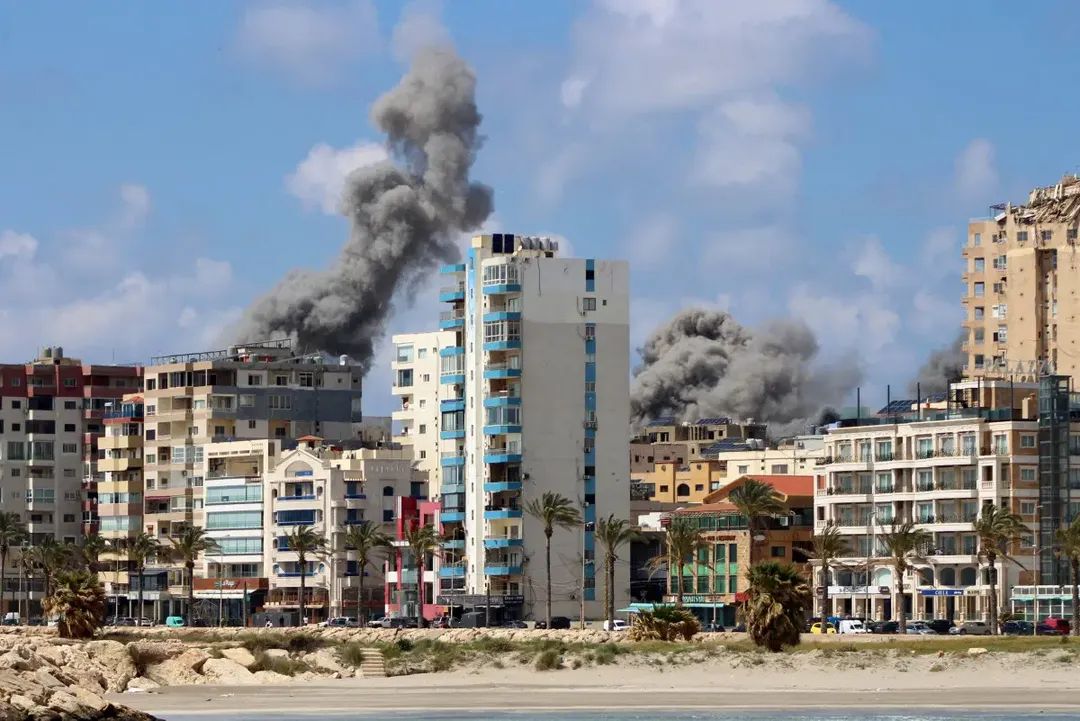
Israel launched a waves of airstrikes on Beirut on Wednesday in what the Israeli military described as the largest coordinated strike across Lebanon since the regional war erupted, marking the most violent attack on the Lebanese capital to date.
Residents in central Beirut reported sudden, deafening blasts that sent people running into the streets, honking cars trying to clear the way, and black smoke billowing over densely populated neighbourhoods such as Barbour, Corniche al‑Mazraa, Ain al‑Mreisseh and Burj Abi Haidar.
“Largest coordinated strike” targeting Hezbollah
The Israeli military said it carried out “the largest coordinated strike across Lebanon” since the start of what it terms Operation Roaring Lion, hitting more than 100 Hezbollah command centers and military sites within roughly 10 minutes. Targets spanned Beirut’s southern suburbs, parts of central Beirut, southern Lebanon, and the eastern Bekaa Valley, as Israel sought to degrade Hezbollah’s infrastructure while the U.S.–Iran truce came into effect.
A statement from the Israeli Defence Forces (IDF) stressed that the Iran–Israel ceasefire did not extend to Lebanon and that “the battle in Lebanon is ongoing,” even as it renewed evacuation orders for areas stretching more than 40 km inside Lebanon.
Widespread damage and civilian toll
On the ground, witnesses described apocalyptic scenes. A photographer reported several buildings ablaze, cars reduced to smouldering wrecks, and frantic emergency responders digging through rubble.
“Plane struck, and people started running left and right, and smoke was billowing” from the targeted building, said Ali Younes, one of several residents interviewed by news agencies. In Corniche al‑Mazraa—a major arterial road—explosions tore into residential blocks and shops, leaving shattered façades and crushed vehicles.
Stories from the streets
Yasser Abdallah, who works in an appliance store in central Beirut, told reporters: “I saw the blast, it was very strong, and there were children killed, some with their hands cut off,” underscoring the apparent toll on civilians.

Lebanese civil‑society documentation groups flagged that residential buildings in neighbourhoods such as Bir Hassan, Hayy al‑Sellom, Msaytbeh, Basta and Choueifat were directly hit, heightening concerns about civilian casualties and damage to homes and property.
Ambulances, hospitals,and displaced families
State‑run media and local responders reported multiple ambulances racing toward the strike zones, where rescuers pulled survivors from collapsed structures and shrapnel‑torn cars. At least one health facility and an ambulance were damaged in the early‑morning waves of bombing, complicating the delivery of urgent care.
Many displaced families, already living in makeshift camps near Beirut’s southern suburbs, expressed fear that the latest strikes would extend the conflict and deepen their sense of inescapable danger.
Regional tensions amid fragile truce
The escalation comes amid a broader regional war that began with a U.S.–Israeli offensive against Iran‑linked targets in late February, triggering cross‑border fighting in Lebanon and the Gaza Strip. Hezbollah has claimed it is nearing a “historic victory” over Israel, even as it warned displaced civilians not to return to southern villages, towns and the southern suburbs of Beirut until a final ceasefire is declared.
Regional leaders and international bodies have warned that the widening campaign in Lebanon could further destabilize an already volatile Middle East, even as diplomatic channels scramble to shore up the fragile Iran–Israel truce.
Do you want to advertise with us?
Do you need publicity for a product, service, or event?
Contact us on WhatsApp +2348033617468, +234 816 612 1513, +234 703 010 7174
or Email: validviewnetwork@gmail.com
CLICK TO JOIN OUR WHATSAPP GROUP