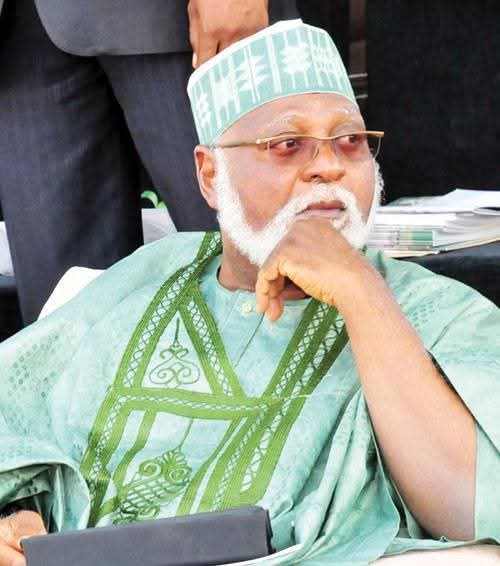
History is rarely a straight line; more often, it is a mosaic of unforeseen disruptions and accidental detours. For General Abdulsalami Abubakar, the man who handed power to civilians and ushered in Nigeria’s longest unbroken democratic era, the ultimate catalyst for his historical destiny was not an act of military valor, but a deeply personal crisis: a severe bout of depression.
In his newly unveiled autobiography, Call of Duty, launched to mark his 84th birthday, the retired general pulls back the curtain on a remarkable paradox. Were it not for a mental health struggle that cut short his dreams of becoming a combat pilot, he would never have ascended to the pinnacle of Nigerian leadership.
The German Detour and the Air Force Exit
The trajectory of Abdulsalami’s life altered sharply in the early 1960s. After graduating from the Provincial Secondary School, Bida, in 1962, he secured admission into the Technical College, Kaduna. However, a parallel interview for the Nigerian Military Training College (now the NDA) won his heart. By 1963, he was enlisted into the infant Nigerian Air Force and dispatched to Germany for elite flight training.
For a time, the clear skies of Europe promised a brilliant career in aviation. Then, the unexpected hit. Abdulsalami succumbed to a debilitating depression. In a military academy setting where rigorous weeding processes were the norm, falling behind mentally or physically meant disqualification. Unable to log the mandatory flight hours or participate in the final phases of training, he was grounded.
Faced with options to remain in the Air Force under non-combat roles like logistics or ordnance, Abdulsalami made a pivotal choice: he returned home and returned to his first love, the Nigerian Army.
“I would say God used depression to shape my destiny,” Abdulsalami writes with striking vulnerability. “It is beyond human comprehension. Maybe I would have crashed and died in training if depression had not halted my training.”
This shift proved defining. In the turbulent landscape of 20th-century Nigerian politics, military heads of state emerged exclusively from the ranks of the Army. Had he remained a decorated, desk-bound Air Force officer, the history of Nigeria would look vastly different today.

From the Trenches to the State House
The road from his re-enlistment to the head of state was paved with narrow escapes. Transferring to the Army just as the Nigerian Civil War erupted in 1967, Abdulsalami lost seniority, slipping behind peers like Ibrahim Babangida and Mamman Vatsa.
Serving under the iconic and fierce Colonel Murtala Muhammed in the 2nd Infantry Division, he cheated death twice:
- The Convoy Blast (February 1968): He narrowly escaped an explosive Biafran ambush on an army fuel convoy after the capture of Awka and Onitsha.
- The Udi Road Ambush: His Land Rover was raked with gunfire. His orderly and signal operator were killed instantly. Abdulsalami took bullets to both arms while shielding his driver—the very driver whose frantic, masterful maneuvering kept the vehicle from flipping and saved their lives.
Years later, in 1979, his career almost ended in a cell. Distressed by news that his wife, Fati, had suffered a miscarriage at the Benin Republic border, the then-Major rushed to her side, briefly leaving his peacekeeping detachment at Ikeja. Upon his return, an explosive verbal altercation with an insensitive superior officer led the Army Chief, Lt-Gen Theophilus Danjuma, to order his immediate arrest. It took the spontaneous, unsolicited intervention of Major-General Emmanuel Abisoye to save him from a certain court-martial and imprisonment.
A Legacy Written in 27 Years of Peace
When General Sani Abacha died suddenly on June 8, 1998, the Provisional Ruling Council turned to Abdulsalami to steady the ship of state.
His brief tenure became a masterclass in keeping political promises. He organized a swift, transparent transition to civil rule, culminating in the inauguration of the Fourth Republic in May 1999. In a country where the longest previous democratic experiment lasted a mere six years (1960–1966), Nigeria has now enjoyed non-stop democratic governance for 27 years—an achievement built entirely on the foundation Abdulsalami laid.
De-stigmatizing the Hidden Enemy
Perhaps the most vital service the elder statesman renders in Call of Duty is using his platform for mental health advocacy. In a society that routinely trivializes, spiritualizes, or mocks psychological trauma, his confession is revolutionary.
By framing depression not as a spiritual curse or a sign of weakness, but as a human condition that God utilized to realign his path, Abdulsalami challenges Nigeria to look at mental health through a lens of empathy and medical reality rather than stigma.
Do you want to advertise with us?
Do you need publicity for a product, service, or event?
Contact us on WhatsApp +2348033617468, +234 816 612 1513, +234 703 010 7174
or Email: validviewnetwork@gmail.com
CLICK TO JOIN OUR WHATSAPP GROUP
His story reminds us that what looks like a dead end can often be a detour to a grander destination. In losing his wings in the skies of Germany, Abdulsalami Abubakar found the ground on which he would eventually guide an entire nation toward democracy.