



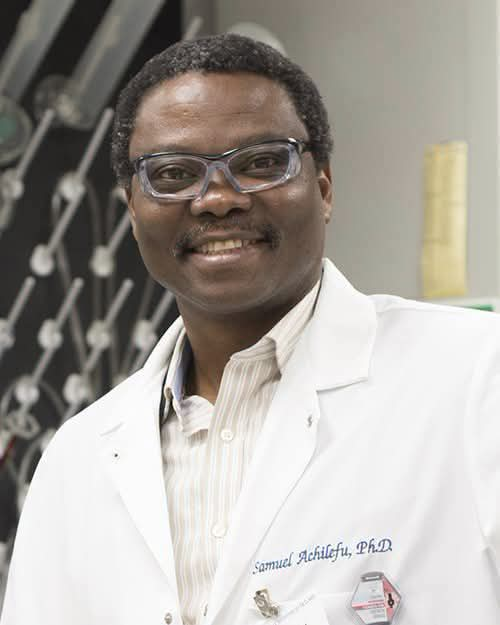
Nigerian-American biomedical engineer Dr. Samuel Achilefu has cemented his place among the world’s elite innovators with his 2025 induction into the National Academy of Engineering, one of the highest professional honours in the United States. Already a member of the National Academy of Medicine and a Fellow of the National Academy of Inventors, Achilefu now belongs to a rare group of scientists recognised across medicine, engineering and invention for transformative contributions that are reshaping cancer care.
Born in northern Nigeria and raised in Osaa-Ukwu in Obingwa, Abia State, Achilefu’s path to scientific leadership began against the backdrop of the Nigerian Civil War, which forced his family southward when he was a young child. He later earned a PhD in molecular and materials chemistry from the University of Nancy in France as a French Government Scholar, followed by postdoctoral training at the University of Oxford in England focused on oxygen transport and haematological science.
These foundations propelled him to the United States, where he spent more than two decades at Washington University School of Medicine in St. Louis before joining the University of Texas Southwestern Medical Center in Dallas in 2022 as the inaugural chair of its Department of Biomedical Engineering. He holds the Lyda Hill Distinguished University Chair and additional appointments in Radiology and the Harold C. Simmons Comprehensive Cancer Center.
Achilefu’s most celebrated invention is the CancerVision Goggles (also known as Medical Vision Goggles or Cancer Viewing Glasses), a wearable system that allows surgeons to see cancer cells in real time during operations. The technology pairs a tumour-targeting fluorescent agent—often injected before surgery—with near-infrared light and a head-mounted display.
Cancerous tissue glows distinctly, enabling surgeons to distinguish malignant cells from healthy ones with far greater precision than traditional visual inspection or touch alone. This reduces the risk of incomplete tumour removal, which can necessitate repeat surgeries or increase the chance of recurrence. The goggles were designed to be relatively low-cost, portable and compatible with standard operating-room workflows, addressing limitations of bulkier fluorescence imaging systems that require extra personnel and expensive equipment.
Beyond the goggles, Achilefu has pioneered fluorescent molecular probes and contrast agents that selectively highlight many cancer types, particularly breast tumours, and has advanced nanotherapeutics and light-activated treatments that can kill cancer cells while sparing healthy tissue. His body of work includes more than 70 issued US patents and over 300 peer-reviewed scientific publications.

He has guided multiple innovations from laboratory concept through clinical translation and commercialisation, launching start-up companies along the way. Recognition for this impact includes the SPIE Britton Chance Biomedical Optics Award, the first Distinguished Investigator Award from the Department of Defense Breast Cancer Research Program, the St. Louis Award, and numerous other national and international honours.
In February 2025, the National Academy of Engineering elected Achilefu for his “contributions and international leadership in the molecular imaging of cancer and molecular nanotherapeutics using biophotonics and nuclear technologies.” He became the first UT Southwestern faculty member to receive the distinction. The formal induction took place later that year. Colleagues and institutions have praised both the practical impact of his technologies on patient outcomes and his role in mentoring the next generation of researchers while building multidisciplinary teams that bridge engineering, chemistry, radiology and oncology.
Do you want to advertise with us?
Do you need publicity for a product, service, or event?
Contact us on WhatsApp +2348033617468, +234 816 612 1513, +234 703 010 7174
or Email: validviewnetwork@gmail.com
CLICK TO JOIN OUR WHATSAPP GROUP
Achilefu’s career stands as a powerful example of how Nigerian talent, combined with rigorous international training and sustained innovation in America, continues to advance global medicine. From a childhood shaped by conflict in Nigeria to leadership at one of the United States’ premier medical centres, his work is helping surgeons leave fewer cancer cells behind—and giving patients a clearer path to recovery.