



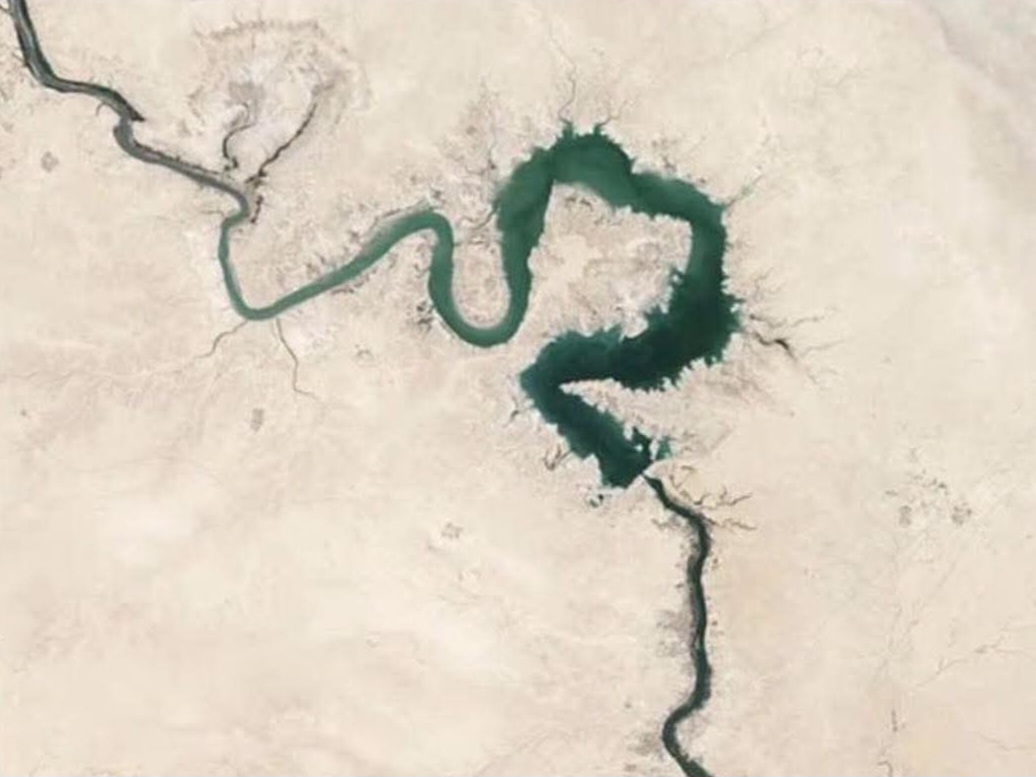
Scientists have finally pieced together the dramatic geological birth of the Euphrates River — one of the four waterways named in the Book of Genesis as flowing from the Garden of Eden — revealing how two colossal ancient rivers were forced together by the restless movements of the Earth’s crust.
A major study published in Nature Geoscience shows that the modern Euphrates emerged roughly 1.6 million years ago when the Palaeo-Karasu and Palaeo-Murat rivers, once entirely separate systems flowing across what is now Turkey and Syria, were redirected and merged by tectonic upheaval. The findings rewrite long-standing theories about the origins of a waterway that later nourished the Fertile Crescent and some of humanity’s earliest civilisations.
For decades, researchers debated where the early Euphrates ended. Some argued it drained into lakes in Anatolia or the Mediterranean; others suggested it already flowed southeast toward the Arabian Peninsula. The new research settles the question. Led by geologist Andrew Madof of Chevron, with collaborators including scientists from the University of Western Australia and the University of Oxford, the team combined seismic imaging of buried sediments (data originally gathered during oil and gas exploration), satellite and surface mapping, geological records, and sophisticated sediment-budget modelling.
They identified two vast prehistoric rivers. The Palaeo-Murat began more than 16.5 million years ago. The Palaeo-Karasu formed later, between about 8.6 and 5.9 million years ago.
During the Messinian Salinity Crisis — a dramatic episode between roughly 5.97 and 5.33 million years ago when the Mediterranean was largely cut off from the Atlantic and its water levels plunged by as much as 1.7 to 2.1 kilometres — both rivers poured into a partially desiccated eastern Mediterranean basin that had become a vast salt desert.

These were no ordinary streams. Modelling indicates the Palaeo-Karasu carried more water and sediment than today’s Nile, while the Palaeo-Murat surpassed the combined modern Tigris and Euphrates. For a geologically brief period of about 120,000 years they dumped enormous volumes of material, creating the Handere and Nahr Menashe deposits now buried beneath the seabed. At their southernmost reach the Palaeo-Murat even approached the ancestral Nile, bringing the two great systems closer than at almost any other time in Earth’s history.
Then the ground itself moved. Progressive tectonic activity along the East Anatolian Fault and in the rising Taurus Mountains altered the landscape’s elevation and slope. Around 3.6 million years ago the Palaeo-Murat avulsed — abruptly changed course — and began flowing southeast onto the Arabian Plate toward what would become the Persian Gulf. Roughly 800,000 years later, about 2.8 million years ago, the Palaeo-Karasu followed, joining its counterpart. By approximately 1.6 million years ago the combined system had stabilised into the modern Euphrates configuration, flowing southeast to the Gulf after linking with the Tigris.
The same tectonic forces that reshaped the rivers also helped create the broad alluvial plains of the Fertile Crescent. Those fertile soils and reliable water later supported the rise of Sumerian, Assyrian and other early societies — the very landscape often called the cradle of civilisation.
The Euphrates stretches nearly 3,000 kilometres from the mountains of Turkey through Syria and Iraq to the Persian Gulf. In the Bible it is listed among the rivers of Eden in Genesis, giving the waterway enduring cultural and spiritual resonance. The researchers are careful to note that their work addresses only the river’s geological development; it does not locate or confirm the historical existence of the Garden of Eden itself.
Still, the study ends a long scientific puzzle. What began as two independent mega-rivers draining into a near-dry Mediterranean was transformed by plate tectonics into the single great river that would help shape human history.
The Earth moved, the waters followed, and one of the most consequential landscapes on the planet was born.
Do you want to advertise with us?
Do you need publicity for a product, service, or event?
Contact us on WhatsApp +2348033617468, +234 816 612 1513, +234 703 010 7174
or Email: validviewnetwork@gmail.com
CLICK TO JOIN OUR WHATSAPP GROUP