


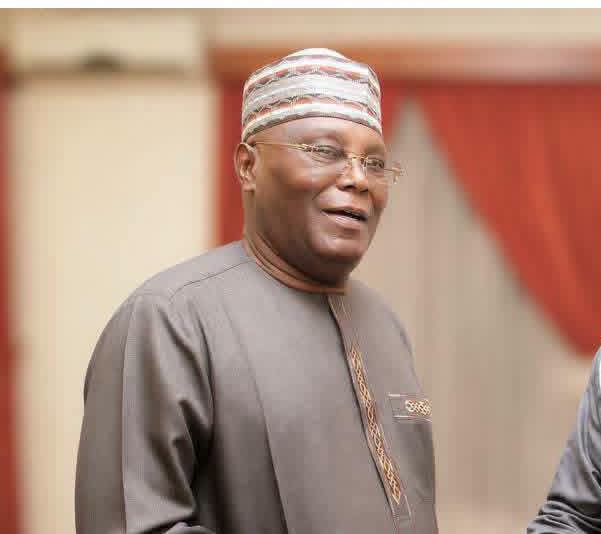
The Federal Government has dismissed former Vice President Atiku Abubakar’s campaign promise to reopen Nigeria’s land borders if elected president in 2027, declaring that the country’s borders are already open and cannot be reopened.
In a strongly worded response, the Minister of Interior, Olubunmi Tunji-Ojo, whose ministry supervises the Nigeria Immigration Service (NIS), faulted Atiku’s recent assertion, calling it an inaccurate portrayal of the nation’s border status and recent history.
Atiku, who recently declared his presidential bid under the African Democratic Congress (ADC), stated during a political meeting in Abuja that he intended to reopen land borders and revitalize trade routes with neighbouring countries. However, the Interior Minister pointed out that the former vice president’s narrative fundamentally distorts a timeline of progressive reopenings executed by successive administrations.
Detailing the chronology of border management, Tunji-Ojo noted that key land frontiers had long been restored to commercial activity. Seme, Illela, Maigatari, and Mfum were reopened on December 16, 2020, followed by Idiroko and Ikom on April 20, 2022. Furthermore, the current administration reinforced this progression in February 2026 by reopening the Kamba and Tsamiya border posts in Kebbi State, re-establishing vital trade corridors with the Niger and Benin Republics.
The minister also addressed Atiku’s specific references to neighboring countries—Cameroon, Chad, Niger, and Benin. He explained that prolonged closures at specific northern and eastern crossings, such as Banki and Amchidé along the Cameroon border, stemmed from counter-insurgency imperatives dating back to 2014 due to the Boko Haram crisis—not the 2019 trade policy. Those locations, alongside Fotokol and Gambaru, were progressively reinstated between 2019 and 2021 following joint regional military and stabilization efforts.
”Folding this separate, security-driven history into one continuous 2019 shutdown misrepresents two distinct issues—trade regulation and counter-insurgency—as a single failure,” Tunji-Ojo stated.
While emphasizing that major economic arteries remain operational, the minister acknowledged that certain northern crossings remain under tighter controls due to lingering threats from banditry and residual insurgent networks. He stressed that maintaining localized security checkpoints is a deliberate tactical safeguard rather than administrative neglect, designed to protect local traders and border communities.

The minister concluded that modern border management requires an integrated approach balancing security, strict documentation, customs compliance, and seamless trade facilitation, rather than treating borders through a binary lens of total closure or absolute deregulation.
”Political competition should not become a competition to rewrite recent history,” Tunji-Ojo admonished. “If he has a new border proposal, he should set it out and explain how it differs from the current approach, rather than treating separate trade, security and infrastructure issues as one and the same.”
Do you want to advertise with us?
Do you need publicity for a product, service, or event?
Contact us on WhatsApp +2348033617468, +234 816 612 1513, +234 703 010 7174
or Email: validviewnetwork@gmail.com
CLICK TO JOIN OUR WHATSAPP GROUP