



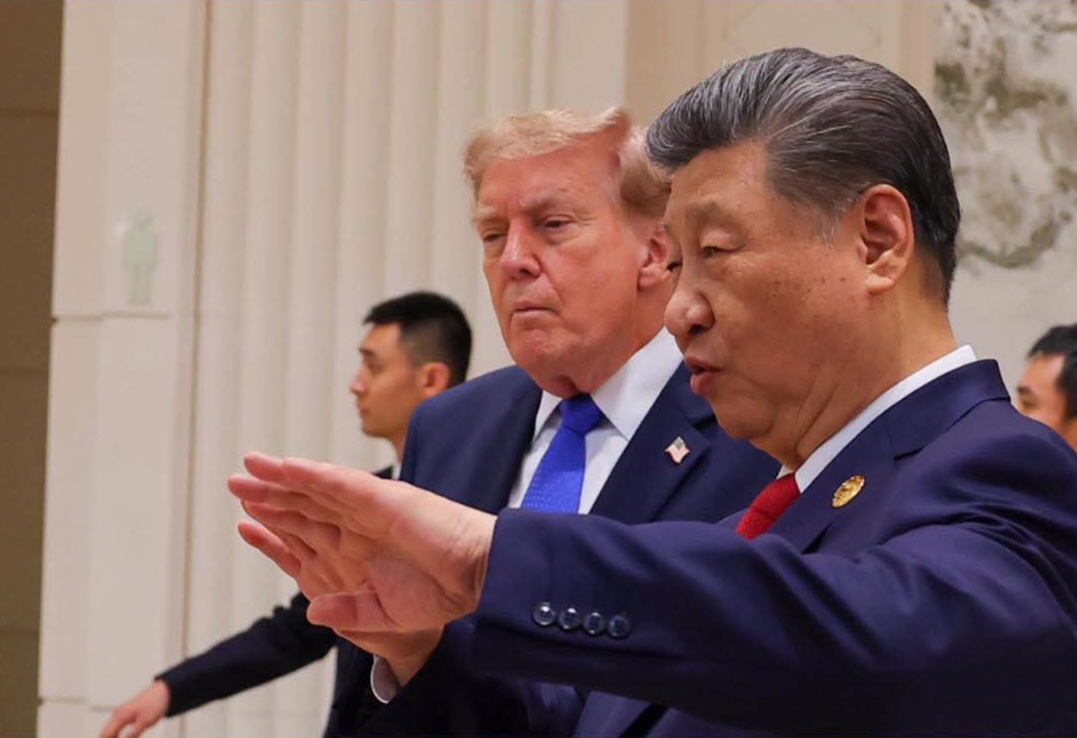
SHENZHEN, China — A clash over press freedom and diplomatic protocol overshadowed the opening of a landmark trilateral summit on Thursday, November 19, after Chinese officials barred a White House pool reporter from covering talks between U.S. President Donald Trump, Chinese President Xi Jinping, and Russian President Vladimir Putin.
The exclusion followed an incident earlier in the day during the Asia-Pacific Economic Cooperation (APEC) summit in Shenzhen, where Bloomberg’s chief political correspondent, Annmarie Hordern, shouted a question to President Trump while he was seated alongside President Xi.
“President Trump, has Jensen Huang been disloyal to the United States?” Hordern called out across the room during the bilateral photo opportunity.
President Trump did not respond to the inquiry. According to pool dispatches and video footage from the scene, President Xi glanced briefly toward the press contingent before looking away, prompting a Chinese security guard to step forward and physically block a camera filming the exchange. A second journalist who attempted to ask a follow-up question was swiftly shushed by Chinese officials.
In the aftermath of the bilateral session, Chinese delegates issued a stern warning to the traveling press corps, stating that shouting questions during official proceedings is considered “extremely rude” and that any journalist doing so would be immediately removed from the room.
When the White House press pool gathered later for the historic three-way talks between Trump, Xi, and Putin, Hordern was denied entry. A White House official confirmed that the administration lobbied Chinese hosts to have the correspondent reinstated, but Beijing stood firm on its decision to exclude her.
While routine in Washington—where journalists regularly shout questions at U.S. presidents and visiting heads of state during on-camera “sprays”—the practice collides sharply with Beijing’s tightly choreographed media environment, where foreign press access is heavily restricted and President Xi rarely fields unscripted questions. Even President Trump appeared to lament the strict media controls earlier on Thursday, telling reporters during his opening remarks, “Everything moved perfectly, and it’s such a shame that the press wasn’t able to see some of it”.

Hordern’s pointed question touched on a high-profile corporate and national security controversy unfolding back in the United States. Jensen Huang stepped down as chief executive officer of artificial intelligence chipmaker Nvidia on November 12, following media reports alleging an extramarital relationship with a woman suspected of having ties to Chinese intelligence.
Following those revelations, Nvidia launched an independent investigation, though the company stated it had found no evidence that corporate secrets or U.S. national security had been compromised. Huang publicly apologized to his family for his infidelity while maintaining his commitment to American national security, and China’s Ministry of Foreign Affairs has dismissed the allegations of an intelligence link as “groundless speculation” aimed at smearing Beijing.
The diplomatic friction over press access occurred on the sidelines of the first-ever trilateral summit bringing together Trump, Xi, and Putin. According to readouts released by Moscow and Beijing, the three leaders held wide-ranging discussions covering nuclear non-proliferation, global oil production and supply, United Nations reform, the war in Ukraine, and the International Criminal Court.
While dozens of international and state-backed journalists were permitted to observe the brief opening remarks of the trilateral meeting, the barred correspondent—along with the remainder of the press corps—was relegated to watching the proceedings via closed-circuit television outside the summit hall.
Do you want to advertise with us?
Do you need publicity for a product, service, or event?
Contact us on WhatsApp +2348033617468, +234 816 612 1513, +234 703 010 7174
or Email: validviewnetwork@gmail.com
CLICK TO JOIN OUR WHATSAPP GROUP