



There is a strange contradiction in Nigeria’s relationship with books.
We complain about poor reading culture, weak academic performance and the declining fortunes of publishing. Yet, in the same country, someone can reproduce another person’s book without permission, sell it cheaply and compete directly with the person who invested money, time and intellectual labour to produce the original.
That is the contradiction behind the latest warning from the Nigerian Copyright Commission, NCC.Speaking in Akure while sensitising booksellers and publishers in Ondo and Ekiti, NCC Director-General, Dr John Asein, warned against the production and sale of pirated books, saying the practice damages the book industry and the wider economy.
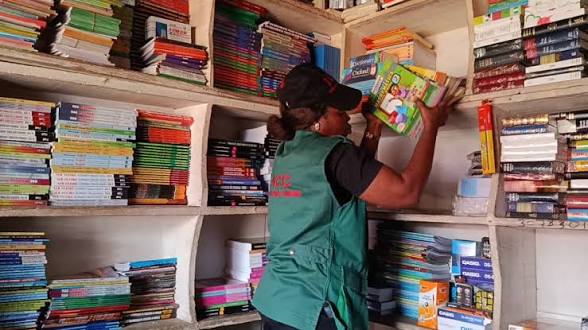
It is a warning worth taking seriously. But the conversation must go beyond telling booksellers not to sell pirated books. The bigger question is this: What happens to the Nigerian book industry when illegality becomes cheaper than honesty?
The Honest Bookseller Is Losing the Price War
Consider two booksellers. One buys genuine books from an authorised publisher or distributor. He pays the legitimate price, transport costs, rent and staff expenses while carrying the normal risks of business.
The other obtains pirated copies cheaply. His supplier did not pay the author. He did not pay the publisher. He did not bear the legitimate production costs. He simply reproduces the finished product and enters the market with a much lower price and sells.
Then the customer asks the inevitable Nigerian question:“How much is your own?” The honest bookseller says ₦10,000. The pirate says ₦5,000.
The customer walks away with the cheaper copy. That is not healthy competition. It is an illegal price advantage created by stealing somebody else’s production costs.
This is why the piracy conversation must include booksellers who sell genuine copies. They are not merely retailers caught between the NCC and pirates. They can become victims themselves.
If legitimate booksellers continually lose customers to sellers of pirated books, the incentive to stock genuine books weakens.
The publisher sells fewer books. The author earns less. The bookseller’s legitimate business suffers. Eventually, everyone who played by the rules is punished for doing so.
The Law Is Already There

Nigeria is not without legal protection. The Copyright Act 2022 modernised the country’s copyright framework and strengthened protection for creators while expanding the regulatory and enforcement responsibilities of the NCC.
A book is therefore not simply a collection of pages that becomes anybody’s property once it reaches a shop.
Unauthorised reproduction, distribution and commercial dealing in infringing copies can attract legal consequences.
The NCC has also continued to warn booksellers, printers and other stakeholders against piracy and has urged businesses in the book trade to deal in genuine materials.
But enforcement must go beyond the shop counter. Piracy can involve an entire chain. Someone reproduces. Someone finances. Someone transports. Someone distributes. Someone sells.
And someone eventually buys. If enforcement catches only the visible retailer while leaving the machinery behind the illegal production untouched, the problem will continue. The NCC must therefore keep following the supply chain.
But Booksellers Have a Responsibility Too
The law cannot protect a bookseller who knowingly closes his eyes to obvious illegality simply because pirated copies offer better margins.
If you are in the book business, know your suppliers. Keep invoices and receipts. Know where your stock came from. Demand proper documentation. Build relationships with legitimate publishers and distributors.
A bookseller should be able to say:
“This is where I bought this book. This is what I paid. This is my receipt.”
That distinction matters. The person who knowingly sells pirated books should face the law. But a legitimate trader who conducted reasonable checks and was deceived by an upstream supplier should not automatically be treated as the mastermind of the crime.
That is what fair enforcement looks like.
And Then There Is the Reader
The consumer cannot be left out. The Nigerian student who buys a pirated textbook is not necessarily thinking about copyright law. He is thinking about school fees, transport, food and accommodation.
If a genuine book costs ₦15,000 while an illegal copy costs ₦5,000, simply telling a struggling student to “buy the original” does not solve the problem.
But the answer cannot be to legitimise intellectual theft because people are poor. Publishers need to explore cheaper editions, digital access, student editions, institutional arrangements and better distribution.
Government and educational institutions can also help create legitimate channels through which students can obtain books at lower costs..
Fight piracy, yes. But make the legitimate alternative affordable enough to compete. Otherwise, the pirate will continue to win the most powerful argument in a struggling economy: “Mine is cheaper.”
What the NCC Must Also Get Right
The NCC deserves support when it protects intellectual property. But enforcement power must come with fairness, transparency and professionalism.
Booksellers should know why their stock is being seized. Publishers should be able to substantiate infringement claims. Traders who dispute allegations should have access to lawful remedies.
The objective should not be to create an atmosphere where every bookseller fears the NCC. The objective should be to create an industry where honest bookselling is safer and more profitable than piracy.
The Book Industry Cannot Survive on Good Intentions
This is ultimately bigger than the NCC. It is about what kind of intellectual economy Nigeria wants.
An author can spend years writing a book. An editor works through the manuscript. A publisher invests in production. A printer invests in materials. A distributor moves the books.
A bookseller puts them on the shelf. Then a pirate copies the finished product and enters the market without carrying most of those costs.
Do you want to advertise with us?
Do you need publicity for a product, service, or event?
Contact us on WhatsApp +2348033617468, +234 816 612 1513, +234 703 010 7174
or Email: validviewnetwork@gmail.com
CLICK TO JOIN OUR WHATSAPP GROUP
That pirate has not become a more efficient businessman. He has simply made everybody else pay for his business.
When honest people stop making money, they leave. The publisher publishes fewer Nigerian authors. The bookseller stocks fewer genuine titles. The author earns less. The reader eventually has fewer quality books to choose from.
That is how piracy quietly kills an industry. So yes, the NCC should enforce the Copyright Act. Publishers must protect their intellectual property. Authors must understand their rights. Booksellers must verify their sources. Schools must stop normalising unauthorised reproduction.
Readers must understand what their purchases support. And government must make the legitimate book market strong enough to survive the competition.
The fight against piracy should therefore not be reduced to NCC versus booksellers. It should be about protecting an entire chain..Protect the author. Protect the publisher. Protect the honest bookseller. Protect the reader.Because a book is not just paper and ink.
Behind every legitimate copy is somebody’s intellectual labour, somebody’s investment and somebody’s livelihood.
When we allow piracy to make honesty unprofitable, we are not merely losing books. We are making it harder for the next Nigerian writer to write, the next publisher to publish and the next reader to find a genuine book.
That is the real cost of piracy. And that is why the warning from the NCC should not simply be heard. It should be understood.