

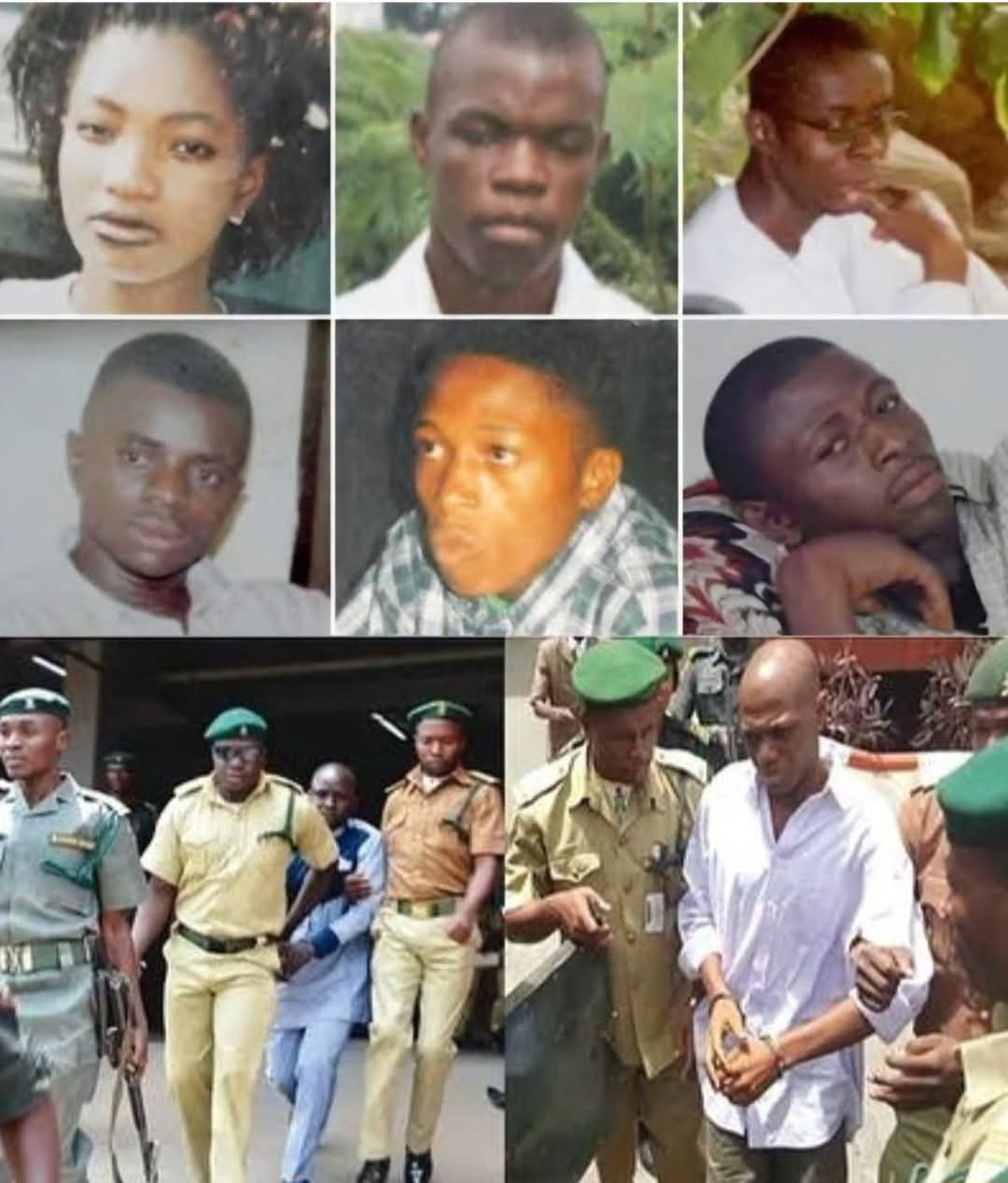
Few tragedies in Nigeria’s recent history have etched themselves into the national consciousness quite like the cold-blooded murder of the group widely remembered as the Apo Six.
On the night of June 7, 2005, what should have been a routine drive home for a group of young, hardworking automobile spare parts traders and their female friend turned into a nightmare of state-sanctioned violence. The victims—Ifeanyi Ozor, Chinedu Meniru, Anthony Nwokike, Paulinus Ogbonna, Ekene Isaac Mgbe, and Augustina Arebu—were returning from an outing in Abuja when their paths crossed with a police patrol team driven by petty ego and brute force.
Anatomy of a Cover-Up
What triggered the brutal incident remains a chilling illustration of institutional abuse. Investigations, including a high-powered judicial commission of inquiry established by then-President Olusegun Obasanjo, revealed that a senior police officer had made romantic advances toward Augustina Arebu (the sole female in the vehicle) at a nightclub, which she turned down.
Spurned and angered, the senior officer allegedly drove ahead to a police checkpoint on Gimbiya Street, Area 11, Garki, falsely labeling the group of young traders as armed robbers. When the victims’ Peugeot car arrived, officers opened fire without warning. Four of the friends died on the spot, while the survivors—including Ifeanyi and Augustina—were taken away, only to be extrajudicially executed and later buried in shallow graves at Utako district.
In a desperate bid to mask the atrocity, the perpetrators planted firearms inside the victims’ vehicle to frame them in a fake shootout narrative. However, public outrage sparked massive riots across the Federal Capital Territory, compelling the federal government to step in, exhume the bodies for autopsies, and unearth a web of deceit.

A Long Road to Partial Justice
The ensuing legal battle stretched across more than a decade, laying bare the systemic bottlenecks plaguing Nigeria’s criminal justice system. It wasn’t until 2017—twelve years after the killings—that a Lagos High Court sitting in Abuja sentenced two police officers to death by hanging for their role in the murders, though other key figures faced protracted trials or controversial acquittals.
The horror of the Apo Six incident served as an early, violent warning sign of the deep-seated impunity within law enforcement units—foreshadowing citizen grievances that would later boil over decades later during nationwide protests against police brutality.
Bringing the Past to the Silver Screen
As memories fade with time, creative documentation has stepped in to ensure history is neither sanitized nor forgotten. Linda Ikeji Media spent years tracking the court filings, investigative reports, and grieving families left in the wake of the tragedy, channeling the extensive research into a feature film titled The Night of June 7th.
The cinematic project aims to humanize the statistics, offering a poignant look at the lives cut short and the relentless battles fought by families seeking closure. The film is scheduled to hit cinema screens nationwide on August 28th, presenting a timely, must-watch reminder of a dark chapter that changed Nigeria’s policing narrative forever.
Do you want to advertise with us?
Do you need publicity for a product, service, or event?
Contact us on WhatsApp +2348033617468, +234 816 612 1513, +234 703 010 7174
or Email: validviewnetwork@gmail.com
CLICK TO JOIN OUR WHATSAPP GROUP