



Leaders of the main nationalist parties in Scotland, Wales and Northern Ireland on Monday declared their nations’ sovereign right to decide their own futures, signing a landmark memorandum of understanding in Cardiff that insists no UK government can block democratic choice.
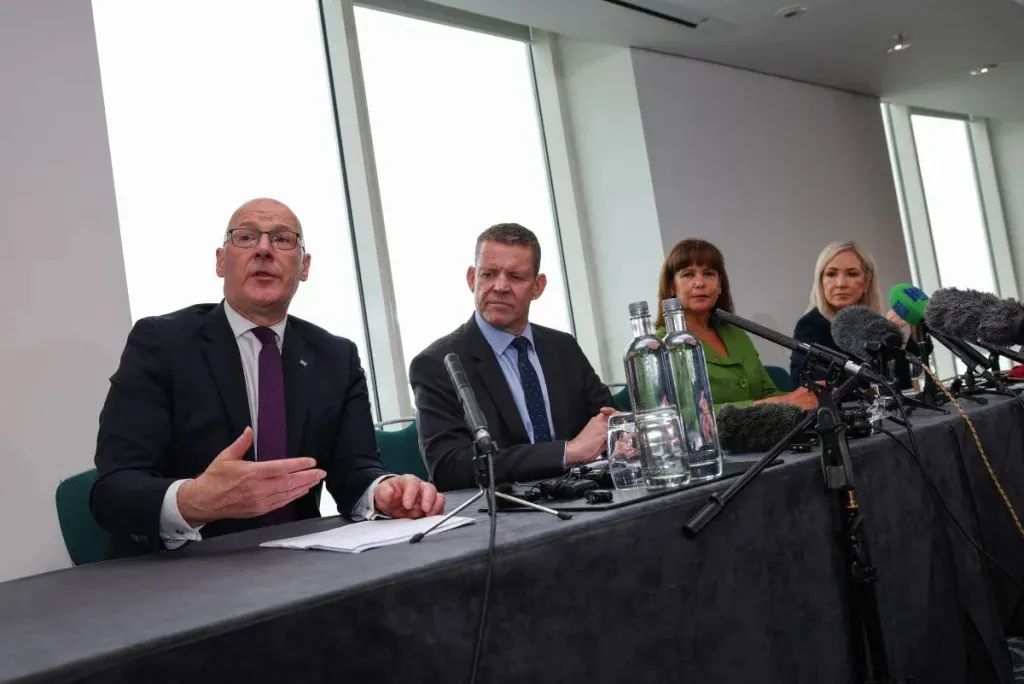
The rare joint meeting brought together Scottish First Minister and SNP leader John Swinney, Welsh First Minister and Plaid Cymru leader Rhun ap Iorwerth, Northern Ireland First Minister Michelle O’Neill and Sinn Féin president Mary Lou McDonald. They met as party leaders rather than in their governmental capacities and produced a document asserting that “our nations have the right to self-determination. No Westminster government has the right to block democracy or undermine the principle that our people will decide their own future.”
The agreement marks a significant moment in UK politics. For the first time since devolution began in 1999, the first ministers of Scotland, Wales and Northern Ireland are all drawn from parties committed to ending the Union. The memorandum states: “For the first time ever, people across these islands have first ministers in Scotland, in Wales and in the North of Ireland who are all committed to independence from the United Kingdom.” It adds that “the future of our nations belongs in the European Union” and declares that “Westminster’s time is coming to an end.”
Momentum, the parties argue, is already visible. Nationalist parties are now the largest forces in the Scottish and Welsh parliaments, while Sinn Féin has led Northern Ireland’s assembly since 2022. The leaders pledged closer cooperation on practical issues including economic growth, energy policy, child poverty and international engagement, while recognising that each nation will move at its own pace.
Differences remain clear. The SNP is pressing for a second Scottish independence referendum within the current Holyrood term, which ends in 2031, citing recent polling trends and the pro-independence majority of MSPs. Sinn Féin continues to push for a border poll on Irish reunification under the terms of the 1998 Good Friday Agreement, which requires the UK government to call such a vote if it believes a majority would favour joining the Republic of Ireland. Plaid Cymru supports Welsh independence in the longer term but has ruled out demanding an immediate referendum.
The Cardiff summit came days after US President Donald Trump publicly backed a united Ireland during a visit to Dublin, a comment O’Neill described as evidence that “the unity debate is very much alive.” It also followed recent remarks by UK Prime Minister Andy Burnham. The Labour leader initially suggested that a Scottish referendum could be considered if a “clear consensus” emerged north of the border, drawing parallels with the Good Friday Agreement mechanism for Northern Ireland. He later clarified in a letter to Swinney and in parliament that independence votes remain “off limits,” insisting the government must focus on the economy and cost of living.
Swinney responded by predicting that Burnham would be the last prime minister of the United Kingdom, arguing that if Scots are given a choice they will opt for independence.
McDonald described the memorandum as historic, saying it represented a collective assertion of “our inalienable right to decide our futures.” The parties called on the British government to “prepare for, plan and facilitate constitutional change in each jurisdiction.”
The regional governments already control substantial areas of policy, including health, education, housing, transport and aspects of taxation. The new agreement signals an intention to use those platforms to build the case for further constitutional change while coordinating pressure on London.

Whether the Cardiff declaration translates into referendums or deeper autonomy remains uncertain. Successive UK governments have resisted further independence votes since Scotland’s narrow 2014 decision to remain in the Union. Yet the unprecedented alignment of pro-independence first ministers, combined with shifting political arithmetic in the devolved nations and external interventions such as Trump’s comments, has placed the future of the United Kingdom under renewed scrutiny.
The leaders left Cardiff insisting that constitutional change is coming and that the people of Scotland, Wales and Northern Ireland, not Westminster, must decide what form it takes.
Do you want to advertise with us?
Do you need publicity for a product, service, or event?
Contact us on WhatsApp +2348033617468, +234 816 612 1513, +234 703 010 7174
or Email: validviewnetwork@gmail.com
CLICK TO JOIN OUR WHATSAPP GROUP