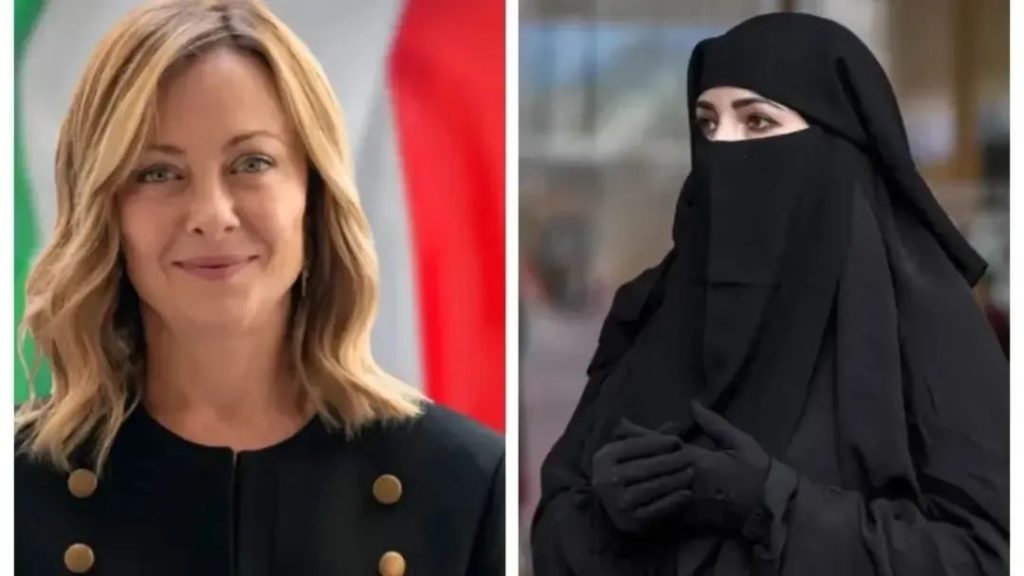
Italian Prime Minister Giorgia Meloni announced on Sunday a package of school measures aimed at strengthening integration, including a ban on full-face coverings such as the burqa and niqab, a legal limit on the number of foreign students in each classroom, and compulsory Italian lessons for the parents of pupils facing serious difficulties settling into the system.
Speaking at Fenix, the annual gathering of Gioventù Nazionale, the youth wing of her Brothers of Italy party, Meloni said the proposals would be brought before the Council of Ministers shortly. “A measure will soon be presented to a Cabinet meeting to legally establish a maximum number of foreign students per class. It also requires parents of foreign students facing serious difficulties integrating into the school system to learn Italian and bans burqas and niqabs in schools,” she told the crowd.
She framed the face-covering ban as a matter of principle and gender equality. “You must go to school with your face uncovered, and in Italy no one, in the name of a real or supposed tradition, can decide that a young woman must hide herself,” Meloni said. “Equality between men and women is non-negotiable. It is non-negotiable on our streets, and it is non-negotiable in our schools.”
On classroom composition, Meloni argued that large numbers of non-Italian speakers undermine genuine integration. “If there is only one child in a class who doesn’t understand Italian, that child will likely be able to learn the language and integrate quickly with the help of classmates and teachers. However, if the number of children who don’t understand the language becomes large – or even the majority – that is no longer integration; it is neglect,” she said. She added that Italian children must not be left feeling sidelined: “It is unacceptable that in an Italian classroom the children who end up feeling pushed into a corner are Italian children because they have become the minority. That cannot be allowed.” Calling the current situation true integration, she said, was “yet another lie, a convenient lie for those who live off ideology.”
Students without Italian citizenship make up roughly 11.6 per cent of the school population — about 930,000 pupils — according to the Fondazione ISMU research institute. That share has edged down slightly over the past decade. Meloni did not specify what the new maximum percentage or absolute number per class would be. A non-binding 2010 circular already recommended a 30 per cent ceiling, but school leaders have long said it is difficult or impossible to enforce in neighbourhoods with high concentrations of foreign residents, where denying enrolment is not an option. Under the planned law, pupils would be redistributed across classes within a school or, if necessary, to nearby schools under regional coordination.
The announcement comes as immigration and cultural integration remain central and polarising issues in Italian politics. Meloni’s coalition is the longest-serving government in Italy since the Second World War, yet her party faces growing pressure from the more hardline National Future party ahead of elections expected in 2027.

Similar face-covering restrictions already exist in several European countries, including public bans in France and Belgium and school-level limits in Austria. Italy would be among the first to legislate an explicit classroom quota for foreign pupils.
In the same speech Meloni also pledged to rename technical and vocational schools as “licei,” arguing the change would underline that they carry equal value and status with academic high schools. Once approved by the cabinet, the main package would still require parliamentary passage. School directors have described the underlying educational goals as reasonable while warning of practical obstacles in diverse urban areas.
Do you want to advertise with us?
Do you need publicity for a product, service, or event?
Contact us on WhatsApp +2348033617468, +234 816 612 1513, +234 703 010 7174
or Email: validviewnetwork@gmail.com
CLICK TO JOIN OUR WHATSAPP GROUP