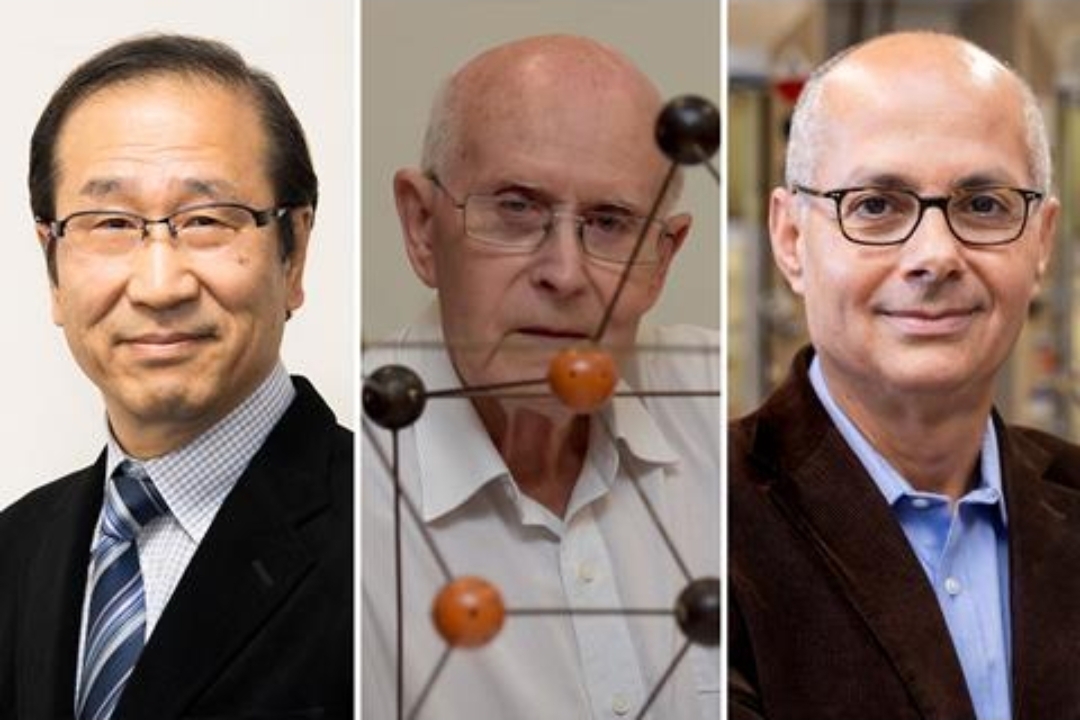
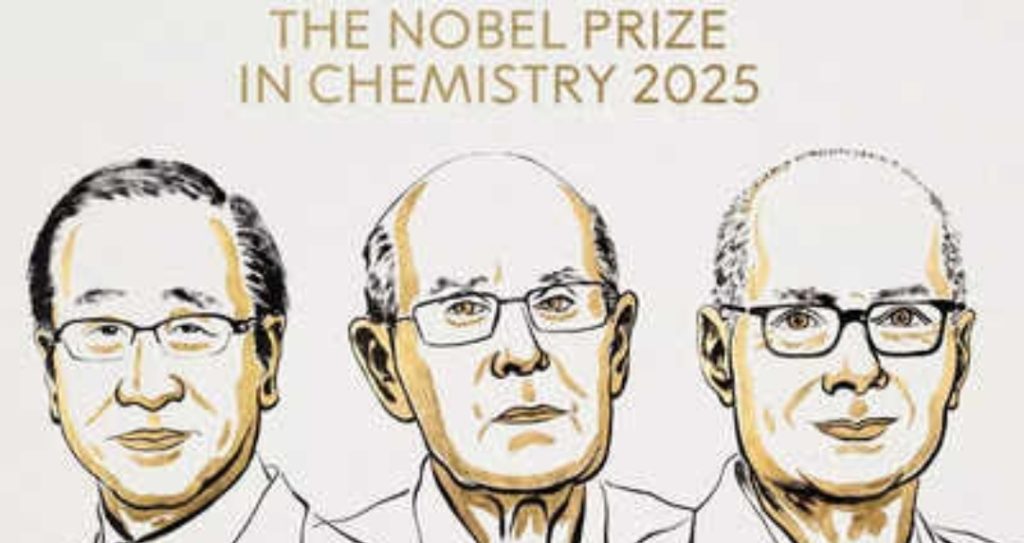
The 2025 Nobel Prize in Chemistry has been awarded to three pioneering scientists — Japan’s Susumu Kitagawa, UK-born Richard Robson, and American-Jordanian Omar M. Yaghi — for their groundbreaking development of metal-organic frameworks (MOFs), a revolutionary form of molecular architecture with extraordinary potential across a range of scientific fields.
Announced by the Nobel Committee on Wednesday, the prize recognizes the trio’s contribution to creating porous, crystalline materials composed of metal ions linked by organic molecules, forming complex structures filled with nanoscale cavities. These MOFs possess the unique capability to allow gases and molecules to flow in and out, opening up vast possibilities for practical applications..
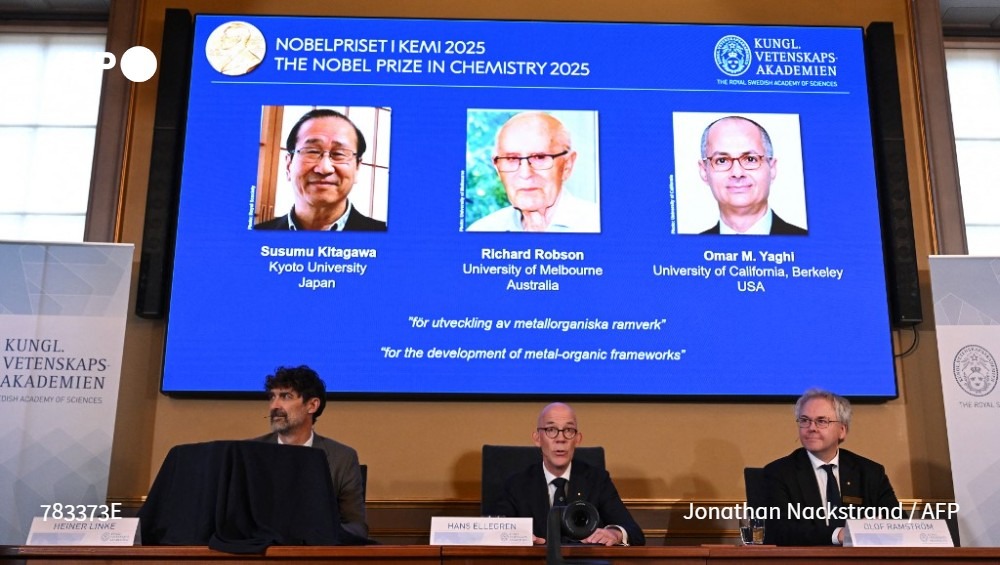
“These constructions, metal-organic frameworks, can be used to harvest water from desert air, capture carbon dioxide, store toxic gases, or catalyse chemical reactions,” the Nobel jury explained. Heiner Linke, Chair of the Nobel Committee for Chemistry, emphasized the transformative promise of these materials, stating, “Metal-organic frameworks have enormous potential, bringing previously unforeseen opportunities for custom-made materials with new functions.”
The origins of this discovery trace back to 1989 when Richard Robson first combined copper ions with an organic molecule to produce a spacious, diamond-like crystalline structure. Although his initial structure was unstable, Kitagawa and Yaghi significantly advanced the field with separate breakthroughs between the early 1990s and 2003. Kitagawa demonstrated the flexible nature of MOFs and their ability to allow gas flow in and out, while Yaghi achieved a highly stable version that could be designed and modified with precision.

This collaboration of ideas has since enabled chemists worldwide to design tens of thousands of different MOFs tailored to specific chemical tasks. Potential applications are vast, including environmental technology such as the capture and storage of carbon dioxide to combat climate change, extraction of pollutants like PFAS from water, storage of hydrogen gas, and even enabling the harvesting of moisture from arid environments.
Omar Yaghi, a professor of chemistry at the University of California, Berkeley, who immigrated to the U.S. from Jordan as a teenager, expressed a lifelong passion for laboratory work. His work, along with Kitagawa who teaches at Kyoto University and Robson based at the University of Melbourne, exemplifies how international scientific collaboration can drive innovation.
The Nobel Prize in Chemistry 2025 highlights metal-organic frameworks as a prime example of how molecular architecture can tackle some of humanity’s greatest challenges with novel and sustainable solutions.
Last year’s Chemistry Nobel was awarded to David Baker, John Jumper, and Demis Hassabis for breakthroughs in protein structure prediction through AI and computational methods, marking yet another leap forward in the life sciences.
Do you want to advertise with us?
Do you need publicity for a product, service, or event?
Contact us on WhatsApp +2348033617468, +234 816 612 1513, +234 703 010 7174
or Email: validviewnetwork@gmail.com
CLICK TO JOIN OUR WHATSAPP GROUP
The 2025 Chemistry Nobel laureates will share a prize sum of 11 million Swedish kronor (approximately £872,000), recognizing their lasting impact on chemistry and the wider scientific community.
This award underscores the expanding role of chemistry in providing scientific breakthroughs that offer practical solutions for environmental sustainability and resource management in an increasingly challenged world.