



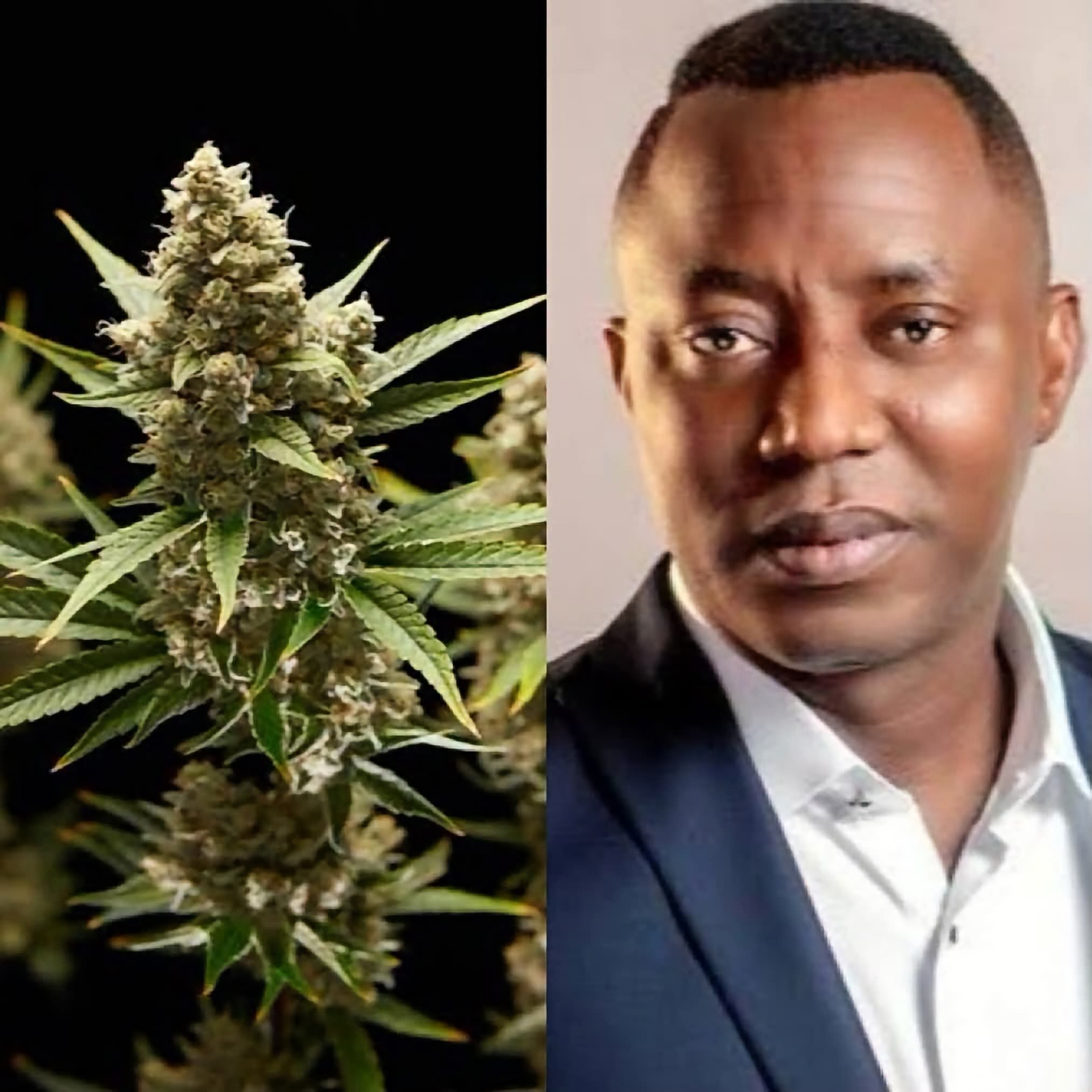
African Action Congress presidential candidate Omoyele Sowore on Tuesday renewed his long-standing campaign for the immediate legalisation and regulation of cannabis in Nigeria, accusing the authorities of throwing away potentially trillions of naira in annual revenue while other countries cash in.
In a strongly worded statement posted on X, Sowore, who has pushed for the policy since 2018, condemned the continued practice of arresting citizens and destroying cannabis plantations. He argued that Nigeria is treating an economically valuable plant as a criminal problem instead of a revenue opportunity.
“While Nigerian authorities continue to arrest citizens, destroy cannabis farms, and criminalise the plant, countries that have legalised and regulated cannabis are collecting substantial government revenue,” he said.

He pointed to concrete figures from jurisdictions that have already taken the leap. Canada generated approximately CAD $2.2 billion in government revenue from recreational cannabis in the 2023–2024 fiscal year. California collected about $1.067 billion in cannabis tax revenue in 2024, while Colorado recorded roughly $255.4 million in marijuana taxes and fees the same year.
Using those benchmarks and an illustrative exchange rate of ₦1,300 to the dollar, Sowore sketched out what a regulated Nigerian industry could deliver. He projected annual government revenue of between $550 million and $2.2 billion — equivalent to ₦715 billion and ₦2.86 trillion — depending on the scale of the market, tax rates, licensing regime, export capacity and the quality of regulation.
Beyond pure tax receipts, Sowore listed wider economic gains: large-scale agricultural employment for farmers, growth in pharmaceutical manufacturing, expansion of industrial hemp production, new avenues for scientific research, and stronger export earnings from cannabis-related products.
“Imagine the potential benefits of a properly regulated Nigerian cannabis industry — agricultural employment, pharmaceutical manufacturing, industrial hemp production, scientific research, export earnings, and tax revenue,” he wrote
He stressed that the numbers remain hypothetical and would hinge on how effectively the government designs and enforces the framework. Still, he insisted the alternative — continued prohibition — is simply costly inaction.
“Rather than simply destroying farms and criminalising possession, Nigeria MUST URGENTLY establish a legal framework that protects public health, regulates production, supports farmers, and generates lawful economic activity,” Sowore declared.
He closed with a blunt slogan and a political challenge: “Legalise It. Regulate It. Tax It. Create Jobs. Generate Revenue!” and called on Nigerians to reject what he described as backward-thinking establishment politicians.
Cannabis remains fully prohibited in Nigeria under the Indian Hemp Act and the National Drug Law Enforcement Agency Act. Cultivation, possession, sale, importation and exportation carry severe penalties, and the NDLEA continues large-scale farm destruction exercises. While limited legislative interest in industrial hemp and medical research has surfaced in recent years, full legalisation for commercial or recreational use has not advanced.
Sowore’s latest intervention injects fresh political energy into a debate that has simmered for years. With the 2027 elections approaching, his revenue-focused argument may force other candidates and the current government to confront whether Nigeria can afford to keep leaving potential billions — or trillions — on the table.
Do you want to advertise with us?
Do you need publicity for a product, service, or event?
Contact us on WhatsApp +2348033617468, +234 816 612 1513, +234 703 010 7174
or Email: validviewnetwork@gmail.com
CLICK TO JOIN OUR WHATSAPP GROUP