



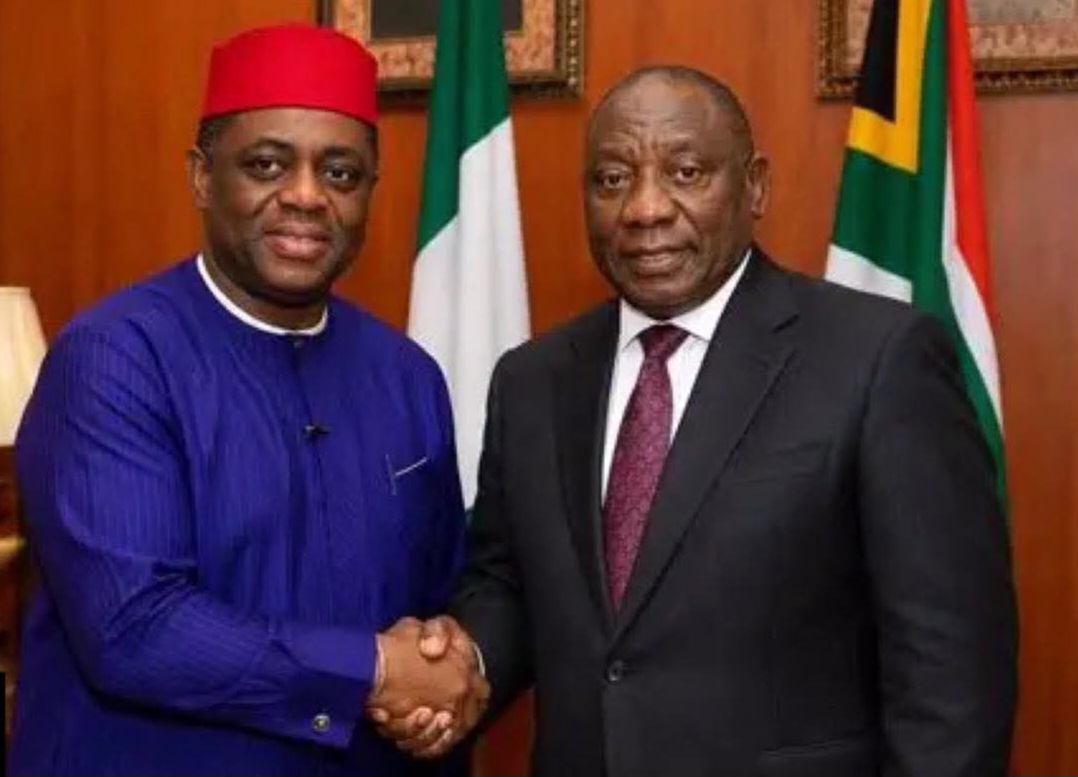
The South African government has formally summoned Nigeria’s High Commissioner, Chief Femi Fani-Kayode, over his conduct and public remarks following the presentation of his diplomatic credentials to President Cyril Ramaphosa in Pretoria.
The diplomatic intervention took place on Tuesday, November 17, 2026, when the Director-General of South Africa’s Department of International Relations and Cooperation (DIRCO), Zane Dangor, met with the Nigerian envoy to register Pretoria’s displeasure over events trailing last Friday’s ceremony.
A Breach of Diplomatic Protocol
During the meeting, Dangor raised concerns regarding Fani-Kayode’s actions at the November 13 event and his subsequent commentary on social media. South African authorities reminded the newly accredited High Commissioner—who is Nigeria’s first substantive envoy to South Africa in nearly four years and is also concurrently accredited to Lesotho and Eswatini—of the strictures of international diplomatic law.
Specifically, Dangor invoked Article 41 of the 1961 Vienna Convention on Diplomatic Relations, which mandates that diplomatic agents respect the laws and regulations of the receiving state and conduct all official business exclusively through the host country’s Ministry of Foreign Affairs. Pretoria stressed that formal grievances or official communications must be channelled strictly through DIRCO rather than aired on public platforms or pursued through alternative avenues.
Despite the reprimand, South Africa sought to de-escalate tensions, reaffirming its commitment to preserving its historic bilateral ties with Nigeria. DIRCO emphasized that the longstanding partnership between Africa’s two largest economies is anchored on mutual respect, friendship, and cooperation, expressing a desire for continued constructive engagement. Following the engagement, Fani-Kayode described his session with Dangor as “cordial and constructive,” noting that both nations remain dedicated to strengthening their ties.
Origins of the Pretoria Row

The diplomatic friction began on Friday, November 13, at the Sefako Makgatho Presidential Guest House in Pretoria, where Fani-Kayode presented his Letters of Credence alongside ambassadors and heads of mission from 14 other countries and the European Union—including France, Germany, Belgium, South Sudan, and Somalia.
During his address, Fani-Kayode had conveyed the goodwill of President Bola Tinubu, pledging to “reset” and rebuild bridges between Abuja and Pretoria. However, shortly after the ceremony, the former Nigerian Aviation Minister took to his official X (formerly Twitter) handle to accuse the South African Presidency of deliberately censoring the Nigerian delegation.
“Every single one of the 15 Ambassadors that were present were introduced formally and gave a speech. Curiously, the South African Presidency refused to air the introduction of my goodself and the Nigerian delegation or to air my speech,” Fani-Kayode alleged. “They went a step further by cutting us out of the livestream completely and went back on livestream only after my speech was concluded.”
Fani-Kayode further claimed that he personally raised the complaint with President Ramaphosa during a post-ceremony photograph session, asserting that the South African leader directed officials to rectify the omission. He also disclosed that he turned down an interview request from the state-owned South African Broadcasting Corporation (SABC) in protest over the perceived slight.
Pretoria Pushes Back
The South African Presidency swiftly rejected the allegations of deliberate discrimination, clarifying that Fani-Kayode—who was the final diplomat in the lineup to present his credentials—had his segment affected by minor technical and operational glitches in the livestream arrangement.
President Ramaphosa’s spokesperson, Vincent Magwenya, also refuted Fani-Kayode’s account of the President’s intervention, noting that Ramaphosa neither possesses the constitutional authority nor the political mandate to interfere in the editorial operations of the SABC. According to Magwenya, the President merely directed the Nigerian envoy to Sophie Mokoena, the SABC’s acting political and foreign editor, as the appropriate media contact to address broadcast queries.
Describing Fani-Kayode’s handling of the matter as “grossly inappropriate,” Magwenya argued that the High Commissioner had blown a minor operational misunderstanding out of proportion. The SABC subsequently reiterated that its editorial coverage operated independently of the Presidency’s livestream feed, while footage of Fani-Kayode’s presentation was later made available.
With South African officials now characterizing the diplomatic reprimand as a “closed matter”, observers in both Abuja and Pretoria will be watching closely to see how the newly installed High Commissioner navigates the delicate terrain of Nigeria–South Africa diplomacy.
Do you want to advertise with us?
Do you need publicity for a product, service, or event?
Contact us on WhatsApp +2348033617468, +234 816 612 1513, +234 703 010 7174
or Email: validviewnetwork@gmail.com
CLICK TO JOIN OUR WHATSAPP GROUP