



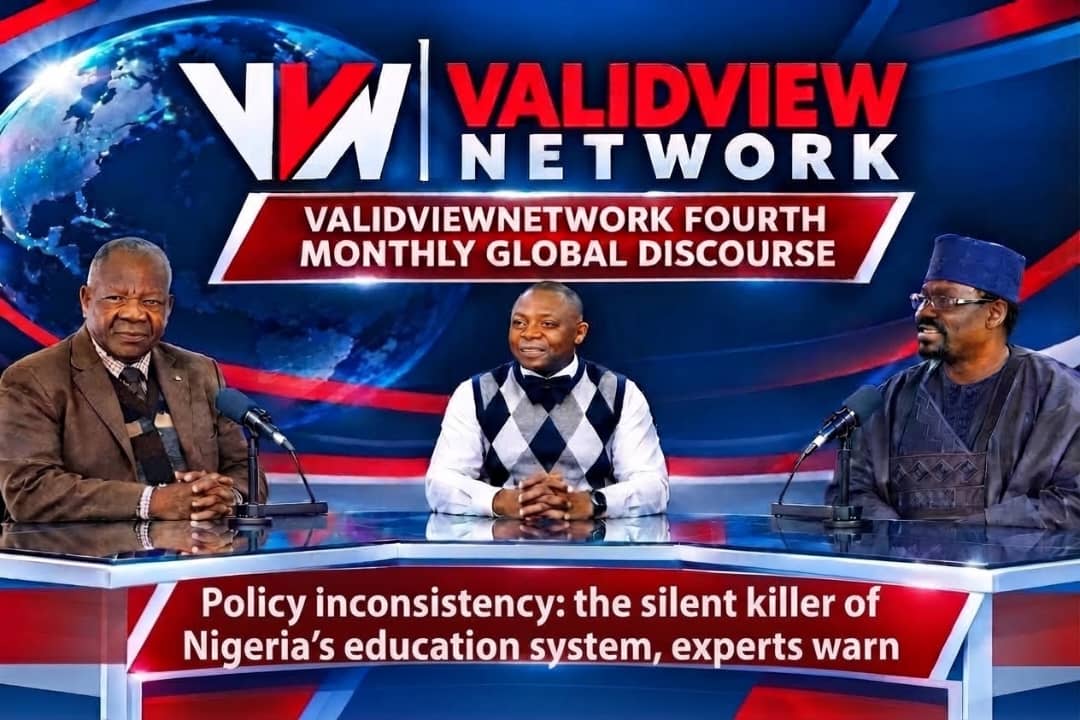
Policy inconsistency has emerged as the silent killer of Nigeria’s education system, systematically dismantling the country’s technological vision and skills pipeline over decades, two eminent thought leaders warned at the weekend.
Nigeria’s education system cannot achieve lasting transformation when major policies are repeatedly changed, abandoned or restructured, the Distinguished Discussants at the Fourth Edition of the ValidViewNetwork Monthly Global Discourse further warned.
The Fourth Edition featured two eminent national figures whose intellectual depth and professional stature enriched the conversation. Emeritus Professor Michael Abiola Omolewa, OON, a globally respected scholar of educational history and national development, brought decades of academic insight into Nigeria’s policy evolution and the structural intentions behind the 6‑3‑3‑4 system. Alongside him, Chief Tola Adeniyi, Akogun, veteran journalist, cultural commentator and one of Nigeria’s most influential public intellectuals, offered a powerful cultural and societal perspective on the nation’s shifting attitudes toward vocational and technical education.
Emeritus Professor Michael Abiola Omolewa, OON, and Chief Tola Adeniyi (Akogun) made the charge during the Fourth Edition of the ValidViewNetwork Monthly Global Discourse, held virtually on Sunday, 27 September 2026.
The session, themed “The Lost Promise of 6-3-3-4: Can Nigeria Still Recover Its Technological Vision?”, brought together policymakers, educators, curriculum planners, youth leaders, industry stakeholders and civic actors to examine the collapse of technical education and its consequences for national development.
The 6-3-3-4 system, conceived in 1969 following the National Curriculum Conference held from 8-12 September of the year was designed as a transformative structure to equip Nigerian youth with practical, technical and vocational skills for industrialisation. It rested on five foundational strengths: harmonised years of schooling across regions, broad stakeholder consultation, strong government investment in technology and specialised institutions, an embedded guidance-and-counselling framework, and a national ambition to build export-ready technical capacity, ValidViewNetwork reports
Professor Omolewa traced how the reform began with an unusual promise. The military government of the time delegated its design to educationists rather than imposing it from above. Yet that promise was quickly undermined, he asserted.
“Frequent changes in government priorities, abrupt curriculum shifts and the absence of long-term implementation frameworks weakened the original vision and disrupted continuity,” the discourse highlighted. The result, the experts argued, was the neglect and eventual collapse of technical colleges that had been intended as the backbone of the nation’s technological future.
Chief Adeniyi linked the policy failures to deeper cultural and societal attitudes that devalued vocational skills in favour of university credentials, parental resistance to technical streams, and the “oil doom” culture that followed the petroleum boom. Together, these forces shifted Nigeria from a skills-driven educational vision toward theory, credentialism and chronic under-investment in technical capacity.
The Distinguished Discussants called for concrete remedies. Chief among them is the establishment of a National Education Continuity Act to shield reforms from political disruptions and guarantee stability, consistency and measurable progress across successive administrations.
They reasoned that education requires long term investment before reforms produce measurable outcomes.Their combined interventions also produced a strong argument that educational reform should not be treated as a temporary project tied to individual administrations.
On the future of Nigeria, they affirmed : “Nigeria’s technological future is not lost, it is waiting to be reclaimed through deliberate policy, cultural reorientation and sustained investment in technical education.”
They warned, ”If Nigeria hopes to build a world‑class education system, it must first defeat its greatest enemy which is policy inconsistency. Until reforms are allowed to live long enough to succeed, the nation will continue rewriting its future instead of building it.”
The discourse is organised by ValidViewNetwork Limited, founded by Dr Kayode Ogunjobi FHEA, FFAN, and operating across Consultancy, Media and Advocacy with emphasis on environmental and educational consultancy, research, communication, publishing, public enlightenment and policy engagement. Mr Lanre Ogundipe, former President of the Nigerian Union of Journalists and African Union of Journalists, chairs the organisation’s Advisory Council.

The Monthly Global Discourse holds every last Sunday of the month from 6:00 PM to 8:00 PM WAT. The Fifth Edition comes up on Sunday, 25 October 2026, with educators, policymakers, young people and the general public encouraged to participate.
Do you want to advertise with us?
Do you need publicity for a product, service, or event?
Contact us on WhatsApp +2348033617468, +234 816 612 1513, +234 703 010 7174
or Email: validviewnetwork@gmail.com
CLICK TO JOIN OUR WHATSAPP GROUP